Surge Arrester vs Circuit Breaker: Functions and Applications
Published: Author: Rachel
A surge arrester limits transient overvoltage; a circuit breaker interrupts excessive current. That is the central difference in any surge arrester vs circuit breaker comparison. The two devices respond to different faults, are connected in different ways, and neither substitutes for the other. A system that experiences lightning or switching surges normally needs an arrester or surge protective device (SPD), while the same system still needs a circuit breaker for overload and short-circuit protection.
This guide compares surge arrester and circuit breaker functions, explains how each behaves during a fault, and shows where the two work together in utility, building and solar applications. It is written for engineers, panel builders and buyers who need a clear boundary between the two products when reviewing a specification.
Surge Arrester vs Circuit Breaker at a Glance
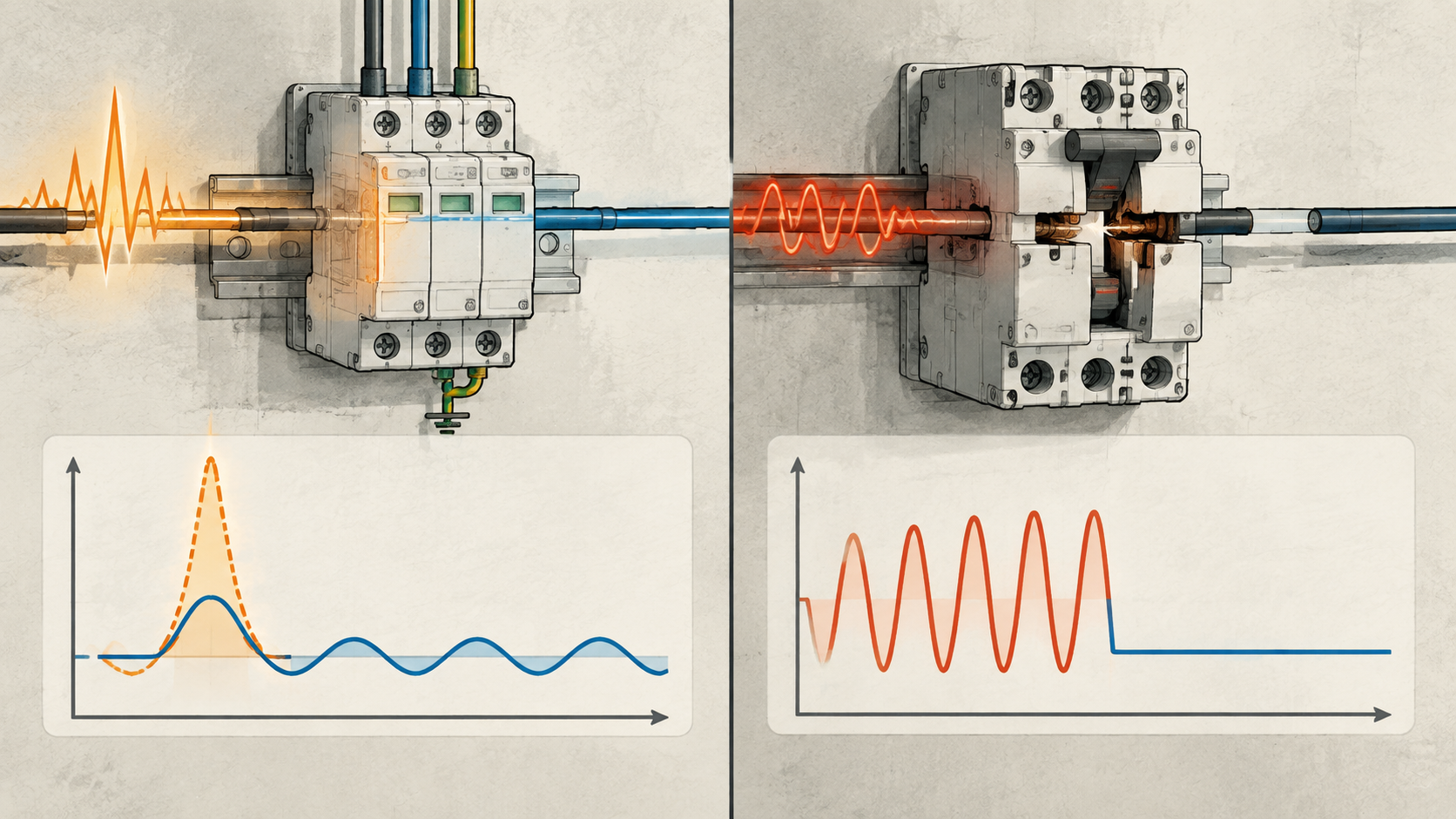
Start with the fault rather than the product name. An arrester is a voltage-limiting device: it conducts when voltage rises above its reference level and stops conducting when the voltage returns to normal. A circuit breaker is a current-interrupting device: it opens its contacts when current exceeds a designed threshold. The table below summarizes the comparison used throughout this guide.
Comparison
Surge arrester
Circuit breaker
Main protection task
Limit transient overvoltage across protected equipment
Interrupt overload and short-circuit current
Fault it responds to
Voltage surge, such as lightning or switching transient
Excessive current, such as overload or short circuit
Typical connection
In parallel (shunt) between conductor and earth or phase-to-phase
In series with the circuit it protects
Behavior after a surge or fault
Returns to high impedance; usually remains in service within its ratings
Trips and opens; can be reclosed after the fault is cleared
What it does not provide
Overload or short-circuit protection for the load
Voltage clamping during a fast transient
Reference product standards (typical)
IEC 60099 series, IEEE C62.11; LV SPDs per IEC 61643 series
IEC 60898 series (MCB), IEC 60947-2 (industrial), UL 489
Conceptual comparison only; not a wiring diagram or to scale.
What a Surge Arrester Does: Voltage Limiting, Not Current Interruption
A surge arrester is designed to limit the voltage that appears across protected equipment. Metal-oxide varistor (MOV) blocks inside the arrester behave like a voltage-controlled switch: they stay highly resistive at normal system voltage and become conductive when the voltage rises above the arrester’s reference voltage. During conduction the arrester discharges surge current to earth and clamps the voltage; when the transient passes, conduction stops and the arrester returns to its high-impedance state.
Because the arrester must not allow a continuous fault current to flow after the surge, its design must prevent power-follow current to earth and withstand the continuous power-frequency voltage of the system it is connected to. Eaton’s surge arrester fundamentals describe the same functions: discharging or bypassing surge current, limiting voltage, preventing follow current, and repeating the operation within the ratings of the relevant standard. Arrester selection therefore involves the maximum continuous operating voltage, temporary overvoltage (TOV) capability, discharge capability and the insulation level of the protected equipment.
The term “surge arrester” is used across voltage ranges. At medium and high voltage, arresters are applied on overhead lines, transformers, switchgear and substations, and are rated and tested to standards such as IEC 60099 and IEEE C62.11. At low voltage, the functionally similar device is normally called a surge protective device (SPD) and is tested to the IEC 61643 series or UL 1449. The operating idea is the same: limit overvoltage, do not interrupt load current.
What a Circuit Breaker Does: Current Interruption, Not Voltage Limiting
A circuit breaker monitors the current through its protected circuit and opens automatically when that current is excessive. It covers two common conditions: overload, where current stays above the rating for long enough to stress the circuit, and short circuit, where a fault drives current far above the rating and must be cleared quickly. After the fault is removed the breaker can normally be reclosed, which is why it is preferred over a one-time fuse where service continuity matters.
A breaker is connected in series, so all load current passes through it. Its operation is mechanical and takes time: a miniature circuit breaker (MCB) typically clears a fault within several milliseconds to tens of milliseconds depending on the fault level and its trip characteristic. That speed is adequate for overcurrent protection, but the breaker does not sense the brief voltage transient that damages electronics. A breaker with a higher voltage rating or a faster trip curve does not add voltage-clamping ability.
Different applications call for different breaker designs: an MCB for final circuits, a molded-case circuit breaker (MCCB) for higher currents, and DC-rated breakers where the supply is direct current, as in solar arrays. The common principle is the same: choose the current rating, trip characteristic and breaking capacity for the circuit, not for surge duty.
Key Functional Differences
Three differences matter most when comparing the two devices: the fault they sense, the speed and nature of their response, and what happens to the system afterwards.
Different sensed quantity. The arrester reacts to voltage; the breaker reacts to current. A lightning-induced surge can raise voltage without immediately creating an overcurrent that the breaker is designed to sense. Conversely, an overload can persist at normal voltage, which the arrester ignores by design.
Different operating principle. The arrester conducts momentarily and then returns to its insulating state, so the protected circuit normally keeps running. The breaker opens a physical gap and interrupts the circuit, so power flow stops until the breaker is reclosed and the fault is resolved.
Different end-of-life behavior. An arrester that is repeatedly overstressed can degrade and may fail to a short-circuit condition; an internal or external disconnector is used to isolate it. A breaker that clears a fault remains reusable, though its performance should be checked after a significant interruption.
Why One Device Cannot Replace the Other
It is tempting to treat “protection” as a single function, but the two devices cover different faults. A circuit breaker cannot clamp a steep voltage surge: its response time is measured in milliseconds, far slower than the microsecond rise time of a lightning transient, and it has no voltage-reference element that would make it conduct only above a set voltage. If a surge reaches sensitive equipment, the breaker will not prevent the overvoltage damage even if it later trips on the resulting current.
A surge arrester is equally unsuitable as a load protector. It does not measure the load current and has no mechanism to disconnect an overloaded or short-circuited circuit. Leaving overcurrent protection to an arrester would leave the wiring and equipment exposed to thermal and magnetic stress during a fault.
Some products combine an SPD function and a disconnecting function in one enclosure, for example a pluggable SPD with an integrated MCB or a surge-protective circuit breaker. The combined device can be a convenient way to meet both requirements, but only within its declared ratings and tested coordination. A combined product is not a license to ignore the separate duty of each function. The detailed rules for choosing the SPD backup device are covered in the site guide to SPD backup fuse or circuit breaker selection.
Applications: Where Each Device Fits
In practice the two devices are usually planned together, with the arrester or SPD covering overvoltage and the breaker or fuse covering overcurrent.
Utility and Industrial Medium-Voltage Installations
Surge arresters are installed near transformers, at line entrances, on riser poles where an overhead line transitions to cable, and at open points where voltage doubling could otherwise occur. The associated circuit breaker protects the line and transformer from fault current and provides switching. The arrester limits the lightning or switching overvoltage that stresses the insulation; the breaker handles the fault current that follows an insulation failure or a system fault.
Building and Low-Voltage Distribution
At the service entrance or in a distribution board, a Type 1 or Type 2 SPD is connected in parallel ahead of the loads, and MCBs protect the outgoing circuits. The SPD limits surges coming in on the supply; each MCB protects its own circuit against overload and short circuit. When the SPD reaches end of life, its disconnector or an upstream protective device separates it from the live bus so a failed module does not create a permanent fault. Our surge protection device range covers Type 1 and Type 2 AC SPDs used in this role.
Solar and DC Applications
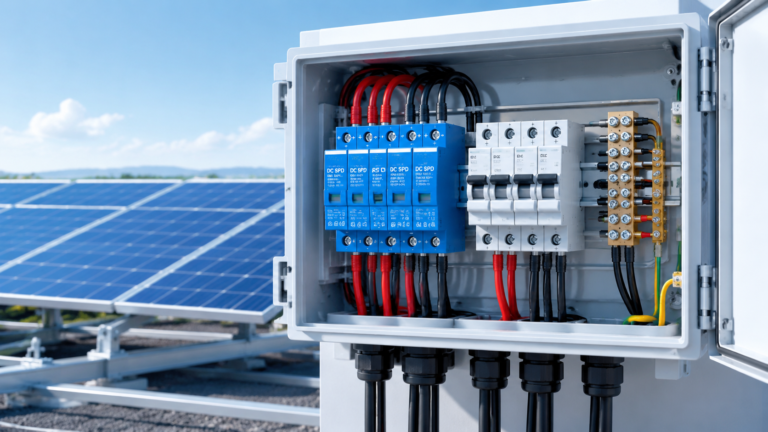
Photovoltaic systems add a DC dimension to the same division of work. A DC SPD protects the inverter and array wiring from lightning-induced surges on the DC side, while DC-rated MCBs or PV fuses protect the strings and the inverter input from overcurrent. On the AC side of the inverter, an AC SPD and an AC breaker provide the equivalent functions. The difference between AC and DC surge protection is not a naming detail: voltage, discharge-current and fault conditions differ, so the correct SPD family must be selected. See the guide to AC SPD vs DC SPD selection and the overview of choosing a solar circuit breaker for the application-specific details.
How to Choose and Coordinate Both Devices
Because the two functions are complementary, a complete specification states both selections and confirms that they can coexist.
Select the overcurrent device for the circuit. Determine the system voltage (AC or DC), the load current, the prospective short-circuit current and the wiring constraints, then choose the breaker or fuse class, current rating, trip characteristic and breaking capacity. Never choose a breaker by matching it to a surge-current number printed on an SPD.
Select the arrester or SPD for the surge duty. Confirm the maximum continuous operating voltage of the system, the expected surge exposure, the required protection level and the location. Read the SPD ratings such as Uc, Up, In and Imax before comparing models; the guide to Iimp, In, Imax and Up specifications explains what each value means.
Check the coordination. The SPD manufacturer’s instructions normally state the permitted backup overcurrent protection and the short-circuit conditions the SPD can withstand. Follow that combination instead of inventing one. Where a separate backup device is not required, confirm that the SPD has a tested internal disconnector for the application.
Check the installation conditions. Keep arrester or SPD connecting leads as short as practical, because lead inductance raises the effective protection level. Verify earthing and conductor sizes against the installation instructions and the applicable code.
Surge Arrester vs Circuit Breaker: Common Questions
Can a circuit breaker protect equipment from lightning surges?
No. A circuit breaker interrupts overcurrent and does not clamp transient overvoltage. Lightning surges can damage equipment even when the breaker remains closed, or the breaker may trip only after the damaging current has already flowed.
Can a surge arrester replace a circuit breaker?
No. An arrester has no mechanism for disconnecting an overloaded or short-circuited circuit. Overcurrent protection must be provided by a breaker or fuse selected for the circuit, and an arrester cannot be assigned that duty.
Do surge arresters and circuit breakers need to be installed together?
Most systems need both functions, but they are often installed at different points: the arrester or SPD at the incoming supply or at the equipment to be protected, and breakers in series with each protected circuit. Whether a separate backup breaker is required for the SPD branch depends on the SPD design and its instructions, as discussed in the SPD backup protection guide on this site.
Are “surge arrester”, “surge protective device” and “lightning arrester” the same thing?
The terms overlap but are not identical. “Surge arrester” is common at medium and high voltage, “SPD” is the standard term for low-voltage devices, and “lightning arrester” emphasizes the lightning role. The differences in terminology and rating context are explained in the comparison of lightning arresters vs surge arresters.
Specify Both Functions Separately
The surge arrester vs circuit breaker question has a practical answer: identify the fault each device must handle. The arrester or SPD limits transient overvoltage; the circuit breaker interrupts overload and short-circuit current. A robust specification names both, confirms the SPD backup and disconnector arrangement, and states how a failed protection component will be detected and replaced.
Most solar DC distribution boxes (DCDBs) are fitted with a Type 2 DC surge protection device (SPD), rated for 8/20 µs surge currents; a Type 1+2 DC SPD is required when the DC circuit is exposed to direct lightning strikes or the site has no external lightning protection system. This guide explains how to decide […]
How to wire and install a Type 2 DC surge protection device on a PV system: terminal connections, parallel wiring, backup fuse or MCB, earthing and common mistakes.
A surge protector limits transient overvoltage; a fuse interrupts overcurrent. Learn the differences, combined-device limits and checks for coordinated protection.