Solar Combiner Box Certification Requirements: IEC 61439, TUV and VDE
Published: Author: Rachel
Certification requirements sit between a solar combiner box being technically suitable and being accepted. In practice, a box that meets every functional requirement can still be rejected at tender stage or on site because the documentation supporting its conformity does not match what the market expects. This is a documentation and compliance topic rather than an engineering one, which is why it tends to surface late.
This guide sets out the standards that apply to photovoltaic combiner boxes, what each one covers, which markets require what, and what to request from a supplier before ordering. It is written for procurement and compliance teams dealing with European, North American, and Middle East project requirements.
Table of Contents
Which Standard Covers What
The standards landscape looks more complicated than it is, because most requirements sit under one core standard. The structure:
Reference
Covers
Applies to
IEC 61439-1
General rules for low-voltage switchgear and controlgear assemblies
All assemblies
IEC 61439-2-2
Specific requirements for PV utility-scale assemblies
Combiner boxes, DC assemblies
IEC 61439-3
Switchgear and controlgear inside assemblies
MCB, MCCB, isolators, SPDs within the box
IEC 61643-11
Surge protective devices; test classes and characteristics
The SPD component
IEC 60269-6
gPV fuse links for photovoltaic systems
The string fuse
IEC 60529
Degrees of protection provided by enclosures (IP code)
Enclosure rating
IEC 62208
Degree of protection of empty enclosures for low-voltage assemblies
Enclosure itself
Two of these deserve clarification because they are regularly confused. IEC 61439-2-2 is the photovoltaic-specific part of the switchgear assembly standard — it is not optional for a PV combiner box. And IEC 61643-11 applies to the SPD as a component, which is a different claim from the assembly’s conformity: an SPD that is individually certified does not by itself make the enclosure into a compliant assembly.
IEC 61439: The Core Standard
IEC 61439-1 establishes the general rules for low-voltage switchgear and controlgear assemblies, including permitted temperature rise, insulation levels, clearances and creepage distances, short-circuit withstand, and the verification methods for each. It defines three verification categories, and these are where most procurement conversations get stuck:
Design verification — verified by calculation or by prototype testing. Valid for a family of assemblies with the same characteristics, allowing variants to be covered without individual testing.
Verification by specific test — specific tests are performed on the assembly. Applies to individual variants that fall outside a verified design.
Verification by manufacturer of a series — where the manufacturer holds a verified design for a series and each unit is subject to routine verification. The broadest and most useful option commercially.
A combiner box supplier holding verification by manufacturer of a series can supply additional string configurations without re-testing each one. A supplier relying on design verification alone may need to confirm whether the specific configuration ordered falls inside the verified family. This question is worth asking, because it affects whether you can accept a modified configuration at all.
The short-circuit withstand rating also deserves attention. Icw (rated short-time withstand current) must be verified for the assembly, not inferred from the components. A box built with individual compliant components is not automatically a compliant assembly.
IEC 61439-2-2: PV Specific Parts
This part addresses what makes a PV assembly different from a general low-voltage assembly, and it is where the substantive requirements sit.
Rated voltage and DC-specific verification
PV assemblies are verified for DC, where arc interruption behaviour differs from AC. Verification of the direct current withstand and, where applicable, the arc withstand applies to the assembly’s DC rating rather than to the AC rating of the components used.
Number of inputs and outputs
A key requirement is verification across the range of string configurations the assembly may serve. A box verified as a 16-in/1-out arrangement is not automatically verified for 1-in/16-out, since the current path, busbar loading, and fault conditions differ. Ask whether the specific configuration being supplied is inside the verified scope.
String fuse protection
Where the assembly provides string fusing, the arrangement and sizing must be verified, and the fuses must be gPV type to IEC 60269-6. This standard exists specifically for PV duty: it addresses the endurance of the fuse element against the sustained arc that forms when a DC fuse operates, which general-purpose DC fuses are not tested for.
Surge protective device coordination
Where the assembly includes an SPD, the coordination between the device and its backup protection is within scope, together with the arrangement of the voltage-limiting and disconnection functions. The SPD must be verified to IEC 61643-11, and its Uc must be appropriate for the DC voltage of the assembly.
Enclosure and environment
The assembly is verified for the declared ambient temperature and altitude. The IP rating is verified per IEC 60529 for the installed condition, which for PV applications means the enclosure’s suitability for outdoor ultraviolet exposure and the specific ingress risks present at the site.
For enclosures sold as components rather than assemblies, IEC 62208 provides the equivalent degree-of-protection framework. Note that an enclosure rated to IEC 62208 is not, on its own, a compliant assembly — it becomes one only when assembled and verified as such.
Related Standards You Will Encounter
IEC 61643-11 — surge protective devices: test classes and characteristics. Applies to the SPD component within the box.
IEC 60269-6 — supplementary application requirements for gPV fuse links.
IEC 60529 — IP codes. IP65 and IP66 are the usual ratings on PV combiner boxes; neither includes immersion, which is IP67.
IEC 60364-4-42 — protection against lightning, including the selection and coordination of SPDs, for the installer’s reference.
IEC 62305 — lightning protection systems. Relevant where the project includes a LPS and LPZ coordination.
EN IEC standards — in Europe, the EN IEC equivalents are the harmonised versions; for CE marking, applying a harmonised standard supports the presumption of conformity.
For European CE marking, the relevant framework is the Low Voltage Directive, with the EMC Directive also applying where the assembly includes active surge protection. Applying harmonised standards gives presumption of conformity, which is why tender documents in Europe usually name specific EN standards rather than generic IEC references.
Third-Party Marks: TUV, VDE and Others
A declaration of conformity and a third-party certificate are different things, and confusion between them causes problems in tender evaluation.
Declaration of conformity (DoC) — the manufacturer asserts the product meets specified standards. This is a legal statement by the manufacturer and is required for CE marking, but it involves no external verification.
Third-party certificate — an external body has examined or tested the product and issued a certificate. Marks commonly encountered include TÜV Rheinland, TÜV SÜD, VDE, Intertek, and DEKRA, depending on the market.
Many European specifications, particularly for utility-scale projects and public tenders, require specific third-party marks rather than accepting a DoC alone. If a project specification names a mark, a declaration from a different body will not satisfy it — the mark itself is the requirement.
Practical points when evaluating third-party certification: confirm the certificate scope covers the specific configuration ordered rather than a product family; confirm it is current; and confirm the certificate holder matches the supplying entity. Certificates that do not cover the exact configuration are a recurring finding in factory audits.
North American Requirements
The North American framework differs from the European one and requires separate attention.
For the enclosure, UL 50E applies to enclosures for electrical equipment, covering construction, materials, and environmental suitability. For the surge protective devices, UL 1449 applies to protective devices, including the classification system that differs from the IEC Type 1/2/3 nomenclature — UL uses Type 1, Type 2, Type 3, and Type 4 classifications with its own test basis. Devices listed to UL 1449 are the relevant marking for this market.
Combinations of listed components do not automatically produce a listed assembly. Depending on the project specification, a field evaluation by a recognised body may be required to establish that the assembled configuration is acceptable. This should be established before procurement, not after installation.
The North American market also expects the DC side of PV systems to be covered by equipment rated for DC, and the disconnect requirement follows NEC Article 690. These are installation-level requirements that affect what the combiner box must provide, particularly around the location and rating of the DC disconnect.
What to Request from a Supplier
A request for documentation should be specific. Nine items cover the assessment:
Declaration of conformity — listing the standards applied, the manufacturer, the product type, and a date.
Test certificates or reports — from an accredited laboratory, referencing the specific product type and configuration.
Verification category — design verification, specific test, or verification by manufacturer of a series, with confirmation that the ordered configuration is inside the verified scope.
Ratings declared — Uc, Up, In/Imax/Iimp, Icw, and the number of poles, in a single consistent place.
IP rating test evidence — not just the rating declared, but the test reference.
Component certificates — for the SPD (to IEC 61643-11 or UL 1449) and the string fuses (gPV to IEC 60269-6).
Materials declaration — enclosure material grade, and for stainless steel, whether 304 or 316L, with the salt-spray test reference where corrosion resistance is claimed.
Third-party marks held — with certificate numbers and scope, where these are required by the project.
A supplier who can supply all nine without delay is generally a supplier who has assembled these products for European or North American projects before. That is a useful proxy when shortlisting.
Common Problems in Supplier Documentation
Ratings quoted without test basis. A stated breaking capacity with no reference to the standard or test report cannot be verified.
Certificate scope narrower than the order. The certificate covers a different string count or voltage rating.
Component certificates presented as assembly evidence. Individual component listings do not establish assembly conformity.
Confusing IEC and UL classifications. These are not equivalent naming schemes; the same “Type 2” label covers different test bases.
Enclosure rating claimed rather than tested. An IP rating stated without test evidence is difficult to accept for a tendered assembly.
Material grade unconfirmed. “Stainless steel” without a grade is ambiguous, and 304 versus 316L determines suitability for coastal sites.
Marking referenced but not held. Suppliers sometimes describe marks they do not actually hold for the specific model.
Documentation not matching the model. Test reports for a different model in the same family are frequently offered as evidence.
Market-Specific Checklist
European Union
IEC 61439-1 and IEC 61439-2-2 conformity, with harmonised EN versions applied
CE marking, Low Voltage Directive, EMC Directive where applicable
EU Declaration of Conformity referencing harmonised standards
TÜV or VDE mark where the project specification requires it
IEC 60269-6 gPV fuses, IEC 61643-11 SPD
Documentation language requirements under the relevant market
United Kingdom
UKCA or CE marking accepted for the period in force
BS EN versions of IEC 61439 where the project specification requires
SPDs to BS EN 61643-11
North America
UL 50E for the enclosure, UL 1449 for the SPD
UL recognised or listed components within the assembly
Field evaluation where the assembly configuration is not covered by a listing
NEC Article 690 compliance for the DC disconnect arrangement
Middle East, Asia, and other markets
IEC standards commonly accepted, often with local registration or approval requirements
Saudi Arabia and UAE commonly require project-specific approvals alongside IEC conformity
Confirm whether local authority approval is required in addition to international certification
For markets where requirements are less standardised, the practical approach is to confirm with the project authority or consultant what documentation they will accept, before ordering. Retrofitting compliance documentation to equipment already on site is considerably more expensive than specifying it upfront.
Related GA&DA Products
GA&DA manufactures solar combiner boxes in plastic IP65 enclosures and 304/316 stainless steel, in configurations from 1/2 to 16/1, rated for 500 V and 1000 V DC. Documentation including declarations of conformity and test references is available for the applicable models. See the full solar combiner box range, or the surge protective devices and gPV fuse links that these enclosures are specified with.
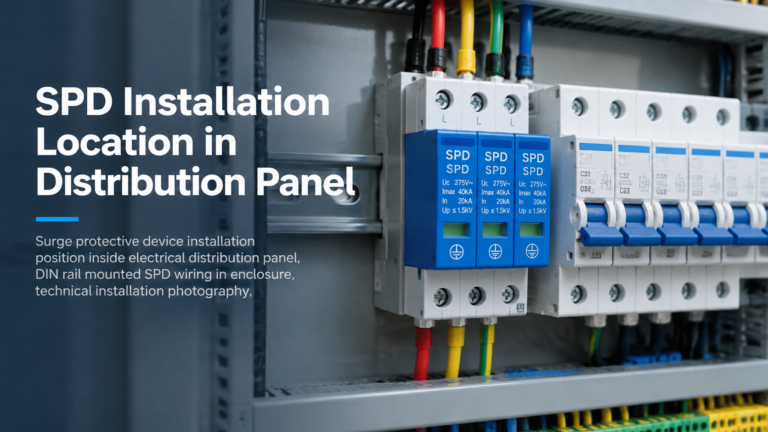
Where a surge protective device is installed determines how much of the surge it actually intercepts. A correctly specified device placed in the wrong position provides far less protection than its datasheet suggests — and because the installation still looks compliant, the shortfall is rarely detected until equipment fails. This guide covers surge protective device […]
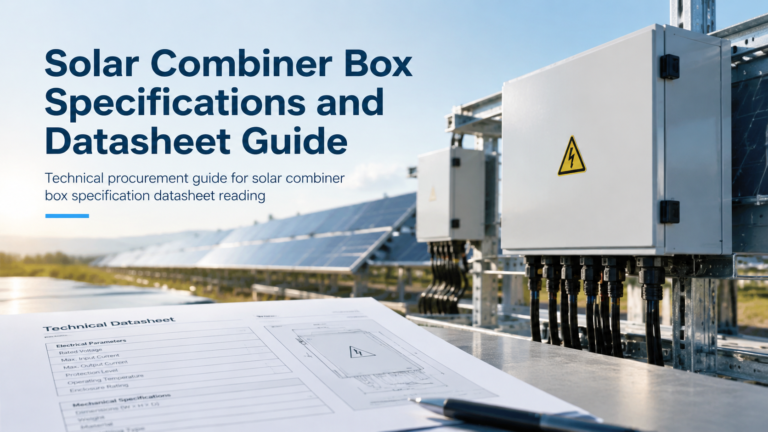
Most solar combiner box datasheets open with a table of ratings, and most buyers skim past it. That table is where the decision actually gets made. A combiner box is a passive enclosure — it does not protect anything by itself — so every number on its datasheet is either a limit you must stay […]
Photovoltaic systems fail in ways that are individually simple and collectively expensive. A DC arc that never clears. A fuse that blows on a cloudy morning. A surge that enters through the PV cable rather than the mains. Each of these sits on the DC side, and each traces back to a protection decision made […]