Choosing the right SPD backup fuse is one of the most overlooked steps in surge protection design. A surge protective device (SPD) diverts transient overvoltage caused by lightning, switching operations or grid disturbances — but when it reaches end of life or fails under abnormal conditions, a correctly sized backup fuse or circuit breaker is what keeps the fault from turning into a fire hazard or a system-wide shutdown.
This guide walks you through how to select anSPD backup fuse or circuit breaker for AC distribution systems, DC systems and solar PV applications, with practical sizing rules and the most common mistakes to avoid. Whether you are a design engineer, a panel builder or a procurement professional, understanding the difference between a surge protector backup fuse and a general-purpose overcurrent device can save you time, money and safety compliance issues.
Key Takeaways
An SPD backup fuse protects the SPD branch, not the load circuit.
Not every SPD needs a separate backup fuse — check the upstream protection rating first.
Fuses generally offer higher breaking capacity in compact size; circuit breakers offer resettable convenience.
DC circuits and solar PV systems require DC-rated or PV-rated backup protection only.
Always verify the SPD manufacturer’s maximum backup fuse rating before selecting.
What Is an SPD Backup Fuse?
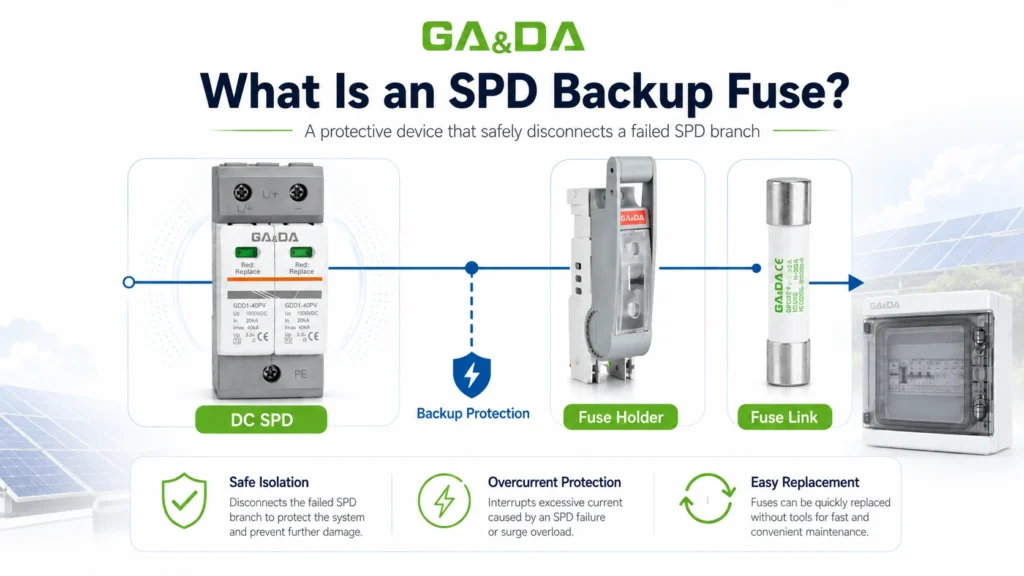
An SPD backup fuseis an overcurrent protection device installed in series with the surge protective device branch. Its function is not to replace the SPD. Instead, it protects the electrical installation if the SPD fails and becomes a short-circuit risk.
The SPD backup fuse helps to:
Disconnect a failed SPD from the circuit
Prevent excessive fault current through the SPD branch
Reduce fire risk caused by abnormal SPD failure
Maintain coordination with the upstream protection device
Improve safety during maintenance and replacement
In some installations, a circuit breaker can also be used as SPD backup protection. The choice between a fuse and a circuit breaker depends on the SPD datasheet, system voltage, prospective short-circuit current, installation space, maintenance preference and local electrical code.
Does Every SPD Need a Backup Fuse?
Not always.
Some SPDs do not require a separate backup fuse when the upstream overcurrent protection device is already within the maximum backup protection rating specified by the SPD manufacturer. For example, if the SPD datasheet states that the maximum backup fuse is 125 A and the upstream breaker is 63 A, a separate backup fuse may not be necessary.
However, if the upstream protection is larger than the SPD’s permitted backup protection rating, a dedicated SPD backup fuse or circuit breaker is usually required.
Quick selection rule:
If upstream protection rating is…
Then…
≤ SPD manufacturer’s max backup protection rating
A separate backup fuse may NOT be needed
> SPD manufacturer’s max backup protection rating
A dedicated SPD backup fuse or circuit breaker IS required
Always check the installation instruction of the specific SPD model before making the final decision.
SPD Backup Fuse vs Circuit Breaker: Which Should You Use?
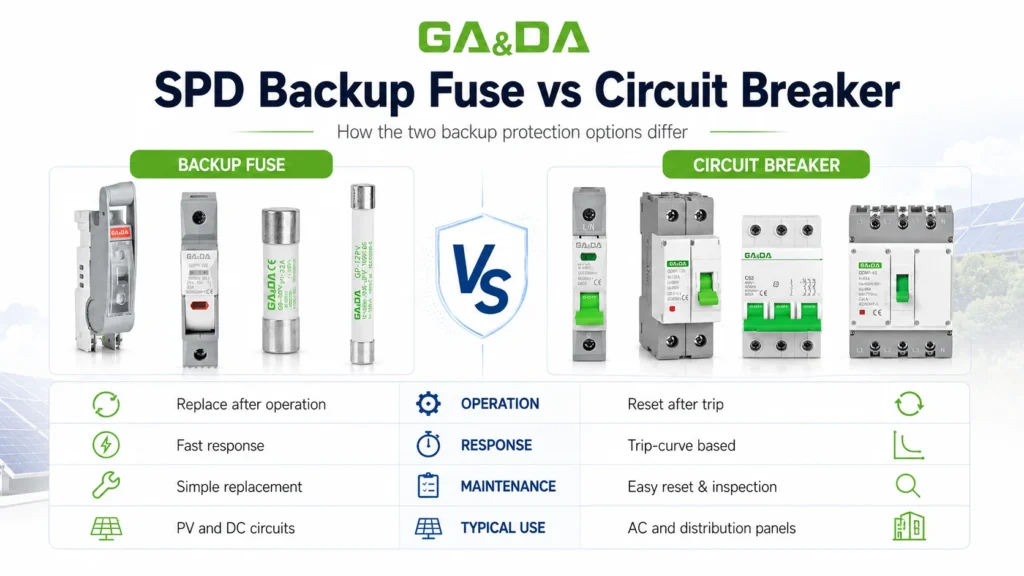
Short answer: For industrial panels and solar PV combiner boxes, an SPD backup fuse is usually the better choice due to its high breaking capacity and compact size. For standard AC distribution boards, a circuit breaker is often more convenient because it can be reset after inspection.
Both fuses and circuit breakers can be used as backup protection, but they behave differently.
Item
SPD Backup Fuse
SPD Backup Circuit Breaker
Operating principle
Melts and opens the circuit under fault current
Trips mechanically under overcurrent or short circuit
Reusability
One-time operation, must be replaced
Can be reset after inspection
Response speed
Usually fast, depending on fuse type
Depends on trip curve and breaker design
Breaking capacity
Often high in compact size
Must be selected carefully for fault current level
Maintenance
Requires replacement after operation
Easier for routine maintenance
Space
Compact fuse holders are available
May require more DIN rail space
Typical use
Industrial panels, PV combiner boxes, DC systems
AC distribution boards and control panels
For many industrial and PV applications, fuses are preferred because of their high breaking capacity and compact size. For low-voltage AC distribution boards, miniature circuit breakers (MCBs) or molded case circuit breakers (MCCBs) may be used when they match the SPD manufacturer’s requirements.
Key Parameters for Selecting an SPD Backup Fuse
1. Maximum Backup Fuse Rating
The first parameter to check is the maximum backup fuse rating in the SPD datasheet.
This value tells you the largest fuse or overcurrent protection device that can safely protect the SPD branch. It may be listed as:
Maximum backup fuse
Max. fuse
Backup protection
Short-circuit backup protection
Recommended backup fuse
Do not select a backup fuse larger than the manufacturer’s specified value. Oversizing the fuse may prevent it from disconnecting the SPD safely during a fault.
2. System Voltage
The backup fuse or circuit breaker must match the system voltage.
For AC systems, check the rated voltage such as 230/400 V AC, 277/480 V AC or other local distribution voltages.
For DC systems, especially solar PV systems, the backup fuse or breaker must be DC rated. A standard AC breaker or fuse should not be used in a DC circuit unless it is specifically approved for that DC voltage.
PV systems often operate at 600 V DC, 1000 V DC or 1500 V DC. The backup protection device must be suitable for the maximum DC system voltage.
3. Short-Circuit Current Rating
The selected fuse or circuit breaker must be able to interrupt the prospective short-circuit current at the installation point.
This is especially important in:
Main distribution boards
Industrial power panels
PV combiner boxes
Battery energy storage systems
DC distribution panels
Sites close to transformers or generators
If the backup protection device has an insufficient breaking capacity, it may fail during a short circuit.
4. AC or DC Application
AC and DC circuits behave differently during fault interruption. This distinction is critical when selecting a surge protector backup fuse or breaker.
In AC systems, the current naturally crosses zero many times per second, which helps extinguish the arc. In DC systems, there is no natural zero crossing, so arc extinction is more difficult. This is why DC-rated fuses and breakers are essential for DC SPD backup protection — including solar PV, battery storage and EV charging applications.
For solar PV applications, only use backup protection devices specifically designed and rated for PV DC circuits.
5. SPD Type and Discharge Capacity
The backup protection should also match the SPD type and its surge current capacity.
Typical SPD fuse types include:
Type 1 SPD for lightning current discharge
Type 2 SPD for switching surges and induced overvoltage
Type 1+2 SPD for combined lightning and surge protection
DC SPD for solar PV and battery systems
Signal SPD for data, control and communication lines
A Type 1 SPD or Type 1+2 SPD may be exposed to higher surge energy than a Type 2 SPD, so the backup protection must be coordinated with the SPD’s tested capability.
6. Selectivity with Upstream Protection
Good SPD backup protection should disconnect only the SPD branch during an SPD fault, without unnecessarily shutting down the entire electrical system.
This is called selectivity or coordination.
For example, if a backup fuse is installed in the SPD branch, it should operate before the main breaker trips during an SPD branch fault. This helps keep the rest of the installation energized while isolating the failed SPD.
7. Installation Space and Maintenance
In compact panels, there may not be enough space for a separate fuse holder or circuit breaker. In that case, an SPD with integrated backup protection may be considered.
For maintenance teams, circuit breakers may be more convenient because they can be reset after inspection. However, after a serious SPD fault, the SPD module should still be checked and replaced if the status indicator shows failure.
When to Use an SPD Backup Fuse
An SPD backup fuse is often suitable when:
The upstream breaker is larger than the SPD’s maximum backup protection rating
The panel requires high short-circuit breaking capacity
The SPD is installed in an industrial power cabinet
The SPD is installed in a PV combiner box
The circuit is DC and requires reliable fault interruption
Compact protection is needed
Selective disconnection of the SPD branch is required
For PV applications, DC fuse links and DC fuse bases are commonly used together with DC SPDs in combiner boxes and PV protection panels.
When to Use an SPD Backup Circuit Breaker
An SPD backup circuit breaker may be suitable when:
The SPD manufacturer allows circuit breaker backup protection
The breaker has the required voltage and breaking capacity
The installation is an AC distribution board
Maintenance teams prefer resettable protection
The panel design already uses MCB or MCCB protection
The circuit breaker trip curve is appropriate for the SPD branch
For AC systems, MCBs or MCCBs can be practical choices. For DC systems, use only DC-rated breakers that are suitable for the operating voltage and fault current level.
Step-by-Step SPD Backup Fuse Selection Guide
Step 1: Identify the SPD Application
First, confirm where the SPD will be installed.
Common installation points include:
Main AC distribution board
Sub-distribution board
Industrial control cabinet
PV combiner box
Inverter DC input side
Inverter AC output side
Battery energy storage cabinet
Communication or signal line
The application determines whether you need AC-rated, DC-rated or PV-rated backup protection. If you are unsure which SPD type your installation requires, check our SPD product category comparison for a full breakdown of Type 1, Type 2 and Type 1+2 applications.
Step 2: Check the SPD Datasheet
Find the maximum backup fuse or recommended backup protection value in the SPD datasheet.
Check these items:
SPD type
Rated voltage
Maximum continuous operating voltage (Uc)
Nominal discharge current (In)
Maximum discharge current (Imax)
Lightning impulse current (Iimp)
Short-circuit current rating (SCCR)
Maximum backup fuse rating
Recommended wiring diagram
Never choose backup protection based only on the SPD’s physical size or pole number.
Step 3: Compare with the Upstream Protection
Check the rating of the upstream fuse, MCB or MCCB.
If the upstream protection is within the SPD manufacturer’s allowed backup protection rating, a separate backup fuse may not be required.
If the upstream protection is higher than the allowed rating, install a dedicated SPD backup fuse or breaker according to the manufacturer’s instructions.
Step 4: Match Voltage and Breaking Capacity
Select a backup fuse or breaker with voltage and breaking capacity suitable for the installation. If you are selecting a surge protective device circuit breaker for an AC panel, match the AC voltage and fault level.
For PV systems, select DC or PV-rated backup protection suitable for the maximum open-circuit voltage (Voc) of the PV array.
Step 5: Confirm Wiring Method
The backup fuse or breaker is normally installed in series with the SPD branch, not in series with the main load circuit.
Keep the wiring short and straight. Long SPD connection leads can increase the let-through voltage and reduce protection performance.
Step 6: Check Status Indication
After installation, make sure the SPD status window is visible. Many SPDs use a green/red indicator to show whether the module is still functional.
If the SPD has a remote signaling contact, connect it to the monitoring system where required. This is useful for industrial panels, PV plants and unmanned sites.
6 Common Mistakes When Selecting an SPD Backup Fuse
Mistake 1: Selecting a backup fuse without checking the SPD datasheet
The backup fuse must match the SPD manufacturer’s recommendation. Using a random fuse size can result in poor coordination or unsafe disconnection.
Mistake 2: Using AC-rated protection devices in DC circuits
DC circuits require DC-rated protection. This is especially important for PV systems and battery systems. AC-rated devices may not interrupt DC fault current safely.
Mistake 3: Oversizing the SPD backup fuse
A larger fuse does not mean better protection. If the fuse rating is too high, it may not disconnect the SPD quickly enough during abnormal failure.
Mistake 4: Ignoring the prospective short-circuit current rating
Every fuse or breaker has a breaking capacity. If the prospective short-circuit current exceeds this value, the protection device may fail during a fault.
Mistake 5: Installing the SPD too far from the busbar
Backup protection is important, but wiring layout is also critical. Long leads increase voltage drop during surge discharge and reduce the actual protection level.
Mistake 6: Confusing load protection with SPD backup protection
The backup fuse protects the SPD branch during abnormal failure. It does not replace the main circuit breaker, load circuit fusing or system-level electrical design.
DC SPD Backup Fuse for Solar PV Systems
Solar PV systems require special attention because the DC side can operate at high voltage and continuous current.
When selecting a DC SPD backup fuse for solar PV systems, check:
Maximum PV system voltage
1000 V DC or 1500 V DC rating
PV string or array configuration
Prospective short-circuit current
SPD type, such as Type 2 DC SPD or Type 1+2 DC SPD
Manufacturer’s recommended backup fuse
DC fuse base and fuse link rating
Combiner box wiring layout
One common error in PV system design is using standard AC-rated gPV fuse links in DC combiner boxes. Even if the physical form factor looks identical, an AC-rated fuse cannot reliably interrupt a DC fault arc at 1000 V DC or 1500 V DC. Always confirm that the fuse link carries an explicit DC voltage rating — this is typically printed on the fuse body and listed in the manufacturer’s datasheet.
Another important consideration: the backup fuse rating must coordinate with both the PV string short-circuit current (Isc) and the SPD’s maximum discharge current capability (Imax). In large PV arrays where multiple strings are paralleled, the available fault current at the combiner box can be significantly higher than a single string’s short-circuit current. Size your DC SPD backup fuse to handle this combined fault level without nuisance operation during normal surge events.
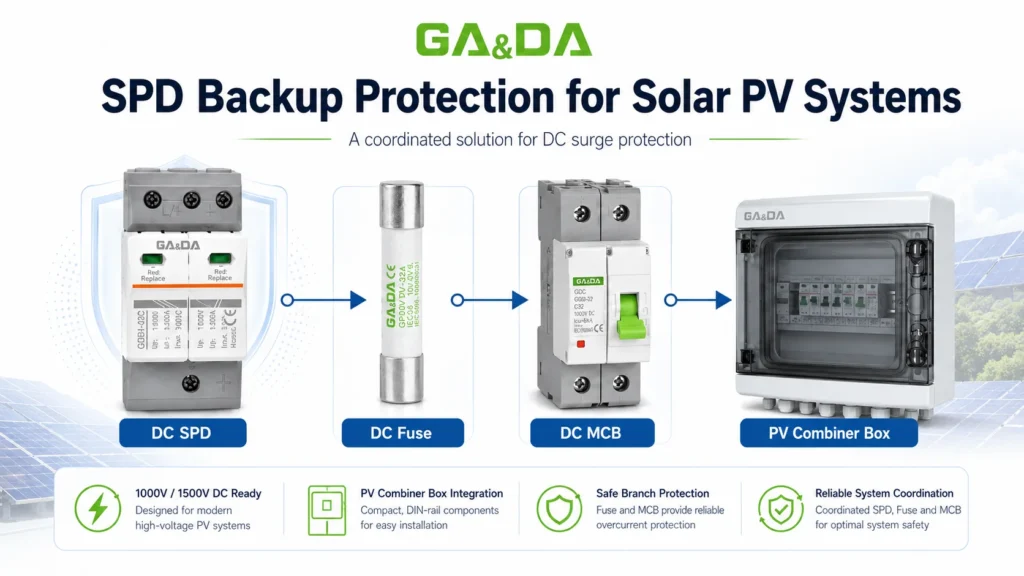
A PV combiner box may include DC SPDs, DC fuses, DC MCBs or DC isolators. These components should be selected as a coordinated system rather than as separate parts.
Recommended GA&DA SPD Backup Protection Products
For projects that require SPD backup protection and coordinated electrical safety, GA&DA offers a complete range of compatible products:
Surge Protective Devices
Type 1 AC SPD (for service entrance and lightning current)
Type 2 AC SPD (for sub-distribution boards)
Type 1+2 AC SPD (combined lightning and surge protection)
Type 2 DC SPD (for solar PV and battery systems)
Type 1+2 DC SPD (for high-energy PV and storage applications)
PV combiner box (integrates DC SPD, DC fuses and monitoring)
PV lightning protection box
Selecting the SPD together with its backup fuse or circuit breaker from the same product ecosystem helps ensure proper coordination, simplifies ordering and reduces installation complexity. Browse the GA&DA product catalogue or contact our technical team for a recommendation tailored to your system voltage, fault level and SPD type.
Conclusion
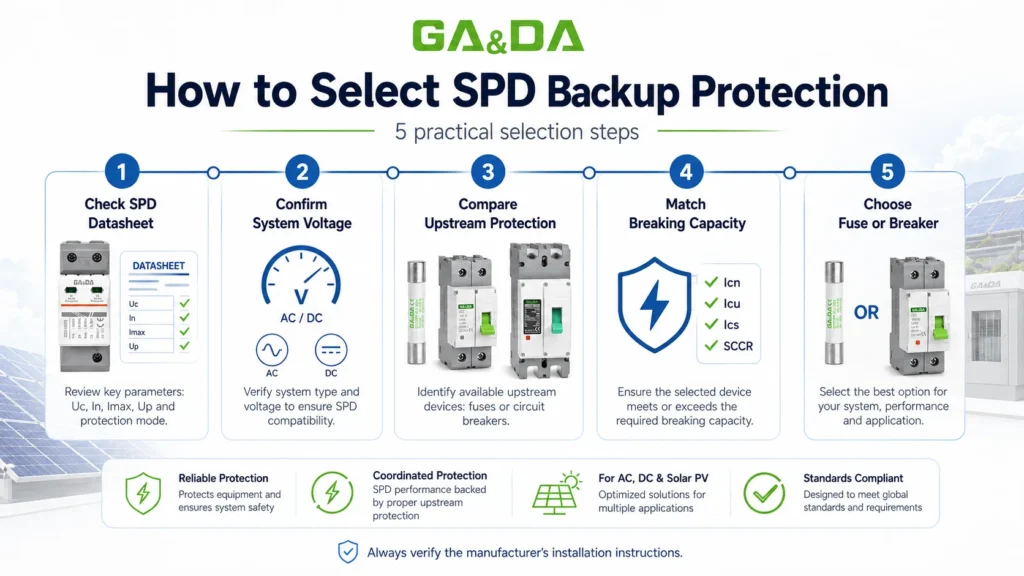
Selecting the correct SPD backup fuse or circuit breaker is essential for safe and reliable surge protection. The process comes down to five key checks:
Read the SPD datasheet — find the maximum backup fuse rating
Compare with the upstream protection rating
Match system voltage (AC, DC or PV-rated)
Confirm the short-circuit breaking capacity is adequate
Choose the right fuse or breaker type for the specific application
For AC distribution boards, an MCB, MCCB or fuse may be used when it matches the SPD manufacturer’s requirements. For solar PV systems, DC-rated or PV-rated backup protection is critical because DC fault interruption is more demanding than AC interruption.
GA&DA supplies a full range of surge protection devices, backup fuses, circuit breakers and PV combiner box solutions for residential, commercial, industrial and solar applications. Whether you need a DC SPD backup fuse for a 1500 V PV array or an SPD backup circuit breaker for an AC distribution board, our technical team can recommend the right product combination for your project.
Browse our SPD and backup protection product catalogue, or contact us directly with your system voltage, fault level and SPD model — and we will help you find the correct solution.
FAQ
What is an SPD backup fuse?
An SPD backup fuse is a fuse installed in series with the surge protective device branch. It disconnects the SPD if the SPD fails and creates a short-circuit risk, preventing dangerous sustained fault current and reducing fire hazard.
Is a backup fuse always required for an SPD?
No. A separate backup fuse may not be required if the upstream protection device is within the SPD manufacturer’s maximum backup protection rating. Always check the SPD datasheet and installation instruction.
Can I use a circuit breaker instead of a fuse for SPD backup protection?
Yes, in some applications. An SPD backup circuit breaker must be allowed by the SPD manufacturer and must match the required voltage, breaking capacity and trip characteristics.
What happens if the SPD backup fuse is too large?
If the backup fuse is too large, it may not disconnect the SPD safely during abnormal failure. This can increase the risk of overheating, equipment damage or fire.
What happens if the SPD backup fuse is too small?
If the backup fuse is too small, it may nuisance-operate during surge events or normal transient conditions, disconnecting the SPD before it is actually damaged. This leaves your system unprotected against the next surge.
What is the difference between an SPD backup fuse and a load fuse?
An SPD backup fuse is installed in series with the SPD branch only. It protects against abnormal SPD failure and disconnects the SPD from the system. A load fuse protects the downstream load circuit and operates under overload or short-circuit conditions caused by connected equipment. The two serve different protective functions and should not be combined into a single device unless the SPD manufacturer explicitly allows it.
Can I use a Type B RCD as SPD backup protection?
No. An RCD (residual current device) is designed to detect earth leakage currents and protect against electric shock. It is not designed to handle the fault current levels that can occur during SPD failure. An RCD should not be used as a substitute for an SPD backup fuse or circuit breaker.
What type of fuse is used for DC SPD in solar PV systems?
For solar PV applications, the fuse should be suitable for DC or PV circuits and rated for the maximum system voltage, such as 1000 V DC or 1500 V DC. This is a critical requirement for any DC SPD backup fuse selection. The final selection should follow the SPD manufacturer’s datasheet.
Should the backup fuse be installed before or after the SPD?
The backup fuse or circuit breaker is normally installed in series with the SPD branch, between the busbar and the SPD. It should be wired according to the SPD manufacturer’s connection diagram.
Can an SPD protect the system after the backup fuse operates?
No. Once the backup fuse operates and disconnects the SPD branch, the SPD is no longer connected to the system. The SPD and the surge protector backup fuse should both be inspected and replaced if necessary before surge protection is restored.
Selecting the wrong surge protective device type is one of the more common and more expensive specification errors in low-voltage installations. The device may work, the installation may pass inspection, and the system will still be under-protected for the actual risk it faces — because Type 1, Type 2, and Type 3 devices are not […]
A blowing solar fuse is either a real fault being cleared or nuisance operation. Learn how to tell the two apart, the causes behind each, the measurements that confirm them, and why replacing the fuse without diagnosing is the wrong response.
A DC-specific comparison of fuses and circuit breakers in solar PV systems: arc extinction without a current zero, operating speed, energy let-through, selectivity, reset and maintenance, with a decision matrix for string, combiner box, inverter DC input, battery/BESS and DC main positions.