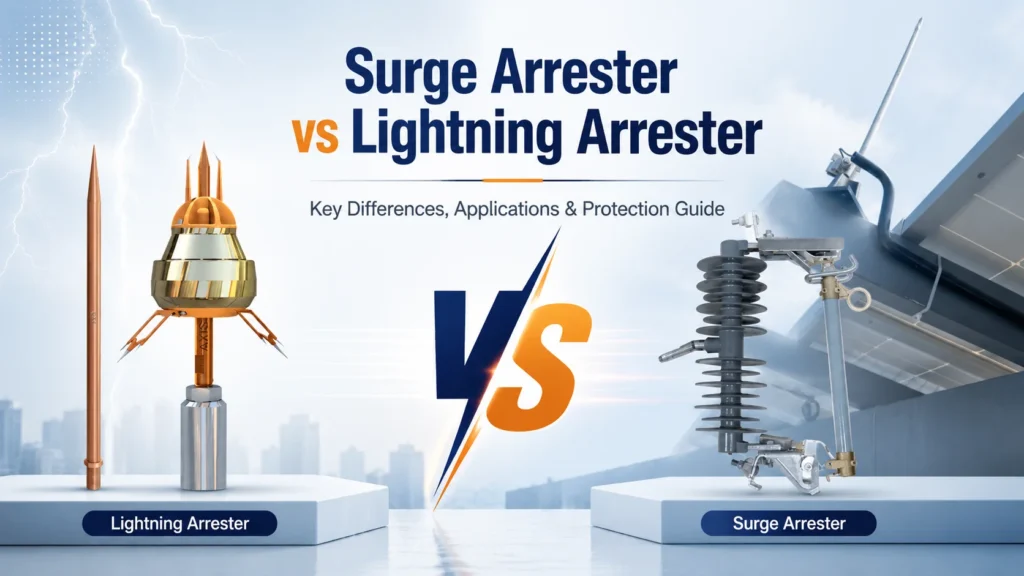
Understanding the difference between Surge Arresters and Lightning Arresters is crucial for protecting electrical systems. Lightning strikes are frequent — according to the UK’s weather department, over 3 million lightning flashes occur every day worldwide, averaging about 44 strikes per second. Protecting buildings and electrical equipment from these events requires properly designed devices.
This article explains the differences, applications, and key points for Surge Arresters and Lightning Arresters.
Lightning Arrester
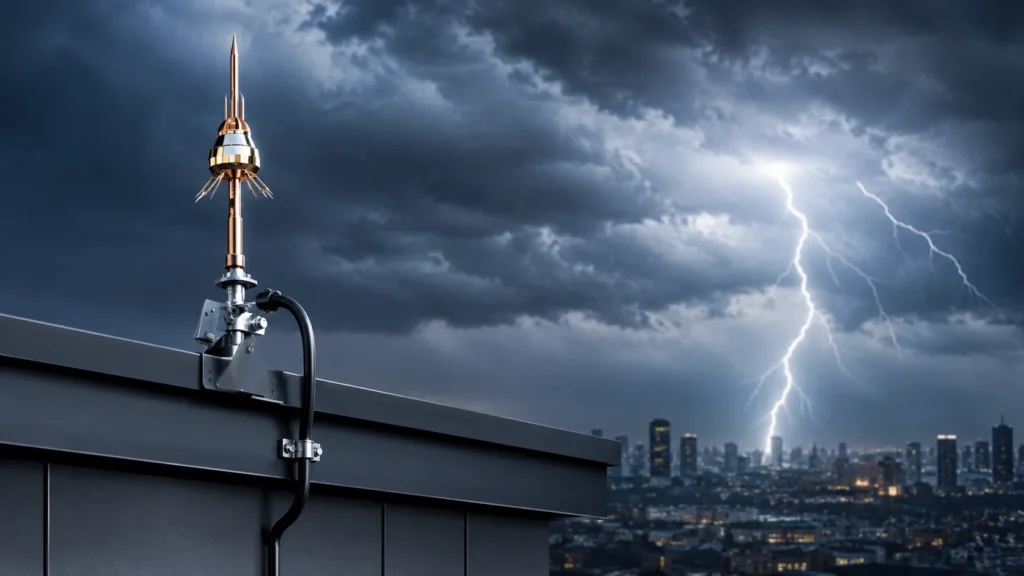
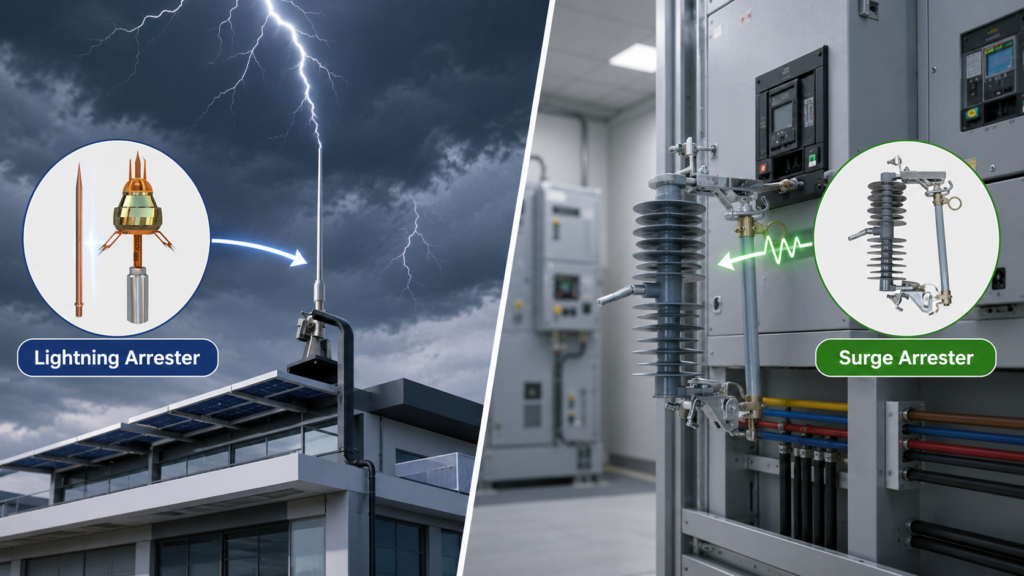
A Lightning Arrester is used to reduce and eliminate lightning risks. When lightning strikes, it releases a large amount of energy in a few seconds, which can damage buildings and electrical systems. Lightning Arresters protect by providing a low-resistance path to ground, safely diverting the charge.
Conventional Lightning Arresters (Franklin Rods) Suitable for small buildings. Long metallic rods, often made of copper, are installed at the highest points. Requires multiple rods, additional down conductors, and complex earthing for larger structures.
Early Streamer Emission (ESE) Lightning Arresters Designed to discharge lightning faster and cover larger areas. Works by emitting charged particles and storing energy from the ambient electromagnetic field. A single ESE arrester can protect a larger area compared to conventional rods.
Installation Recommendations
Place at the highest point of the building.
Connect to a low-resistance grounding system.
Use multiple devices for larger areas to ensure full coverage.
Applications
Residential homes, commercial buildings, industrial facilities, and power substations.
Where are Surge Arrester
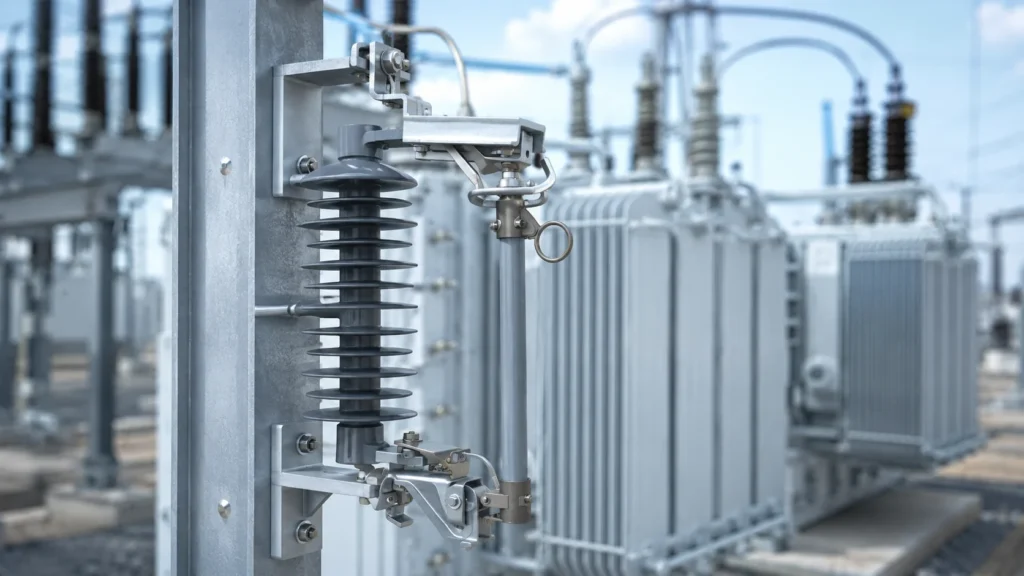
Surge Arresters protect internal electrical systems from overvoltages. They usually use Metal Oxide Varistors (MOVs), which vary resistance with voltage to absorb or divert surges.
Types of Overvoltage Surges
Normal Power Frequency Overvoltage: Temporary spikes from faulty wiring, sudden power restoration, or overloads.
Lightning Surge: Caused by nearby lightning strikes.
Switching Surge: Generated from opening or closing high-voltage lines or switching inductive/capacitive loads.
Installation Locations
Electrical substations at feeder entrances.
Around power transformers to protect high-value equipment.
Within pad-mounted transformers, domestic circuit breakers, and riser poles.
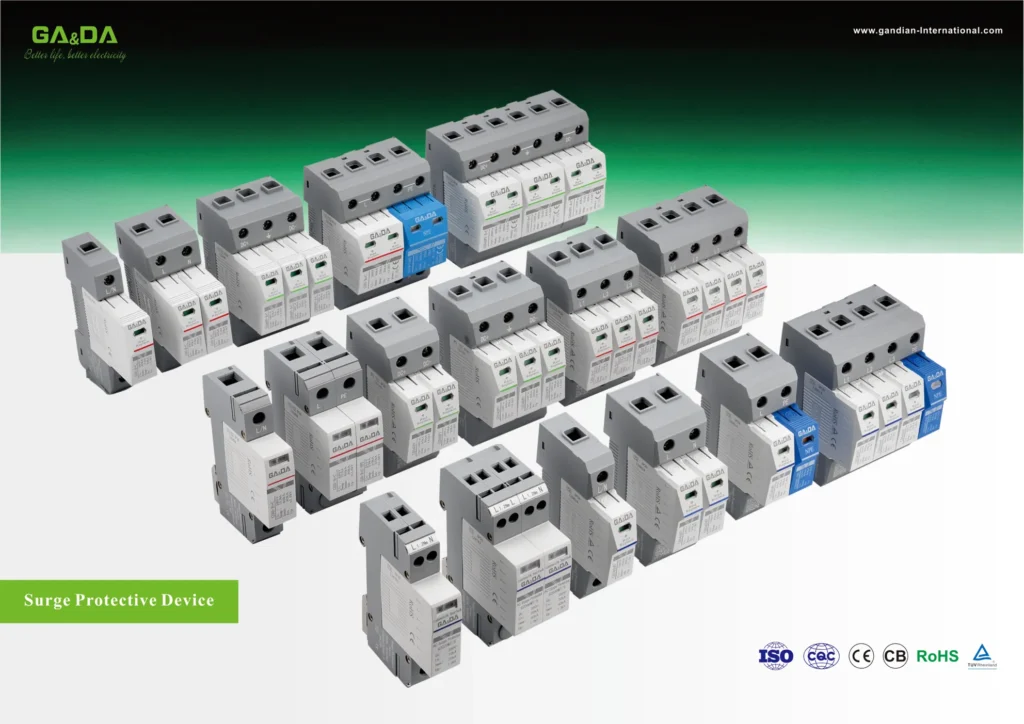
Note: Do not confuse Surge Arresters with Surge Protectors (SPDs), which are for low-voltage home appliances. SPDs also use MOVs but are designed to protect home wiring and appliances from voltage spikes.
Key Differences Between Surge Arresters and Lightning Arresters
Can a Lightning Arrester protect internal electrical equipment?
Lightning Arresters are primarily designed to protect buildings and external structures from direct lightning strikes. To protect internal electrical systems, you should install Surge Arresters or SPDs at strategic points like transformers, distribution panels, or sensitive equipment.
Can Surge Arresters prevent damage from direct lightning strikes?
No, Surge Arresters are designed to handle overvoltages caused by lightning-induced surges, switching operations, or transient spikes. Direct lightning strikes require Lightning Arresters for safe grounding.
How do I choose between a conventional Lightning Rod and an ESE Lightning Arrester?
Conventional rods are suitable for small buildings with simple protection needs. ESE (Early Streamer Emission) devices cover larger areas and are ideal for industrial buildings, factories, or commercial complexes where fewer units can provide broader coverage.
Do SPDs (Surge Protection Devices) replace Surge Arresters?
No, SPDs are for low-voltage applications and protect appliances in homes or small offices. Surge Arresters protect medium/high-voltage electrical systems and are used in substations or industrial distribution setups.
How often should Lightning and Surge Arresters be inspected?
It is recommended to inspect them at least once a year or after any severe storm. Check for physical damage, corrosion, grounding integrity, and proper mounting.
When a buyer asks me for an industrial AC surge suppressor, they almost never say, “Please quote Type 1, Type 2 and Type 3 SPDs with coordinated protection per IEC 61643-11.”They say: “Boss, factory keeps tripping, PLC sometimes dies, give me a surge protector that works.” So in this article, I’ll break down the difference between Type […]
Type 1 Surge Protection Device – Reliable Lightning Surge Arrester for Service Entrance ![GANDIAN Type 1 SPD with labeled callouts showing surge modules, remote signaling contact, and compact DIN-rail housing] Protect your facility’s main distribution board with our Type 1 / Class I surge protection device, engineered for direct lightning current handling and superior surge […]
Whole House Surge Protection Device: Reliable Home Surge Protection Protect your entire home with the GANDIAN Whole House Surge Protection Device, engineered for comprehensive electrical surge protection. This whole house surge protector shields your home from damaging voltage spikes caused by lightning, power outages, or electrical switching. Designed as a main panel surge protector, it […]
We use cookies to enhance your browsing experience, serve personalised ads or content, and analyse our traffic. By clicking "Accept All", you consent to our use of cookies.