Iimp, In, Imax and Up Explained: How to Read SPD Specifications
Published: Author: Rachel
Reading SPD specifications correctly is one of the most important steps in selecting a reliable surge protection device. Many buyers only compare the largest kA value on the label, but parameters such as Iimp, In, Imax, Up and Uc each describe a different part of SPD performance. If these values are misunderstood, the selected SPD may not match the actual installation environment, system voltage or protection requirement.
This guide explains the key SPD parameters in a practical way, helping you understand what Iimp, In, Imax and Up mean, how they are used in Type 1, Type 2, AC, DC and solar PV surge protection devices, and what to check before comparing different SPD models for electrical panels, industrial systems or photovoltaic applications.
Key Takeaways
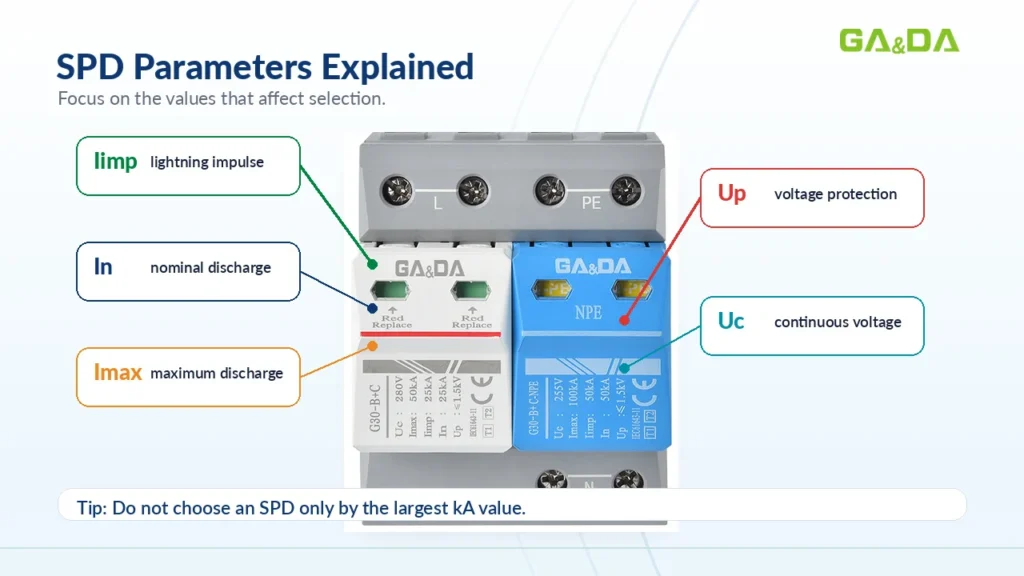
Iimp is mainly used for Type 1 SPDs and shows the ability to discharge high-energy lightning current.
In means nominal discharge current and reflects the SPD’s standard repeated surge discharge capability.
Imax shows the maximum discharge current, but it should not be the only value used for SPD selection.
Up means voltage protection level; a lower Up value generally means better limitation of residual voltage.
Uc or Ucpv must match the actual AC or DC system voltage to avoid early SPD failure or poor protection.
A correct SPD selection should consider SPD type, system voltage, discharge capacity, voltage protection level and backup protection together.
What Are SPD Specifications?
SPD specifications describe the electrical performance, application range and protection capability of a surge protection device. These values help engineers, installers, panel builders and buyers decide whether a particular SPD is suitable for an AC distribution system, DC system, solar PV system or industrial control panel.
A typical SPD datasheet may include:
SPD type or class
Nominal voltage
Maximum continuous operating voltage
Nominal discharge current
Maximum discharge current
Impulse current
Voltage protection level
Response time
Pole configuration
Backup fuse or circuit breaker rating
Visual indicator
Remote signaling contact
Applicable standard
Operating temperature
Installation method
Among all these parameters, Iimp, In, Imax, Up and Uc are the most commonly used values when comparing SPDs. However, they should not be read separately. A high discharge current rating does not always mean better protection if the voltage protection level or operating voltage is not suitable for the system.
What Does Iimp Mean in SPD Specifications?
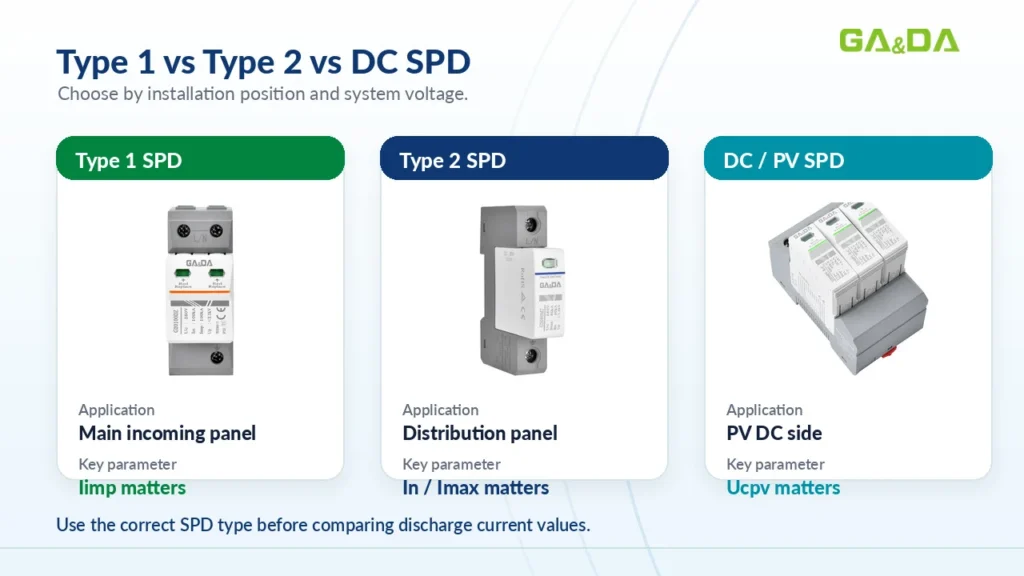
Iimp means impulse current. It is mainly used for Type 1 SPDs and Type 1+2 SPDs.
Iimp shows the SPD’s ability to discharge high-energy lightning current. It is commonly associated with a 10/350 μs lightning impulse waveform. This type of waveform represents a high-energy lightning current that may enter the electrical installation from direct lightning impact or nearby lightning activity.
In simple terms:
Iimp tells you how much lightning impulse current the SPD can discharge.
For example, if a Type 1 SPD is marked as:
Iimp = 12.5 kA per pole
It means each pole of the SPD is designed to discharge a 12.5 kA lightning impulse current under the specified test condition.
When Is Iimp Important?
Iimp is important when selecting SPDs for:
Main distribution boards
Service entrance panels
Buildings with external lightning protection systems
Industrial facilities
Outdoor electrical installations
Sites with overhead incoming lines
Solar PV installations in lightning-prone areas
If a project requires Type 1 protection, Iimp should be checked carefully. In this case, only comparing Imax is not enough, because Imax is normally related to Type 2 surge discharge performance, not Type 1 lightning current performance.
What Does In Mean in SPD Specifications?
In means nominal discharge current. It is one of the most important parameters for Type 2 SPDs.
In shows the surge current value that the SPD can discharge repeatedly under standard test conditions. It is commonly associated with an 8/20 μs waveform, which is widely used for Type 2 surge protection testing.
In simple terms:
In tells you the SPD’s standard repeated discharge capacity.
For example, if an SPD is marked as:
In = 20 kA
It means the SPD is designed to discharge a nominal surge current of 20 kA under the specified test waveform.
Why In Matters
In is very useful when comparing Type 2 SPDs used in:
Distribution boards
Sub-distribution panels
Commercial buildings
Industrial control cabinets
Machinery panels
Solar PV combiner boxes
Inverter protection
Low-voltage electrical systems
A higher In value generally means stronger repeated surge discharge capability. However, it still needs to match the installation level, system voltage, grounding condition and expected surge exposure.
What Does Imax Mean in SPD Specifications?
Imax means maximum discharge current. It represents the maximum surge current that a Type 2 SPD can discharge under specified test conditions.
In simple terms:
Imax tells you the maximum surge current the SPD can handle once under defined conditions.
For example, a Type 2 SPD may be marked as:
In = 20 kA
Imax = 40 kA
This means the SPD has a nominal discharge current of 20 kA and a maximum discharge current of 40 kA.
Why Imax Can Be Misleading
Many buyers focus only on Imax because it is usually the largest number on the product label. For example, 40 kA, 60 kA, 80 kA or 100 kA can look attractive in product comparison.
However, Imax alone does not determine whether the SPD is suitable.
A high Imax value does not help if:
The SPD voltage rating is wrong
The Up value is too high
The SPD type does not match the installation position
The backup fuse or circuit breaker is not coordinated
An AC SPD is used in a DC system
The grounding system is poor
A Type 1 SPD is required but only a Type 2 SPD is installed
For this reason, Imax should be used as one reference value, not the only selection standard.
What Does Up Mean in SPD Specifications?
Up means voltage protection level. It indicates the residual voltage that remains across the SPD terminals when the SPD operates during a surge event.
In simple terms:
Up tells you how much voltage may still reach the protected equipment after the SPD operates.
For example, if an SPD is marked as:
Up ≤ 1.5 kV
It means the residual voltage is limited to 1.5 kV or less under specified test conditions.
Why Up Is So Important
The purpose of an SPD is not only to discharge surge current. More importantly, it must limit the overvoltage to a level that connected equipment can tolerate.
A lower Up value generally means better voltage limitation. This is especially important for protecting sensitive equipment such as:
Inverters
PLCs
Control systems
Power supplies
Communication equipment
Solar PV equipment
Measurement devices
Industrial automation systems
However, Up should not be evaluated alone. Cable length, installation method, grounding quality and coordination with other protection stages can also affect the actual protection performance.
What Does Uc Mean in SPD Specifications?
Uc means maximum continuous operating voltage. It is the maximum voltage that can be continuously applied to the SPD without causing abnormal operation.
For AC systems, common Uc values may include 275 V, 320 V, 385 V or 420 V depending on the system configuration and application.
For solar PV systems, the parameter is often shown as Ucpv, such as:
600 V DC
1000 V DC
1200 V DC
1500 V DC
In simple terms:
Uc or Ucpv must match the actual system voltage.
What Happens If Uc Is Wrong?
If Uc is too low, the SPD may operate under normal voltage fluctuation, overheat, age quickly or fail early.
If Uc is too high, the SPD may not limit the surge voltage early enough, reducing protection effectiveness.
For DC solar systems, Ucpv must be selected according to the maximum open-circuit voltage of the PV string. A 1000 V DC SPD should not be used in a 1500 V DC PV system unless the actual system voltage is within the product’s rated range.
Iimp vs In vs Imax vs Up vs Uc: Quick Comparison
Parameter
Full Meaning
Commonly Used For
What It Tells You
Iimp
Impulse current
Type 1 SPD / Type 1+2 SPD
Ability to discharge high-energy lightning current
In
Nominal discharge current
Type 2 SPD
Standard repeated surge discharge capacity
Imax
Maximum discharge current
Type 2 SPD
Maximum surge discharge capacity under specified conditions
Up
Voltage protection level
All SPD types
Residual voltage after SPD operation
Uc
Maximum continuous operating voltage
AC SPD / DC SPD
Whether the SPD matches the system voltage
Ucpv
Maximum continuous operating voltage for PV
DC SPD / PV SPD
Whether the SPD matches the PV system voltage
How to Read an SPD Datasheet Step by Step
A professional SPD selection should not start by choosing the highest kA value. Instead, follow a systematic process.
Step 1: Confirm the System Type
First, identify where the SPD will be installed.
Common applications include:
AC distribution board
DC distribution system
Solar PV combiner box
Inverter input or output side
Industrial control cabinet
Building main distribution panel
Signal or communication line
AC SPDs and DC SPDs are not interchangeable. DC systems require SPDs designed for DC voltage and DC arc behavior.
Step 2: Confirm the SPD Type
Next, confirm whether the project requires:
Type 1 SPD
Type 2 SPD
Type 1+2 SPD
Type 3 SPD
Type 1 SPDs are usually used at main incoming panels or lightning-exposed locations. Type 2 SPDs are commonly used in distribution boards and equipment-level protection. Type 1+2 SPDs combine lightning current discharge and surge protection capability in one device.
Step 3: Check Iimp for Type 1 SPD
If the installation requires Type 1 protection, check Iimp first. This value tells you whether the SPD can handle high-energy lightning impulse current.
Do not use Imax as the main selection value for Type 1 applications.
Step 4: Check In and Imax for Type 2 SPD
For Type 2 SPDs, check both In and Imax.
In shows the standard discharge capability. Imax shows the maximum discharge capability. A good selection should consider both values together with voltage protection level and system exposure.
Step 5: Check Up for Equipment Protection
Check whether the Up value is low enough for the equipment you want to protect. Sensitive equipment usually requires better voltage limitation.
If the Up value is too high, connected equipment may still be exposed to damaging residual voltage.
Step 6: Check Uc or Ucpv
Make sure the SPD voltage rating matches the actual system voltage.
For AC systems, check phase-to-neutral and phase-to-phase voltage. For PV systems, check the maximum open-circuit voltage of the PV string.
Step 7: Check Backup Protection
Every SPD should be installed according to the manufacturer’s recommended backup fuse or circuit breaker. Backup protection helps isolate fault current if the SPD reaches end of life or fails under abnormal conditions.
Example: Reading a Type 2 DC SPD Specification
A Type 2 DC SPD for solar PV systems may show the following values:
Specification
Example Value
Meaning
Ucpv
1000 V DC
Suitable for PV systems up to the rated DC voltage
In
20 kA
Nominal discharge current
Imax
40 kA
Maximum discharge current
Up
≤ 3.8 kV
Voltage protection level
Poles
2P or 3P
Wiring configuration
Indicator
Green / Red
Visual status indication
Remote contact
Optional
Allows remote alarm monitoring
This specification tells you that the SPD is designed for a 1000 V DC solar PV system and can discharge surge current according to its rated performance.
If the project uses a 1500 V DC PV system, this 1000 V DC SPD should not be selected. A suitable 1500 V DC SPD should be used instead.
Common Mistakes When Comparing SPD Specifications
Mistake 1: Choosing Only by Imax
A higher Imax value does not automatically mean better protection. The correct selection also depends on SPD type, Uc, Up, In, Iimp, system voltage and installation position.
Mistake 2: Ignoring Iimp for Type 1 SPD
For Type 1 SPD selection, Iimp is critical. If a site is exposed to direct lightning current, using only a Type 2 SPD may not provide the required protection level.
Mistake 3: Using AC SPD in DC Systems
AC and DC SPDs are different. A standard AC SPD should not be used on the DC side of a solar PV system.
Mistake 4: Ignoring Up
If Up is too high, sensitive equipment may still be damaged by residual voltage even when an SPD is installed.
Mistake 5: Selecting the Wrong Uc or Ucpv
Wrong voltage selection may cause early SPD failure or insufficient surge protection. Always match Uc or Ucpv with the actual system voltage.
Mistake 6: Ignoring Backup Fuse or Circuit Breaker
Backup protection must coordinate with the SPD and the system fault current. Incorrect backup protection may create safety risks or maintenance problems.
How GA&DA Supports SPD Selection
GA&DA provides AC SPDs, DC SPDs, Type 1 SPDs, Type 2 SPDs, Type 1+2 SPDs and PV surge protection solutions for electrical distribution, industrial systems and solar PV applications.
If you are comparing Iimp, In, Imax, Up, Uc or Ucpv values for your project, GA&DA can help you select a suitable SPD according to:
System voltage
AC or DC application
SPD type
Installation position
Discharge current requirement
Voltage protection level
Backup fuse or circuit breaker
PV system voltage
OEM or distributor requirements
For project selection, datasheet comparison or bulk order inquiry, contact GA&DA to get professional SPD recommendations.
FAQ About SPD Specifications
What does Iimp mean on an SPD?
Iimp means impulse current. It is mainly used for Type 1 SPDs and shows the ability of the SPD to discharge high-energy lightning impulse current.
What is the difference between In and Imax?
In is the nominal discharge current and shows the standard repeated discharge capability. Imax is the maximum discharge current and shows the maximum surge current the SPD can discharge under specified conditions.
Is higher Imax always better?
No. A higher Imax value does not always mean better protection. You should also check In, Up, Uc, SPD type, installation position and backup protection.
What does Up mean in surge protection?
Up means voltage protection level. It indicates the residual voltage that may remain when the SPD operates. A lower Up value generally means better voltage limitation.
What does Uc mean in SPD specifications?
Uc means maximum continuous operating voltage. It must match the actual system voltage so that the SPD can operate safely and effectively.
What is Ucpv in a DC SPD?
Ucpv is the maximum continuous operating voltage for photovoltaic DC applications. It is used to select SPDs for solar PV systems, such as 1000 V DC or 1500 V DC installations.
Which parameter is most important for Type 1 SPD?
For Type 1 SPD, Iimp is one of the most important parameters because it shows lightning impulse current discharge capability.
Which parameter is most important for Type 2 SPD?
For Type 2 SPD, In, Imax and Up are all important. In shows nominal discharge performance, Imax shows maximum discharge capability, and Up shows voltage limitation performance.
Conclusion
Understanding SPD specifications is essential for selecting the right surge protection device. Iimp, In, Imax, Up and Uc each describe a different part of SPD performance. Iimp is important for Type 1 lightning current protection, In and Imax are important for Type 2 surge discharge capacity, Up shows voltage limitation performance, and Uc or Ucpv confirms whether the SPD matches the system voltage.
Do not select an SPD only by the largest kA value. A reliable selection should consider the complete specification, including SPD type, system voltage, installation position, voltage protection level and backup protection.
Looking for a reliable surge protection device manufacturer? Contact GA&DA to get AC SPD, DC SPD, PV SPD and Type 1+2 SPD recommendations for your electrical or solar project.
An SPD that has failed is not automatically a bad device. Most surge protection devices are sacrificial by design: they absorb surge energy, give up a little of their capacity each time, and eventually reach a condition in which they can no longer clamp anything useful and must come out of service. Ask why does […]
Ask when should an SPD be replaced and most answers stop at the status window. That is one input, and on its own a weak one: it shows that a device has reached end of life, never that a device is still fit for service. An SPD can be electrically exhausted while the window still […]
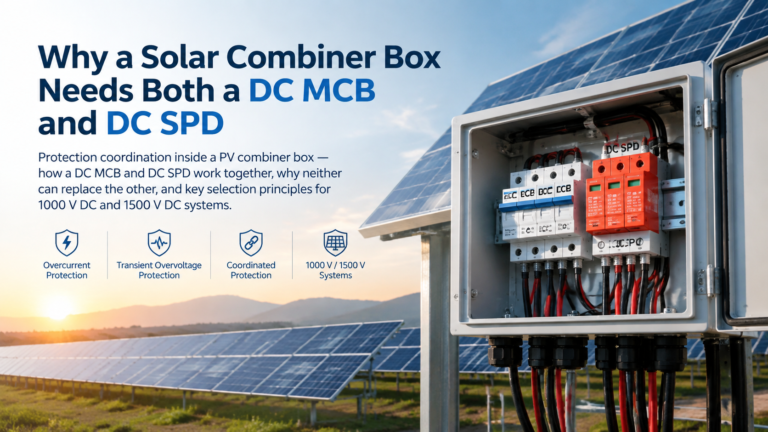
Why a solar combiner box needs both a DC MCB and a DC SPD: the division of labour between overcurrent and transient overvoltage protection, why neither device can substitute for the other, how they coordinate on the DC bus including the SPD backup protection requirement, and how the pairing changes between 1000 V DC and 1500 V DC systems.