DC Fuse vs DC Circuit Breaker for Solar PV Systems
Yayın tarihi: Yazar: Rachel
On the AC side of a solar installation, choosing between a fuse and a breaker is largely a question of cost and convenience. On the DC side it is a different engineering problem. A PV array has no natural current zero, its fault current is capped by the modules themselves, and the string stays live whenever daylight reaches it. That combination changes which device wins — and at which position in the circuit.
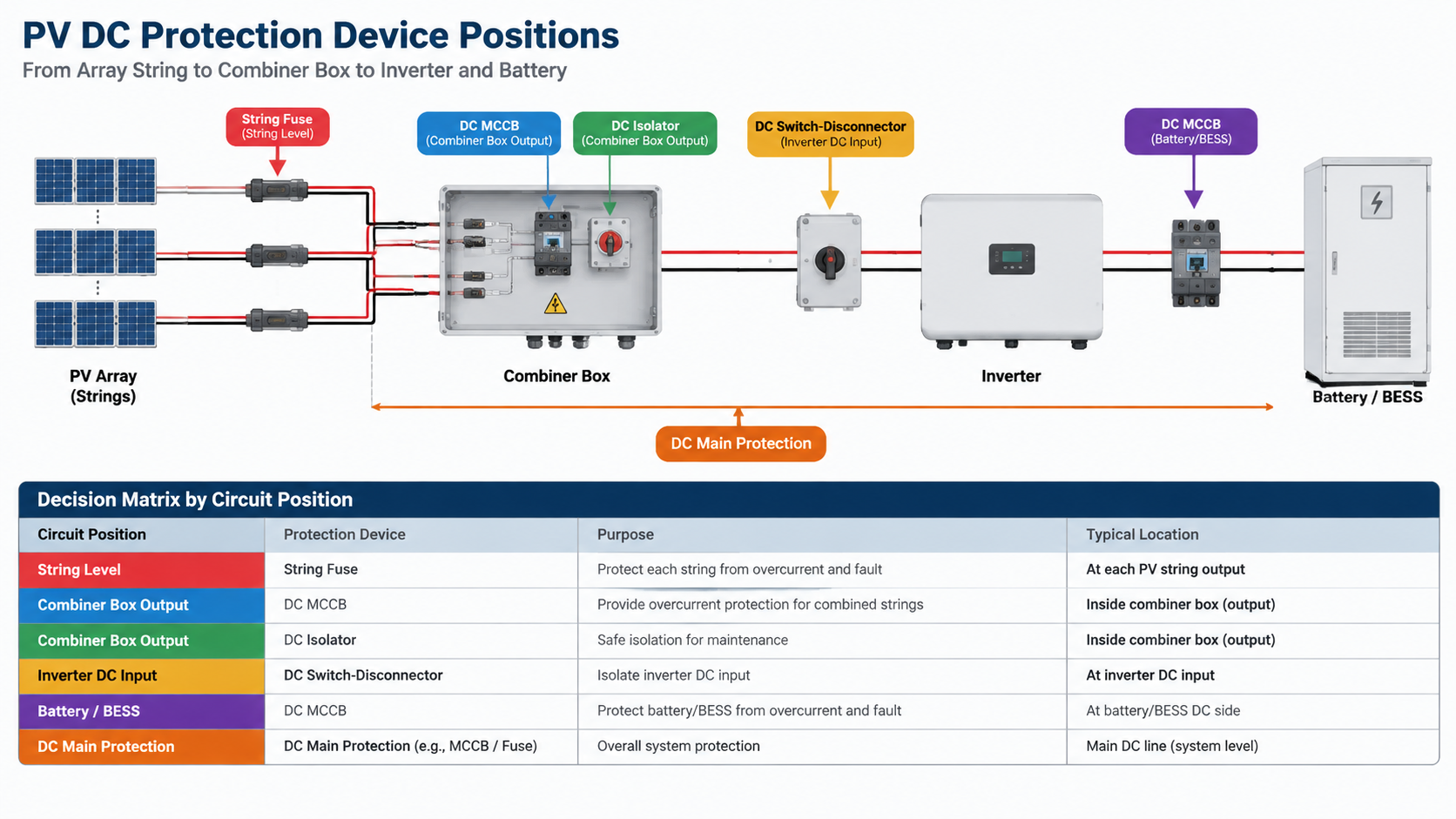
This article compares the DC fuse vs DC circuit breaker decision as it actually plays out inside PV systems: how each device extinguishes a DC arc, where each wins on operating speed, energy let-through, selectivity, reset and maintenance, and which device belongs at string level, combiner box output, inverter DC input, battery/BESS and the DC main.
It assumes you already know what a fuse is and what a circuit breaker is. If you want that ground-level comparison instead, it is covered in fuse vs circuit breaker: key differences and when to use each. That material does not address DC behaviour, which is the whole subject here.
Why a DC arc is harder to extinguish than an AC arc
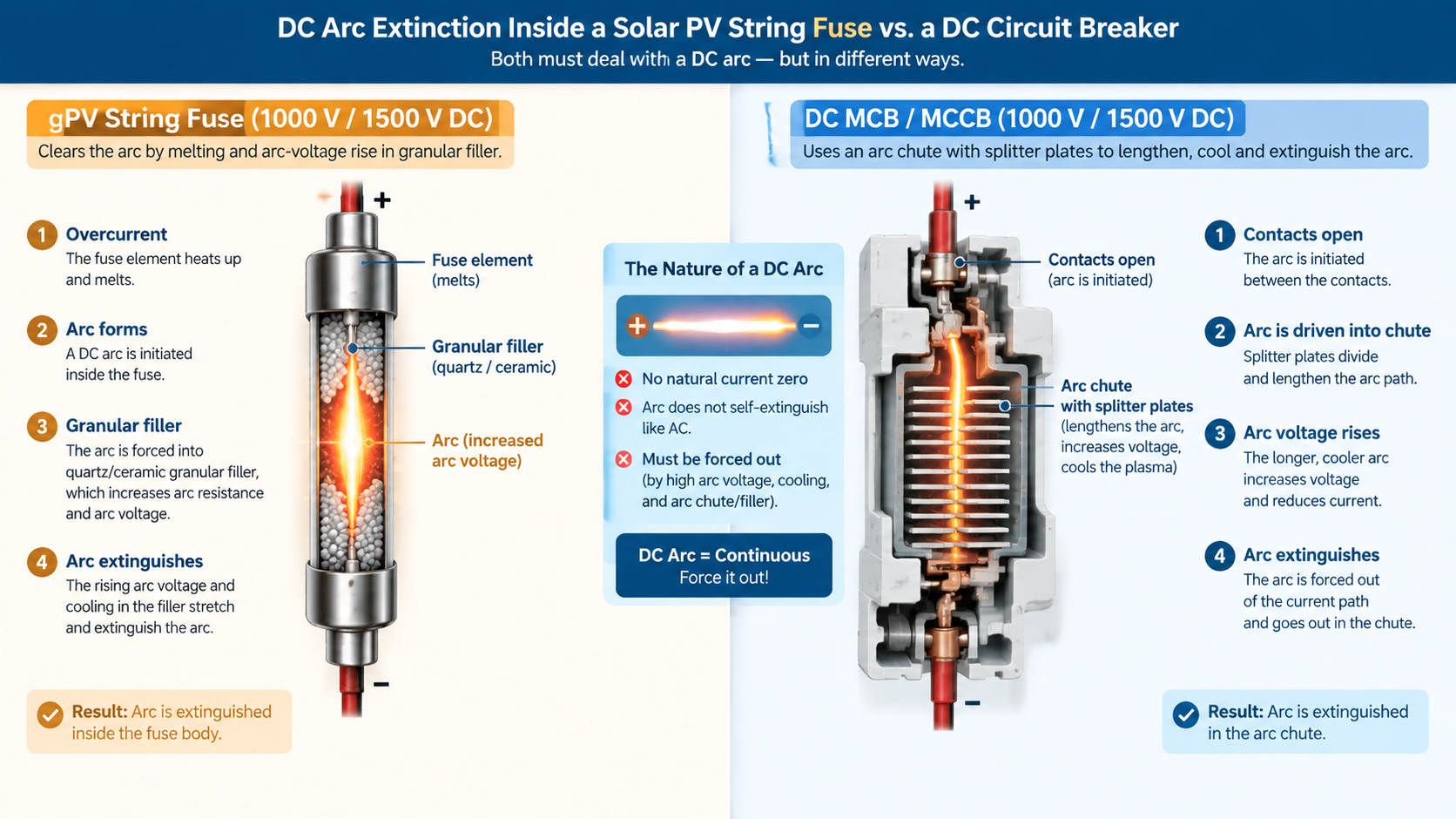
On AC, current passes through zero 100 or 120 times a second. At every zero crossing the arc momentarily loses its energy source, and the device only has to stop it re-striking. On DC the current is unidirectional and continuous: the arc keeps drawing energy from the array, and it will not go out on its own. To clear it, the device has to raise the arc voltage above the system voltage and force the current to zero artificially.
Three consequences follow for PV work:
The DC voltage rating is a hard limit. A device rated 1000 V DC is not a 1500 V DC device. The arc voltage a given construction can develop is fixed.
Series poles raise capability, but only as tested. Many DC breakers reach a higher DC voltage rating by connecting two or more poles in series. Where that is permitted, the datasheet states the rating for that exact pole configuration.
Loop inductance lengthens the arc. That is why a DC interrupting rating is quoted together with a circuit time constant (L/R): the same device behaves differently in two circuits with different time constants.
The PV array is a current-limited source
A PV module behaves close to a constant-current source. A bolted short circuit on a string produces roughly Isc — typically only a few percent above the current at maximum power. There is no multi-kiloampere transient as there would be on a transformer-fed AC system. Two things follow:
A fault may not produce enough current to operate anything quickly. A high-resistance fault — a corroded connector, water in a junction, a partially damaged module — can sit at a current barely above normal operating current. Neither a fuse element nor a magnetic trip responds to that in useful time.
Back-feed, not forward fault current, is the design case at string level. When one string faults, the other parallel strings push current into the fault. With eight parallel strings, the faulted string sees the combined output of the other seven.
Establish the prospective fault current before choosing any device. The sizing method itself is set out in gPV fuse selection for 1000 V and 1500 V strings; this article assumes that number is known and looks only at which device type fits.
Where each device family sits on a PV DC circuit
Both families exist in DC-rated versions:
gPV fuse. A cartridge fuse designed for PV DC duty, in the 10×38, 14×51, 14×85 and similar body sizes, fitted in a holder rated for the same DC voltage and current. It is single-use and current-limiting. As a device class, gPV fuses are designed and tested to IEC 60269-6 and the equivalent North American standard — confirm the claim on the specific datasheet.
DC circuit breaker. A DC MCB on DIN rail at smaller ratings, a DC MCCB at higher currents and up to 1500 V DC in dedicated designs, plus DC switch-disconnectors that isolate but provide no overcurrent protection. Selection is covered in solar circuit breaker selection.
Neither family substitutes for the other by default. The rest of this article is about which one earns its place at each position.
Head-to-head: the six things that decide it
1. Arc extinction and DC interrupting capability
A fuse melts its element, an arc forms inside granular filler — usually silica sand — and the filler cools and splits that arc. Arc voltage climbs steeply, current is driven to zero, and the event is over before the first power-frequency half-cycle would have finished. There is no mechanism to fail, which is why a fuse is the more predictable of the two.
A breaker parts its contacts and drives the arc into a chute with splitter plates, or uses a magnetic blowout coil, until the arc voltage exceeds the system voltage. It works extremely well, but it depends on a mechanism, which is why breakers carry a mechanical endurance rating.
For both, read the DC interrupting rating at the actual system voltage and circuit time constant. A device described as “500 V DC per pole” with two poles in series is not automatically a 1000 V DC device — the datasheet has to say so for that configuration.
2. Operating speed and energy let-through
At high prospective fault current, a current-limiting fuse responds in a fraction of a half-cycle and caps the peak let-through current and the I²t that everything downstream has to survive. This matters more in PV than in most DC applications, because the weakest links are the ones you are trying to save: module connectors, thin string cable, and the internal ribbons of the faulted module.
A breaker has a mechanical opening time before the arc even begins, so at high fault current it typically lets more energy through than a fuse of comparable rating.
At low overload — around 1.5 times rated current — the comparison often reverses, because a fuse element can be slower there than a breaker’s thermal element. Do not generalise from either case. The shape of the two time-current curves, read at the real internal enclosure temperature, decides it for a specific pair of catalogue numbers.
3. Selectivity and coordination
Selectivity means the device closest to a fault operates and nothing upstream does. In a combiner box feeding a DC main, you want a string fault to take out one circuit, not the array.
Fuse to fuse: selectivity is achieved through a current ratio between the two elements, confirmed from the manufacturer’s selectivity tables.
Breaker to breaker: adjustable trip settings let selectivity be tuned, which is a genuine advantage on a DC main.
Mixed pairs: fuse upstream of breaker, or breaker upstream of fuse, is common and perfectly valid — but the coordination must come from published tables. It cannot be inferred from current ratings.
There is a DC-specific trap here. Because array fault current is limited, a downstream device may never reach the current needed for fast operation, so the upstream device clears the fault — or nothing clears it at all. Coordination has to be checked against the real prospective fault current at each point, not a nominal figure.
4. Reset, isolation and remote operation
This is where a breaker is often the only practical answer.
A fuse is single-use. Once it operates it must be replaced with an identical device, which means holding spares of the correct class, rating, body size and DC voltage rating. On a remote plant, that is a truck roll every time.
A breaker can be reset, and if it is rated for isolation it can serve as the local means of disconnection for maintenance. Motor-operated and shunt-trip versions can be opened remotely, and auxiliary contacts can report status to a monitoring system.
For a BESS or a large central-inverter plant, remote trip and status feedback are usually mandatory, and a fuse cannot provide either.
5. Cost and total cost of ownership
A gPV fuse plus a matched holder is cheaper per circuit than a DC breaker of the same rating. At string level, where there may be dozens of circuits and no switching function is needed, that advantage compounds.
It narrows once consumables and labour are counted. A breaker costs more up front and needs no spares, but has a mechanical life and needs periodic operating checks. Which is cheaper over twenty years depends mostly on how often the device operates — and if it operates often, the cost driver is the fault, not the device.
6. Failure signature and diagnosis
A blown fuse is a clear, one-way record that a fault occurred, and it identifies the circuit. You cannot overlook it, and you cannot put it back without thinking about why it went.
A tripped breaker is resettable, which is convenient and also a risk: it is easy to reset and walk away. A breaker that trips repeatedly is reporting a condition, and the correct response is to measure, not to keep closing it. A trip can also be thermal — overload, loose terminal, high ambient inside the enclosure — or magnetic, meaning a short circuit. Those two have different causes and different fixes.
Decision matrix by circuit position
The position in the system decides the device far more than any general preference does. Use the table below as a starting point for the conversation with your supplier, then verify every line against the datasheet.
Circuit position
Usual solution
Why
What to verify
String level (module to combiner box)
gPV string fuse in a matched holder
Back-feed from parallel strings is the design fault; current limiting protects connectors and string cable
Maximum series fuse rating on the module datasheet; DC voltage rating; ambient derating
Combiner box output (box DC main)
DC MCCB, or a fuse, plus a means of isolation
Higher current, and the position normally needs isolation and often status signalling
Prospective fault current against the instantaneous trip threshold; selectivity with the string fuses
Inverter DC input
DC switch-disconnector, plus whatever the inverter manufacturer specifies
The requirement here is isolation for maintenance, not fault clearing
The inverter manual — do not substitute a different device type or rating
Battery and BESS DC
DC MCCB with adequate DC breaking capacity; DC fuse where energy let-through has to be limited
A battery is not a current-limited source and can deliver very high fault current
Breaking capacity at the actual DC voltage; circuit time constant; energy let-through
DC main or main DC distribution
DC MCCB with adjustable settings and remote shunt trip, or a large DC fuse
Selectivity with everything downstream, plus remote operation
Coordination study; arc-flash and PPE assessment for the position
Scenario-based recommendations
Small rooftop, one or two strings per MPPT
With a single string per MPPT there is no parallel string to back-feed into a fault, so the case for string fusing weakens considerably. Whether any string protection is required at all depends on the string count and on the local code, and the module’s maximum series fuse rating is the ceiling for whatever is installed there. What matters most is that any device used is genuinely DC-rated at the string’s worst-case voltage and that its tripping threshold sits below the current the array can actually deliver — a device that cannot be operated by the available fault current protects nothing.
Commercial rooftop with distributed combiner boxes
String fuses plus a combiner output breaker is the standard pattern, and the combiner box is where the two device types meet and must be coordinated. String count, box rating and output device all follow from the array layout; that calculation is set out in PV combiner box sizing. Keep one fuse class and rating per box, label every circuit, and record which device protects which string so the next person on site does not have to guess.
Utility-scale plant with central inverters
String fuses perform the fast, current-limiting work at the point of the fault. DC MCCBs on the main DC bus provide switching, isolation, adjustable selectivity and remote trip. Neither is redundant: they work on different time scales, and a string fuse backed by a DC MCCB is not a compromise but each device doing what it is best at.
Battery and BESS DC circuits
This is the one position where the fuse-versus-breaker answer genuinely changes, because a battery is not a current-limited source. Prospective fault current can be high, stored energy is large, and the circuit time constant may be longer than in a PV array. A DC MCCB with breaking capacity adequate for the system voltage is the usual answer where switching and remote operation are needed; DC fuses are used where energy let-through has to be limited. Frame and rating selection is covered in the DC MCCB guide for solar and battery systems up to 1500 V.
In all of these cases the design question is never simply “which one” — it is “which function does this position need”.
A short selection procedure
Fix the circuit position: string, combiner output, inverter input, battery, or DC main.
Establish the continuous design current and the prospective fault current — back-feed from parallel strings, which is module-limited, or battery fault current, which is not.
Confirm the DC voltage rating covers the worst-case string voltage, using the cold-temperature open-circuit voltage from the module datasheet rather than the nameplate value.
Use the module datasheet’s maximum series fuse rating as the ceiling for any string protection.
Verify interrupting or breaking capacity at that DC voltage and at the circuit time constant the manufacturer specifies.
Verify coordination with the device immediately upstream and downstream from the manufacturer’s tables.
Apply derating for the real internal enclosure temperature, and for altitude if the site is high.
Decide whether the position needs a switching, isolation or status function. If it does, a fuse alone cannot deliver it.
At every step, read the datasheet for the exact catalogue number you intend to buy. A summary that says “1000 V DC” without stating the pole configuration, the time constant and the interrupting rating is not enough to specify from.
Common mistakes
Fitting an AC-rated device on a DC circuit. An AC device relies on the zero crossing to help it clear. The general difference between the two device types is explained in the difference between a fuse and a circuit breaker, but the DC rating is a separate specification and has to be read off the datasheet for the voltage and circuit conditions you actually have.
Assuming a breaker’s magnetic trip will operate on a string fault. If the array cannot deliver the current the instantaneous element needs, it will not trip on a short circuit in the time you expect.
Exceeding the module’s maximum series fuse rating to stop a fuse blowing. That figure is a limit set by the module manufacturer, and a larger fuse stops protecting the module.
Ignoring series-pole requirements. A DC breaker’s voltage rating applies to the pole configuration the manufacturer tested, not to any configuration the installer can build.
Ignoring enclosure temperature. A device derated for 60 °C internal air is a different device on paper and in service.
Replacing a fuse or resetting a breaker without diagnosing why it operated. Repeated operation is a symptom, not an inconvenience.
Safety before you touch either device
A PV array is a live source whenever daylight falls on it, and it cannot be switched off at the source. Before any work on DC circuits: isolate where a means of isolation exists, verify dead with an instrument you have proven on a known live source, wear the PPE the task assessment requires, and use insulated tools. Do not open a DC circuit under load unless the device is specifically rated to do so, because a DC arc does not self-extinguish. Work to the local code and the project specification, and never bypass a protective device to keep a string in service.
Sık Sorulan Sorular
Is a DC fuse better than a DC circuit breaker for a solar string?
At most string-level positions a gPV fuse is the usual choice: it is current-limiting, cheap per circuit, and no switching function is needed there. A DC breaker becomes the better answer when you need reset, isolation, status signalling or remote operation. Neither is universally better — the position decides.
Can I use a DC MCB instead of a string fuse?
Only if it is genuinely DC-rated at the system’s worst-case voltage, permitted in that position, and its instantaneous trip threshold is below the current the array can actually deliver. Many DIN-rail DC MCBs reach their DC rating only in a specific pole configuration and at a specific voltage. Check the datasheet and the module manufacturer’s requirements before substituting.
Why does my DC breaker not trip when a string faults?
Two common reasons. The array’s fault current is limited to around Isc, which may fall below the breaker’s instantaneous trip threshold; and a high-resistance fault draws barely more than normal operating current, so neither the thermal nor the magnetic element responds quickly. This is a device selection and coordination issue, not a reason to oversize or bypass anything.
Does the string fuse protect the inverter?
No. A string fuse protects the string cable, the connectors and the modules against back-feed current. The inverter’s DC input has its own protection, specified by the inverter manufacturer. Both have to be present and coordinated.
Which is cheaper over the life of the plant?
A fuse and holder is cheaper to install at string level, and the number of circuits makes that difference add up. A breaker costs more up front but has no consumable and no spares inventory. Where a device is expected to operate often, the deciding cost is not the device at all — it is the fault that keeps operating it.
Sonuç
The DC fuse vs DC circuit breaker decision in solar PV comes down to the function each position needs, not to a general preference for one device. Where the job is to limit energy into a fault quickly and cheaply across many parallel circuits, a gPV fuse earns its place. Where the job is switching, isolation, adjustable selectivity or remote operation, a DC breaker does. Where both functions are required — which is most DC mains and battery circuits — both devices belong, and the engineering effort goes into coordinating them against the real prospective fault current and the real DC voltage.
Browse the DC and gPV fuse range for string-level devices, and match the holder, the DC voltage rating and the interrupting rating to the string you actually have rather than to the one on the nameplate.
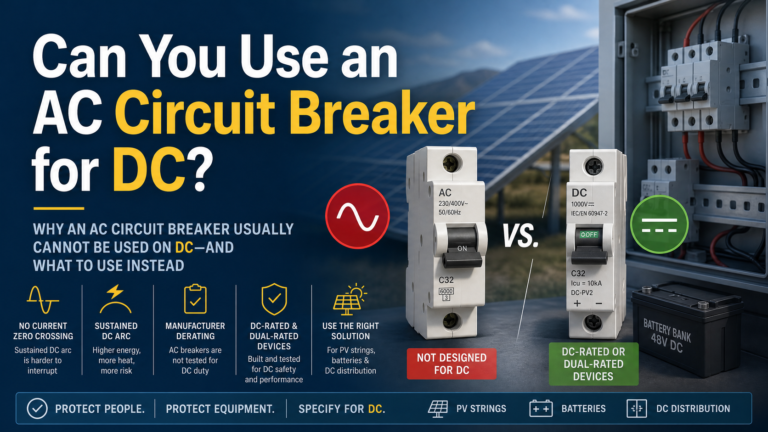
Can an AC circuit breaker be used for DC? Usually no. Unless that specific device carries a declared DC rating — or a dual rating — at your system voltage, an AC-only breaker can fail to open, weld its contacts or destroy itself, because DC has no natural current zero to extinguish the arc. That […]
A blowing solar fuse is either a real fault being cleared or nuisance operation. Learn how to tell the two apart, the causes behind each, the measurements that confirm them, and why replacing the fuse without diagnosing is the wrong response.
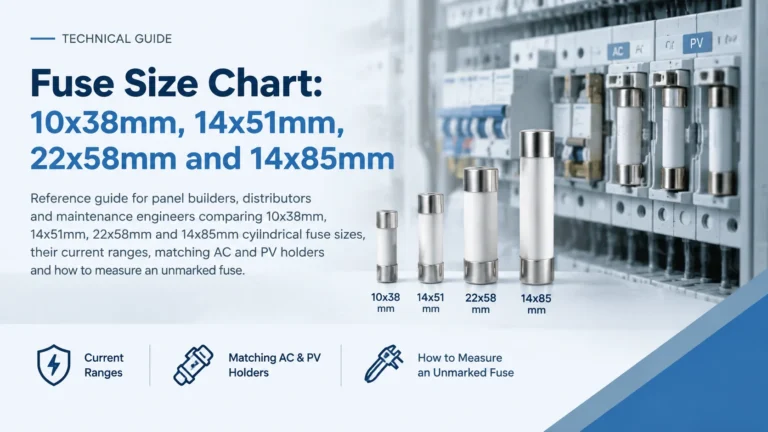
A fuse size chart for 10x38, 14x51, 22x58 and 14x85mm fuses: dimensions, current ranges, matching AC and PV holders, and how to measure an unmarked fuse.