Can an AC circuit breaker be used for DC? Usually no. Unless that specific device carries a declared DC rating — or a dual rating — at your system voltage, an AC-only breaker can fail to open, weld its contacts or destroy itself, because DC has no natural current zero to extinguish the arc.
That is the whole answer for most installations. The reasoning is worth knowing, because it explains why a device that looks identical on the DIN rail behaves completely differently once the current stops alternating — and what to check before buying a replacement.
This stays narrow. For the broader AC-versus-DC device comparison and for PV selection, the PV circuit breaker ve solar circuit breaker guides cover that ground. The question here is only whether an AC breaker can do a DC job.
How an AC Breaker Clears an Arc
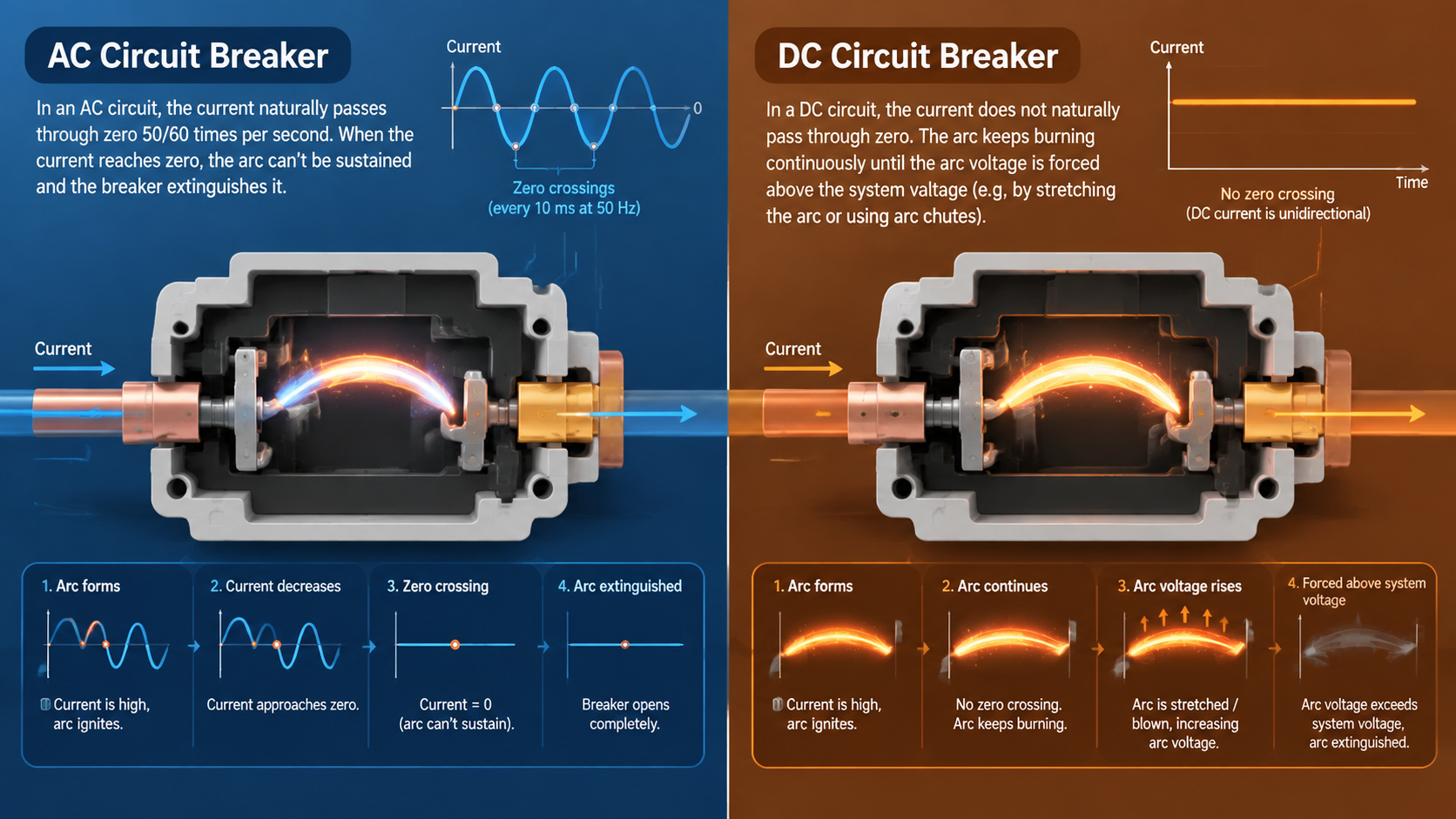
Part the contacts under load and the current does not stop instantly. The voltage across the widening gap ionises the air and an arc forms — a channel of plasma carrying the fault current. An AC breaker attacks it with a stretched arc path, splitter plates in an arc chute, and a vent for the hot ionised gas.
But the decisive event is not in the breaker. Alternating current passes through zero 100 times a second at 50 Hz, 120 times at 60 Hz. At each of those instants the arc receives no energy: it cools, the plasma loses conductivity, and the voltage across the gap cannot restrike it. An AC breaker is designed around an assumption that the supply itself will keep bringing the current back to zero.
Why a DC Arc Refuses to Go Out
Direct current never reverses, so it never reaches zero on its own. The arc simply continues: current keeps flowing through the same ionised channel, the channel keeps being replenished, and the gap keeps conducting. Nothing has taken the energy away.
To extinguish a DC arc you must force the current to zero — by raising the arc voltage above the system voltage, cooling the plasma below ionisation temperature, or physically stretching and splitting the arc until it cannot sustain itself. That is why DC devices look different inside: longer contact gaps, different arc chutes, magnetic blowout to drive the arc into a splitter stack, and often a sealed arc chamber. Where an AC device may clear in a fraction of a half cycle, DC interruption is a genuinely harder problem.
Note also that an arc needs very little voltage to sustain — arc welding runs at a few tens of volts. “It is only 24 volts” is not a safety argument.
What Happens in Practice
The failure is not always dramatic, which is what makes it dangerous. An AC-only breaker in DC service can appear to work for months, then behave in one of several ways on the day it matters.
What you observe
What is happening
Consequence
Handle moves to OFF but current continues
The arc restrikes across the parting contacts; the gap never de-ionises
The circuit is not isolated, and someone may treat the open breaker as isolation
Contacts weld shut
Arc heat melts and fuses the contact faces
The device can no longer open; an upstream device must clear every future fault
Cracked case, soot, ruptured arc chute
Arc energy released inside a chamber built for a half-cycle event
The device is destroyed; enclosure and adjacent devices may be damaged
Works one day, fails the next
Whether the arc dies depends on current, contact speed and magnetic field
A past success is not evidence of a defined DC breaking capacity
One misunderstanding deserves its own paragraph. Tripping and breaking are two different functions. The sensing element responds to current, and DC current heats a bimetallic strip or drives a magnetic plunger just as AC does — so an AC-only breaker may well trip on a DC fault. The problem is what happens next. A breaker that trips but cannot break the arc has removed the operator’s warning that something is wrong while leaving the energy in place.
The Derating Question
Where a breaker has been evaluated for DC, its datasheet will show a DC rating: typically a maximum DC voltage lower than the AC figure on the front face, often stated separately for each pole configuration. That reduction is real, and it is usually described as derating.
What is not real is a universal derating factor. There is no single number that applies across brands, no ratio that holds between device families, and no rule of thumb that converts a 240 V AC marking into a safe DC figure. Two breakers with identical AC markings may have entirely different DC capabilities, or none at all — it depends on contact geometry, arc chute design, magnetic blowout and how the device was actually tested.
So the rule is: read the DC rating from the datasheet of the exact device you are installing, at your system voltage and fault current, and treat a blank as a no. If there is no DC rating table, the device has no DC rating for your purpose. That is an answer, not a gap to be filled by calculation. Never extrapolate one brand’s table to another brand’s product, and treat the front-face marking as the AC rating only.
DC-Rated, Dual-Rated and Polarised Devices
AC-only. Tested for alternating current only. No DC rating exists, whatever the terminals look like.
DC-rated. Carries a declared DC voltage and breaking capacity under stated conditions — usually the pole arrangement, the current, and for higher-voltage DC a circuit time constant, because circuit inductance affects how hard the arc is to extinguish.
Dual-rated. Declared for both, each with its own limits. The DC figures are normally lower than the AC figures, not equal to them.
Polarised DC devices. Designed for one current direction, with terminals marked for line and load. Reversing them is a genuine failure mode. Never assume a DC breaker is non-polarised; check the marking.
You will hear that connecting two or three poles in series raises DC voltage capability, because the arc is split across several gaps and the total arc voltage rises. The principle is sound. The practice is not a field technique.
Series connection is a manufacturer-defined configuration. It is valid only where the datasheet or installation instructions state the DC voltage for that specific pole arrangement and show the wiring that achieves it, including polarity at each terminal. Some manufacturers publish such tables; others publish nothing, and a device acquires no rating because someone fitted a link. Improvised jumpers alter clearances, can defeat the arc chutes and create an untested configuration. If the datasheet does not describe it, do not do it.
What to Use Instead
Başvuru
What belongs there
Why
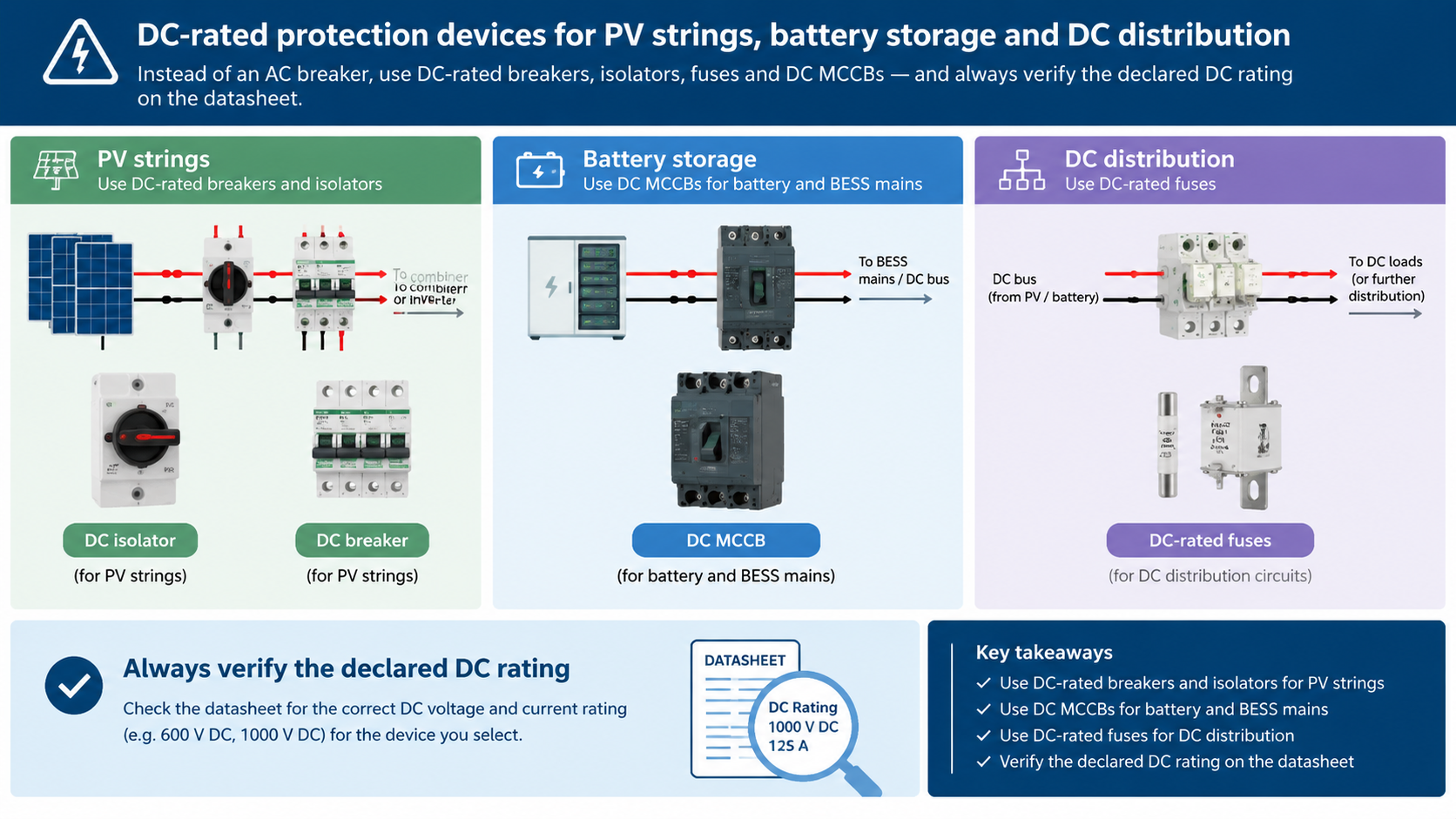
PV string and array DC
Breakers or isolators declared for the string voltage (1000 V or 1500 V DC), or gPV fuses in matched holders
The circuit is DC, live in daylight, and must be broken safely under load at full string voltage
Battery and BESS main DC
DC MCCBs declared for the battery voltage and prospective fault current, or a DC fuse with a rated switch-disconnector
Fault current is high and the circuit is inductive, so arc extinction is demanding
DC distribution and control panels
Devices with a declared DC rating at that voltage, plus DC-rated fuses
Low voltage reduces but does not remove the arc problem
AC side of the inverter, distribution boards, mains
Standard AC breakers, as designed
The circuit is alternating current; device and installation standard already fit it
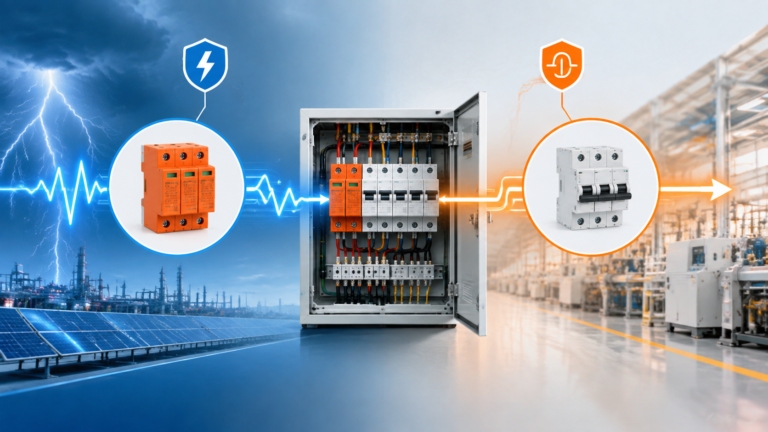
For fuse-based DC protection the same logic applies; the differences in device behaviour are set out in AC ve DC sigortaları. Surge protection is a separate device class with its own reasoning, covered in DC vs AC surge protection.
Safety Note
Isolate, verify dead with a tester you have proved before and after use, apply PPE, and work to a method statement. PV arrays generate whenever there is light, so the array side of any isolator stays live in daylight — never work on energised PV strings. And never open a DC circuit on load with a device not rated to break it: a device that cannot extinguish its arc turns routine switching into an arc flash event.
Standards Context, at a High Level
Product standards follow the same split as the hardware. Miniature circuit breakers for household and similar installations are commonly designed to IEC 60898-1, which addresses AC operation, with IEC 60898-2 covering breakers intended for AC and DC operation. Industrial breakers are generally designed to IEC 60947-2, which includes DC ratings where the manufacturer declares them; switch-disconnectors fall under IEC 60947-3, which provides DC utilisation categories, including those used for photovoltaic applications. In North America, UL 489 and UL 1077 apply to different device classes, and a device may hold one and not the other.
The consequence for a buyer is not which standard number appears on the box. It is that DC capability is a declared rating for a specific device under specific conditions — not something you can infer from the AC rating, the size of the breaker or the brand. Ask for the DC rating table and its conditions, and check it against your system voltage, your prospective fault current and your local code.
Checking a Breaker for DC Before You Install It
Voltage. What maximum DC voltage is declared, for the pole configuration you intend to use?
Current. What DC breaking capacity is declared at that voltage? This concerns fault current, not the nominal rating on the handle.
Conditions. Does the rating assume a maximum circuit time constant, ambient temperature or altitude that your installation meets?
Kutupluluk. Is the device polarised? If so, is the wiring correct at every terminal for your current direction?
Evidence. Which standard is claimed, and will the supplier provide the test report or declaration of conformity? If any answer is missing, the answer for that device is no.
Sık Sorulan Sorular
Can I use an AC breaker on a 24 V DC circuit?
Only if that device carries a declared DC rating at 24 V. Low voltage makes arc extinction easier, but not free or automatic, and an undeclared device gives you no defined breaking capacity. DC-rated devices for control and instrument circuits are widely available, so there is little reason to accept the uncertainty.
My AC breaker trips on DC — isn’t that working?
No. Tripping is not breaking. The sensing element responds to current in either case, so a DC fault can operate an AC device, but the device may still be unable to interrupt the arc and isolate the circuit. It looks as though it has done its job while leaving the fault energy in place.
Can I connect two poles in series for a higher DC rating?
Only where the manufacturer documents that configuration and states the DC voltage and wiring for it. Field-fitted links on a device with no published series rating create an untested configuration and can defeat the arc chutes.
What is the difference between a DC breaker and an AC breaker?
Mainly arc-extinction design and declared ratings. DC devices use longer gaps, different arc chutes and often magnetic blowout to force the current to zero, and their datasheets carry DC voltage, breaking capacity and circuit-condition limits. The wider comparison, including PV and battery applications, is in our PV circuit breaker ve solar circuit breaker guides.
Does a dual-rated breaker work for both AC and DC?
Yes, but at the ratings declared for each, and the DC limits are normally lower than the AC limits. A dual rating is not a licence to use the AC figure on a DC circuit — read the DC column, at your voltage, with the stated conditions.
The safe position is simple: buy the device that declares a DC rating at your system voltage, keep the datasheet with the installation record, and never substitute an AC breaker because it fits the rail. If you are specifying DC breakers, DC isolators or PV fuses and want the DC ratings and conditions documented up front, send us the system voltage, the string or battery configuration and the prospective fault current, and we will tell you which devices carry a declared DC rating for it.
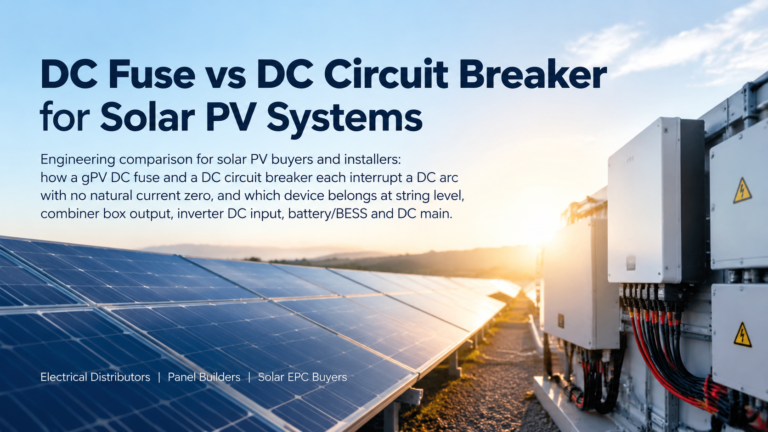
A DC-specific comparison of fuses and circuit breakers in solar PV systems: arc extinction without a current zero, operating speed, energy let-through, selectivity, reset and maintenance, with a decision matrix for string, combiner box, inverter DC input, battery/BESS and DC main positions.
Aşırı gerilim tutucular geçici aşırı gerilimleri sınırlar; devre kesiciler ise aşırı yükleri ve kısa devreleri ortadan kaldırır. İşlevlerini, uygulama alanlarını ve koordinasyonlarını karşılaştırın.
Learn how to choose the right solar circuit breaker for PV systems, including DC MCB, DC MCCB, voltage rating, current rating, poles, breaking capacity, and installation points.