When selecting a DC surge protection device for a solar PV system, one common question is whether to use a 1000V DC SPD or a 1500V DC SPD. At first glance, the answer may seem simple: match the SPD voltage rating to the system voltage. In real projects, however, the decision also depends on PV string voltage, inverter input rating, open-circuit voltage under cold conditions, installation position, system scale, and local electrical requirements.
In most cases, a 1000V DC SPD is used for residential, small commercial, and older PV systems designed around 1000V DC architecture. A 1500V DC SPD is used for modern commercial, industrial, and utility-scale PV systems where longer strings and higher DC bus voltages are required.
Choosing the wrong voltage rating can reduce protection performance, shorten SPD service life, or create safety risks. This guide explains the key differences between 1000V and 1500V DC SPDs and helps you choose the right option for your solar PV application.
What Is a DC SPD?
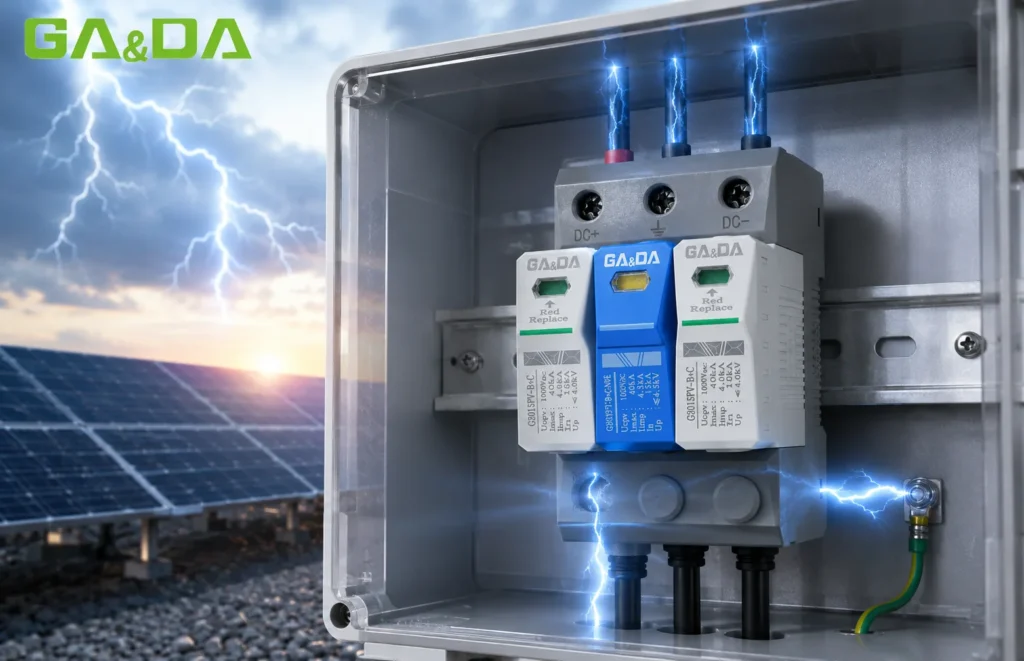
A DC SPD, or DC surge protection device, is designed to protect DC circuits against transient overvoltage caused by lightning, grid switching, inductive coupling, or other surge events. In solar PV systems, DC SPDs are usually installed on the DC side of the system, such as:
Unlike AC systems, DC circuits do not have a natural current zero crossing. This makes arc extinction more difficult. For this reason, a DC SPD must be specifically designed and rated for DC use. An AC SPD should not be used as a substitute for a DC SPD in photovoltaic systems.
What Does 1000V or 1500V Mean in a DC SPD?
The 1000V or 1500V rating usually refers to the maximum continuous operating voltage range that the SPD can withstand in a DC circuit. In PV applications, this value must be selected according to the maximum possible voltage of the solar array, not only the nominal operating voltage.
Solar PV voltage changes with temperature. When the ambient temperature drops, the open-circuit voltage of PV modules increases. This means a PV string that appears safe under standard test conditions may reach a much higher voltage in cold weather.
Because of this, the selected DC SPD must have a voltage rating suitable for the highest expected PV string voltage under actual operating conditions.
1000V DC SPD: Typical Applications
A 1000V DC SPD is commonly used in PV systems with a maximum DC voltage up to 1000V. This is still a common design in many residential, commercial, and distributed solar projects.
For many distributed PV projects, 1000V DC architecture is cost-effective, easier to design, and widely supported by inverters, breakers, fuses, disconnect switches, and combiner box components.
A 1000V DC SPD is usually the right choice when the inverter, combiner box, fuse holder, DC breaker, and cable insulation are all designed for 1000V DC systems.
1500V DC SPD: Typical Applications
A 1500V DC SPD is used in high-voltage PV systems where the DC side can reach up to 1500V. This design has become common in large commercial, industrial, and utility-scale solar projects.
Typical applications include:
Utility-scale solar farms
Large commercial rooftop PV systems
Ground-mounted solar plants
High-power string inverter systems
Central inverter PV stations
1500V PV combiner boxes
Large battery energy storage systems using high-voltage DC architecture
The main advantage of a 1500V system is that it allows longer PV strings. Longer strings can reduce the number of strings, cables, combiner boxes, and installation work. For large-scale projects, this can help reduce balance-of-system cost and improve overall project efficiency.
However, 1500V systems require all related DC components to be rated accordingly, including SPDs, fuses, circuit breakers, disconnect switches, connectors, cables, and insulation systems.
1000V vs 1500V DC SPD: Key Differences
The most important difference between a 1000V and 1500V DC SPD is not only the number printed on the product label. It affects system compatibility, safety margin, insulation coordination, and installation planning.
Comparison Item
1000V DC SPD
1500V DC SPD
Typical system type
Residential, commercial, distributed PV
Commercial, industrial, utility-scale PV
PV string length
Shorter strings
Longer strings
Common installation
Small combiner boxes, inverter DC input
Large combiner boxes, solar farms, high-voltage inverters
System voltage
Up to 1000V DC
Up to 1500V DC
Component requirements
1000V-rated DC components
1500V-rated DC components
Project scale
Small to medium
Medium to large
Cost level
Usually lower
Usually higher
Safety requirement
Standard PV DC protection
Higher insulation and coordination requirements
In simple terms, a 1000V DC SPD is suitable for standard PV systems up to 1000V. A 1500V DC SPD is necessary when the PV system is designed for high-voltage operation up to 1500V.
Can You Use a 1500V DC SPD in a 1000V System?
Technically, a higher voltage-rated SPD may survive in a lower voltage system, but that does not automatically mean it is the best choice. Surge protection is not only about withstanding voltage. It is also about limiting transient overvoltage to a level that the protected equipment can tolerate.
If the voltage rating of the SPD is much higher than required, the protection level may also be higher. This means the SPD may allow a higher residual voltage to pass before it fully conducts. For sensitive equipment, this can reduce the effectiveness of protection.
For a 1000V PV system, a properly selected 1000V DC SPD is usually a better choice than simply choosing a 1500V model. The SPD should match the system voltage, inverter insulation level, and protection coordination requirements.
Can You Use a 1000V DC SPD in a 1500V System?
No. A 1000V DC SPD should not be used in a 1500V PV system.
If the system voltage exceeds the SPD’s rated continuous operating voltage, the SPD may be overstressed during normal operation. This can cause overheating, premature aging, thermal disconnection, or failure. In severe cases, it may create safety risks inside the combiner box or inverter cabinet.
For any PV system designed around 1500V DC architecture, a 1500V DC SPD should be selected together with other 1500V-rated DC components.
How to Choose Between 1000V and 1500V DC SPD
To choose the right DC SPD, check the following points before placing an order.
1. Check the Maximum PV System Voltage
Start with the inverter datasheet and PV string design. Identify the maximum DC input voltage of the inverter and the maximum open-circuit voltage of the PV string under the lowest expected ambient temperature.
If the system is designed up to 1000V DC, use a suitable 1000V DC SPD. If the system is designed up to 1500V DC, use a suitable 1500V DC SPD.
Do not select the SPD only based on the nominal working voltage. Always consider the maximum possible voltage.
2. Match the SPD with the Inverter Rating
The inverter is one of the most valuable devices in a solar PV system. The DC SPD should be selected to protect the inverter input from transient overvoltage.
For a 1000V inverter, choose a DC SPD suitable for 1000V PV systems. For a 1500V inverter, choose a 1500V DC SPD. If the inverter manufacturer provides surge protection recommendations, follow those requirements.
3. Check the Installation Location
A DC SPD may be installed in different positions, and the required type may vary depending on the system design.
Common locations include:
PV combiner box
Inverter DC input
DC distribution cabinet
Battery DC cabinet
Outdoor solar control box
For large PV systems with long cable runs, SPDs may be required at both the combiner box side and inverter side to reduce surge risk along the DC cable path.
4. Choose Type 2 or Type 1+2 DC SPD
For many PV systems, Type 2 DC SPDs are used to protect against induced surges and switching overvoltage. In areas with high lightning exposure, external lightning protection systems, or long outdoor cable runs, Type 1+2 DC SPDs may be required.
As a basic selection rule:
Use Type 2 DC SPD for general PV surge protection.
Use Type 1+2 DC SPD when the system may be exposed to partial lightning current or higher surge energy.
Use coordinated protection when SPDs are installed at multiple levels.
The choice between Type 2 and Type 1+2 should be made together with the voltage rating. For example, a 1500V utility-scale PV system may require a 1500V Type 1+2 DC SPD in the combiner box and coordinated protection near the inverter.
5. Check Discharge Current Ratings
Besides voltage, buyers should also compare discharge current ratings such as nominal discharge current and maximum discharge current. These values indicate how much surge current the SPD can handle under specified test conditions.
For smaller PV systems, standard Type 2 DC SPDs may be sufficient. For large outdoor PV arrays, high lightning-risk areas, or exposed ground-mounted systems, higher discharge capacity may be preferred.
When comparing products, do not select only by price. Check the full specification, including:
Maximum continuous operating voltage
Nominal discharge current
Maximum discharge current
Impulse current for Type 1+2 models
Voltage protection level
Response time
Pole configuration
Remote signaling option
Thermal disconnector
Visual status indicator
Replaceable module design
6. Make Sure All DC Components Match the Same Voltage Level
A 1500V DC SPD alone does not make the whole system suitable for 1500V operation. Every related component must be rated for the system voltage.
For a 1500V PV system, check:
DC SPD
DC fuse
DC fuse holder
DC circuit breaker
DC isolator
PV connectors
Combiner box
Cable insulation
Inverter DC input
Labels and wiring design
Using one lower-rated component in a high-voltage DC system can create a weak point. System safety depends on the complete protection chain, not one device alone.
Common Selection Mistakes
Mistake 1: Choosing the SPD by Price Only
A low-cost SPD may look acceptable in a quotation, but if it has poor internal components, weak thermal protection, or unclear certification, it can fail early in outdoor PV applications. For solar projects, reliability is more important than the lowest unit price.
Mistake 2: Using AC SPD in a DC Circuit
AC and DC SPDs are not interchangeable. DC circuits have different arc behavior and require DC-rated internal design. Always select a DC SPD specifically designed for photovoltaic or DC power applications.
Mistake 3: Ignoring Cold Weather Voltage Rise
PV open-circuit voltage increases in cold weather. If the designer ignores temperature correction, the real string voltage may exceed the expected value. This can cause the wrong SPD voltage rating to be selected.
Mistake 4: Using 1000V SPD in a 1500V System
This is one of the most serious mistakes. A 1000V SPD should not be used where the maximum system voltage can reach 1500V DC.
Mistake 5: No Coordination with Fuse or Breaker
SPDs should be coordinated with upstream or backup protection where required. The fuse or breaker must be suitable for DC use and match the short-circuit characteristics of the system.
Quick Selection Guide
Use this simple guide as a starting point:
Choose a 1000V DC SPD if:
Your inverter maximum DC input voltage is 1000V or lower.
Your PV string design is based on 1000V DC architecture.
The project is residential, commercial rooftop, or small distributed PV.
Your combiner box and DC components are rated for 1000V DC.
Choose a 1500V DC SPD if:
Your inverter maximum DC input voltage is 1500V.
Your PV string voltage can exceed the 1000V range.
The project is a large commercial or utility-scale solar plant.
You are using 1500V DC combiner boxes, fuses, breakers, and cables.
You need longer PV strings and reduced balance-of-system cost.
1000V vs 1500V DC SPD: Which One Is Better?
Neither one is universally better. The right choice depends on the PV system design.
A 1000V DC SPD is better for systems designed around 1000V DC. It provides suitable protection without unnecessary over-rating. A 1500V DC SPD is better for high-voltage PV systems where the DC side is designed to operate up to 1500V.
The key is not to choose the highest voltage rating blindly. The key is to choose the SPD that matches the actual system voltage, inverter rating, protection level, installation environment, and safety requirements.
Why Choose GA&DA DC SPDs for Solar PV Systems?
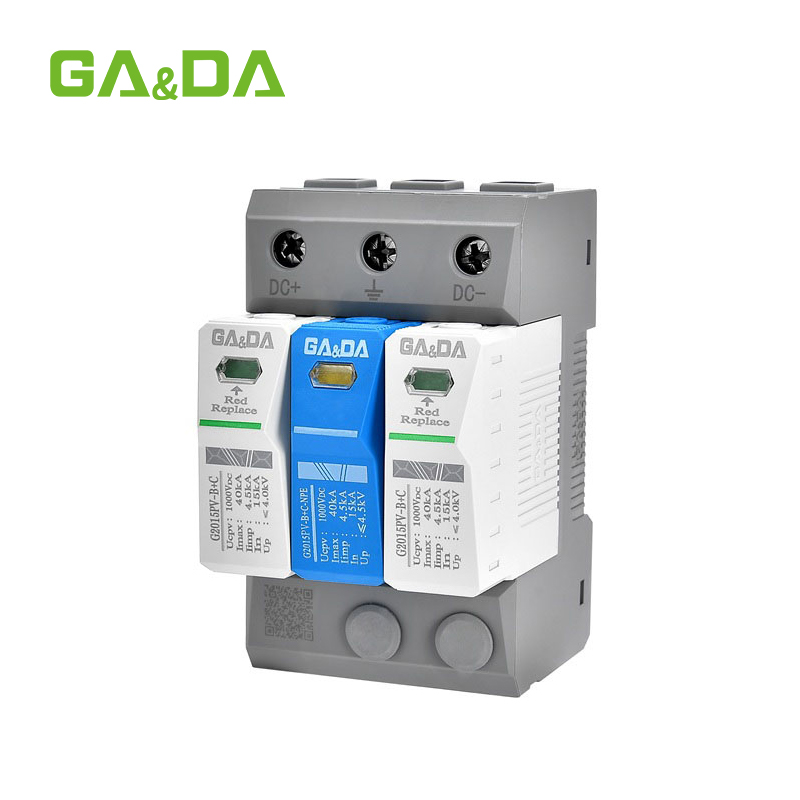
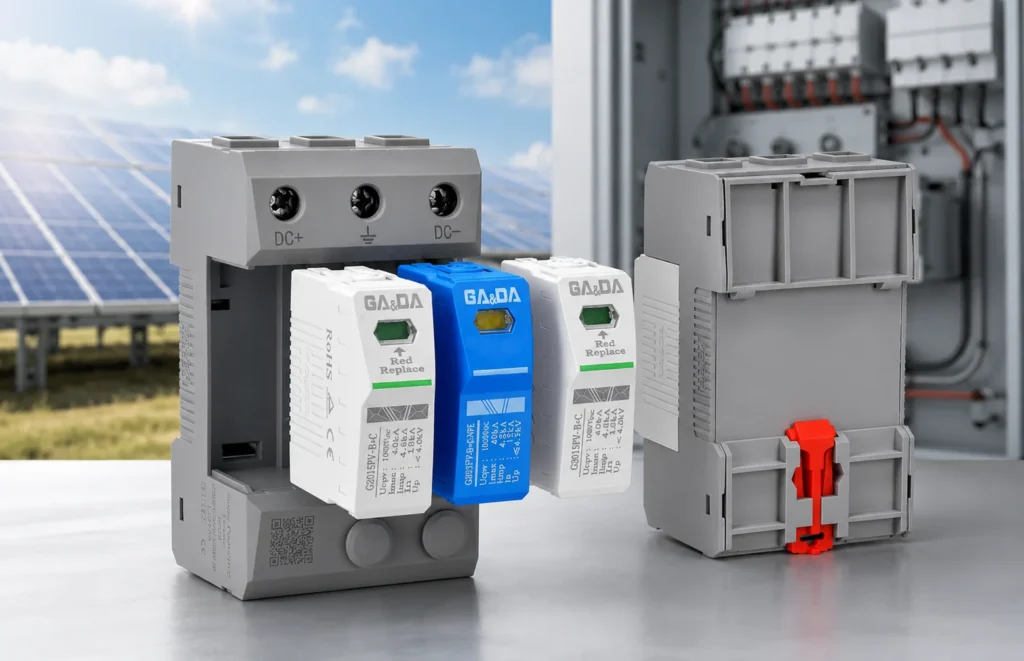
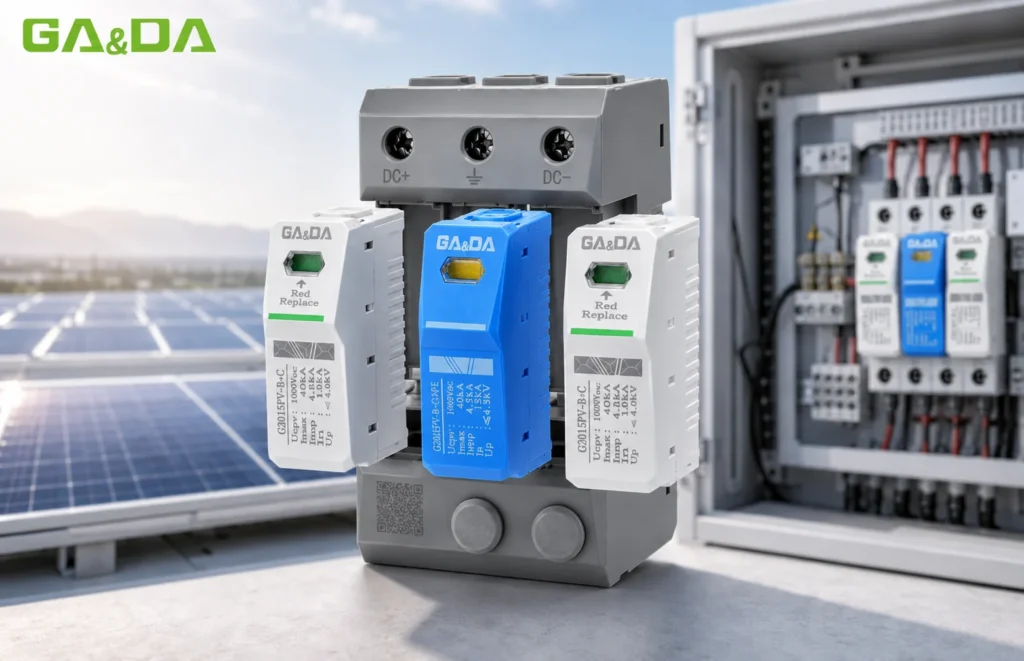
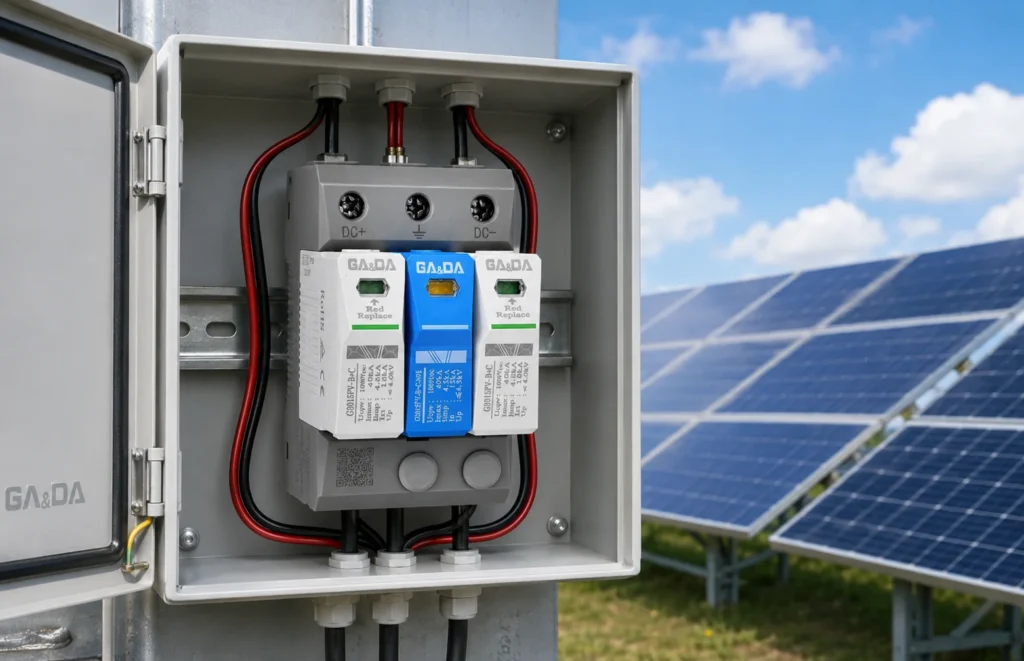
GA&DA provides DC surge protection devices for solar PV systems, including Type 2 DC SPDs and Type 1+2 DC SPDs for different project requirements. Our DC SPD solutions are suitable for PV combiner boxes, inverter DC inputs, solar distribution systems, and high-voltage DC protection applications.
Key advantages include:
DC SPD options for solar PV systems
Type 2 and Type 1+2 surge protection designs
Suitable for 1000V and 1500V DC system requirements
Visual status indication for maintenance
Replaceable plug-in modules
Thermal disconnection protection
OEM and ODM support for distributors and project buyers
Support for PV combiner box and DC protection system solutions
If you are not sure whether your project needs a 1000V or 1500V DC SPD, GA&DA can help you review the system voltage, installation position, and protection requirements.
Conclusion
When comparing 1000V vs 1500V DC SPD, the correct choice depends on the maximum DC voltage of your solar PV system. Use a 1000V DC SPD for systems designed around 1000V DC. Use a 1500V DC SPD for high-voltage PV systems, large solar farms, and projects using 1500V-rated inverters, combiner boxes, fuses, breakers, and cables.
For safe and reliable surge protection, always check the inverter rating, PV string voltage, installation location, SPD type, discharge current, and compatibility with other DC protection components.
Need help choosing the right DC surge protection device for your solar project? Contact GA&DA to get technical support, product specifications, and a fast quotation for 1000V and 1500V DC SPD solutions.
FAQ
What is the difference between 1000V and 1500V DC SPD?
The main difference is the voltage level they are designed for. A 1000V DC SPD is used in PV systems up to 1000V DC, while a 1500V DC SPD is used in high-voltage PV systems up to 1500V DC.
Can I use a 1500V DC SPD for a 1000V solar system?
It may physically operate, but it is not always the best choice. A properly selected 1000V DC SPD usually provides more suitable protection coordination for a 1000V system.
Can I use a 1000V DC SPD in a 1500V PV system?
No. A 1000V DC SPD should not be used in a 1500V system because the system voltage may exceed the SPD’s rating and cause failure or safety risks.
Where should a DC SPD be installed in a solar PV system?
A DC SPD is commonly installed in PV combiner boxes, inverter DC input cabinets, DC distribution boxes, or battery DC cabinets. Large systems may require SPDs at multiple locations.
Do I need Type 2 or Type 1+2 DC SPD?
Type 2 DC SPD is suitable for general surge protection. Type 1+2 DC SPD is recommended for systems with higher lightning exposure, external lightning protection systems, or long outdoor PV cable runs.
Is 1500V DC SPD only for solar farms?
Mostly, 1500V DC SPDs are used in large commercial, industrial, and utility-scale PV systems. However, any system designed for 1500V DC architecture should use appropriately rated 1500V DC protection devices.
Does a higher voltage SPD mean better protection?
Not necessarily. A higher voltage rating does not automatically mean better protection. The SPD should match the system voltage and required protection level.
Selecting the wrong surge protective device type is one of the more common and more expensive specification errors in low-voltage installations. The device may work, the installation may pass inspection, and the system will still be under-protected for the actual risk it faces — because Type 1, Type 2, and Type 3 devices are not […]
An SPD that has failed is not automatically a bad device. Most surge protection devices are sacrificial by design: they absorb surge energy, give up a little of their capacity each time, and eventually reach a condition in which they can no longer clamp anything useful and must come out of service. Ask why does […]
Ask when should an SPD be replaced and most answers stop at the status window. That is one input, and on its own a weak one: it shows that a device has reached end of life, never that a device is still fit for service. An SPD can be electrically exhausted while the window still […]