What Is a Solar Combiner Box? A Practical Guide for PV System Buyers
Published: Author: Rachel
A solar combiner box is often described as a box that “combines solar strings.” That description is correct, but it does not tell a buyer what actually needs to be specified.
For an EPC contractor, distributor or project purchaser, the more useful question is: what must this box handle, protect and connect?
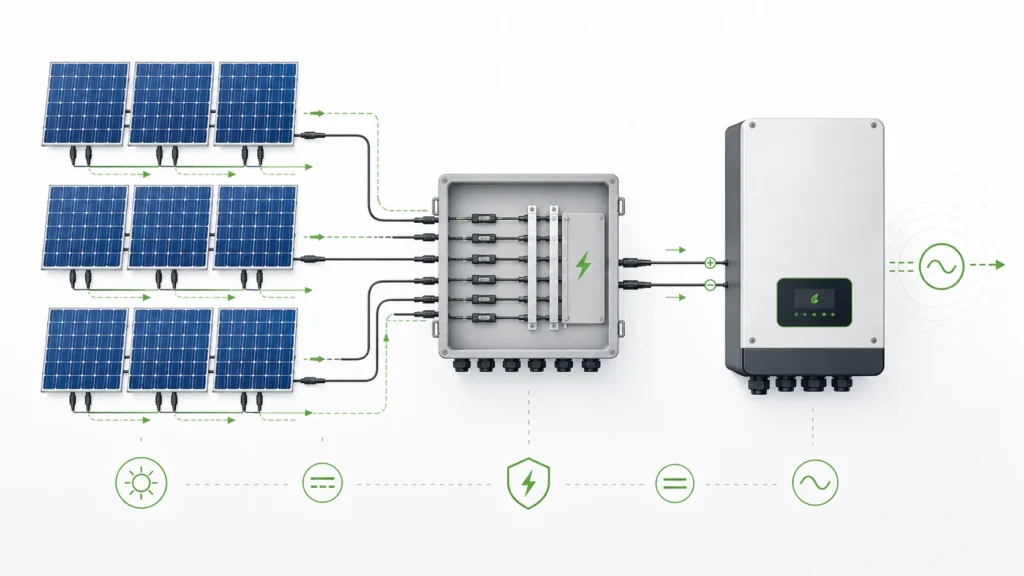
A solar combiner box sits on the DC side of a PV system. It receives cables from several PV strings, protects those circuits where required, combines the current through internal busbars and sends the DC output onward to the inverter. The enclosure may look simple from the outside, but its electrical configuration has to match the array voltage, number of strings, current level, installation environment and protection requirements.
This guide explains where a solar combiner box fits in a PV system, what is inside it and how to prepare a practical specification before requesting a quotation.
What Is a Solar Combiner Box?
A solar combiner box is a weather-protected electrical enclosure used to collect the DC output of multiple solar panel strings.
A PV string is a group of solar modules connected in series. Large rooftop and ground-mounted systems often use several strings in parallel. Rather than bringing every string directly to the inverter, installers route the string cables to a central combiner box.
Inside the box, each string can be protected individually before the positive and negative conductors are brought together on DC busbars. One larger output circuit then runs to the inverter.
A typical DC-side arrangement looks like this:
PV String 1 ─ Fuse / DC MCB ─┐
PV String 2 ─ Fuse / DC MCB ─┼─ DC Busbar ─ DC Isolator ─ Inverter
PV String 3 ─ Fuse / DC MCB ─┤
PV String 4 ─ Fuse / DC MCB ─┘
                              │
                         DC SPD to PE
The solar combiner box is therefore not merely a cable junction. It is a central point for string connection, overcurrent protection, surge protection, isolation and grounding.
What Does a Solar Combiner Box Do in a PV System?
The main task is to reduce several DC string circuits into a manageable output circuit before the inverter.
That brings four practical advantages.
First, it keeps string wiring organized. An installer can identify where each string enters the system without tracing every cable all the way to the inverter.
Second, it creates a location for string-level protection. When strings are connected in parallel, a fault in one string can be fed by current from the other strings. Correctly selected gPV fuses or DC-rated breakers help protect the affected circuit.
Third, it provides a convenient place to install a DC surge protective device. This is important in outdoor PV systems where lightning-induced transient voltage can travel along DC cables and damage inverter electronics.
Finally, it gives technicians a defined DC isolation point for inspection and maintenance. The exact isolation arrangement depends on the project design and local requirements.
When Is a Solar Combiner Box Needed?
A separate solar combiner box is most common when multiple PV strings must be paralleled before the inverter.
For a small residential system with one or two strings, the inverter may already have enough DC inputs, fuses and isolation functions. In that situation, an additional box may not be necessary.
The need becomes clearer when a project has:
Four, six, eight or more PV strings feeding one inverter input area
Long DC cable routes between the array and the inverter
A requirement for individual string fuses, DC breakers or string monitoring
A need to simplify future inspection and fault finding
The correct approach is not to decide based only on system size in kilowatts. Start with the number of parallel strings, the maximum system voltage and the current of each string.
What Is Inside a Solar Combiner Box?
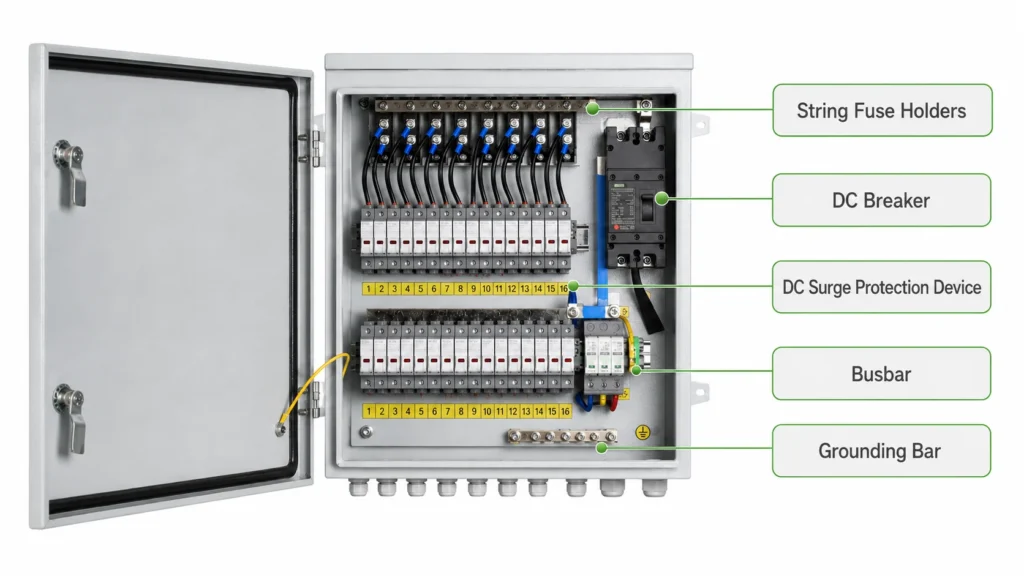
The internal design should follow the project specification. A standard DC solar combiner box may include the following components.
Component
What It Does
What Buyers Should Confirm
PV input terminals or cable glands
Accepts cables from individual PV strings
Number of inputs, cable size and cable-entry direction
gPV fuse and fuse holder
Protects each string against reverse current and overcurrent
DC voltage rating, fuse current and number of poles
DC MCB or DC MCCB
Provides circuit protection and, in some designs, switching or isolation
DC-rated breaking capacity and current rating
Positive and negative busbars
Combine the incoming string conductors
Current capacity, terminal size and copper quality
DC SPD
Diverts transient surge voltage to the PE grounding system
Ucpv, Type 1 or Type 2 requirement, remote signal option
DC isolator
Allows the DC circuit to be disconnected for maintenance
Voltage, current and pole configuration
PE grounding bar
Connects the SPD and grounding conductors
Terminal capacity and grounding arrangement
Enclosure
Protects all internal components
Material, IP rating, UV resistance and corrosion resistance
The most important point is that all DC-side components must be designed and rated for DC use. A device suitable for an AC circuit is not automatically suitable for a PV DC circuit.
Solar PV Combiner Box Procurement Guidelines
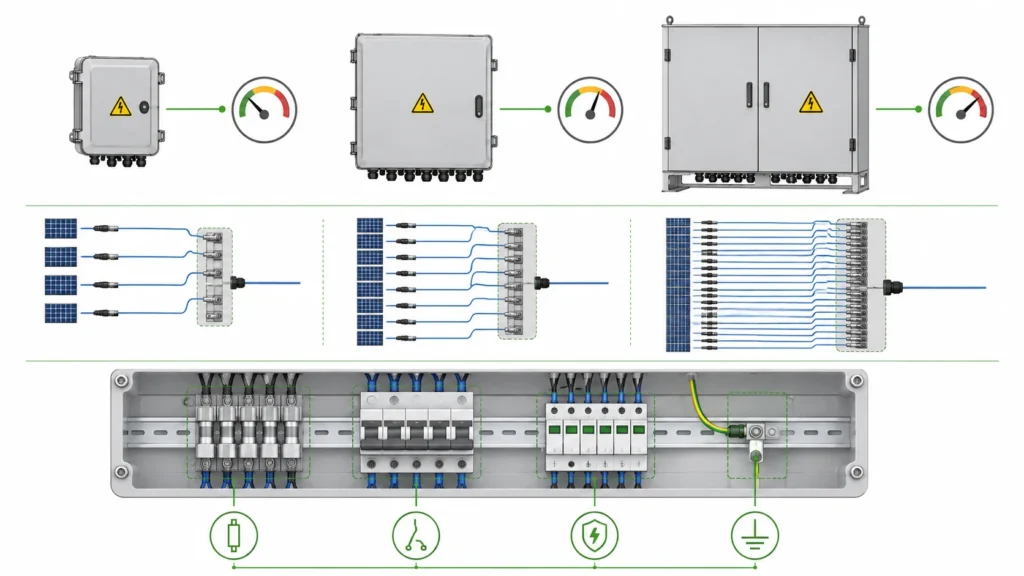
When comparing suppliers, it is useful to group requirements in four ways: voltage, input configuration, output configuration and type.
The table below can be used as a starting point when preparing a request for quotation.
Procurement Category
Common Options
What It Means for Your Project
By Voltage
600V DC, 1000V DC, 1500V DC
The box, fuse holders, SPDs, breakers, isolators and terminals must all meet or exceed the PV system’s maximum DC voltage.
By Input
2–4 in 1 out, 6–8 in 1 out, 10–14 in 1 out, 16–24 in 1 out
This is the number of PV strings entering one DC combiner box before being combined into a common output.
By Output
1 in 1 out, 2 in 2 out, 3 in 3 out, 4 in 4 out
This is more relevant to AC combiner or distribution designs, where inverter outputs may remain as separate outgoing circuits rather than being combined into one DC output.
By Type
DC, AC, AC+DC
DC boxes are installed between the PV array and inverter. AC boxes are installed after the inverter. AC+DC solutions should only be used when the circuit separation and local compliance requirements are clearly defined.
By Voltage: 600V DC, 1000V DC or 1500V DC?
Voltage is the first item to confirm because every internal component depends on it.
A 600V DC box may suit certain small or older PV systems. A 1000V DC configuration is widely used in many commercial and industrial projects. A 1500V DC solar combiner box is common in utility-scale projects because higher DC voltage can reduce current and cable losses across large arrays.
Do not select voltage by looking only at the inverter nameplate. The system’s maximum string open-circuit voltage must be checked under the lowest expected ambient temperature, because PV module voltage rises in cold conditions.
For example, a 1000V-rated fuse holder or SPD cannot be used in a 1500V DC system simply because the system normally operates below 1000V. The selected rating must safely cover the actual maximum design voltage.
By Input: How Many Strings Will Enter the Box?
For a standard PV DC combiner box, input count is usually expressed as “X in 1 out.”
A 4-in-1-out unit combines four PV strings into one output. An 8-in-1-out unit combines eight strings. A 16-in-1-out design is more suitable for larger installations where the inverter and array design allow that number of strings to be paralleled.
Before choosing the input count, confirm:
Number of strings connected in parallel
Maximum current of each string
Total output current after combining
Whether positive and negative lines require individual protection
Whether future system expansion is planned
Available installation space and cable-entry direction
It is usually better to specify the exact number of strings rather than choose a larger box without checking current rating and cable layout. An oversized enclosure may be acceptable, but the protection design still has to match the actual array.
By Output: DC Output and AC Output Are Different Questions
This is a point that often causes confusion during procurement.
A DC solar combiner box normally takes multiple PV string inputs and produces one combined DC output to an inverter. Its common format is therefore 4-in-1-out, 8-in-1-out or 16-in-1-out.
An AC combiner box sits on the other side of the inverter. It can receive output circuits from several inverters and distribute or combine AC power toward the grid connection or main distribution system.
That is why multi-output descriptions such as 2-in-2-out, 3-in-3-out or 4-in-4-out are usually associated with AC distribution requirements, not the standard DC string-combining function.
When requesting a quote, state clearly whether you need:
A DC PV string combiner before the inverter
An AC combiner after several inverters
Separate AC and DC enclosures for the same project
A specially engineered cabinet with safely separated AC and DC sections
DC Combiner Box vs AC Combiner Box
Item
DC Combiner Box
AC Combiner Box
Installation position
Between PV array and inverter
After the inverter
Power type
Direct current from PV strings
Alternating current from inverter outputs
Typical inputs
Multiple PV strings
Multiple inverter output circuits
Typical components
gPV fuses, DC SPD, DC isolator, DC MCB/MCCB
AC MCB/MCCB, AC SPD, AC isolator, metering options
Main purpose
Combine and protect PV string circuits
Combine and protect inverter AC output circuits
The two products may appear similar because both are electrical enclosures, but their internal components and switching requirements are different. A supplier should confirm the circuit type before selecting breakers, SPDs and isolators.
How to Choose the Right Enclosure Material
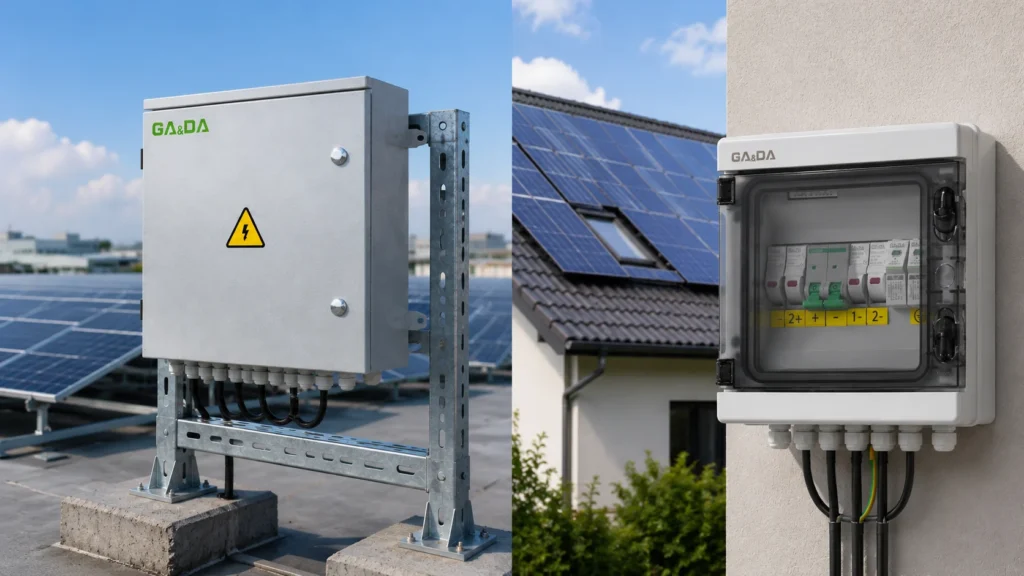
Solar combiner boxes are commonly supplied with metal or plastic enclosures.
A metal enclosure is often preferred for commercial rooftops, ground-mounted systems and more demanding outdoor conditions. It can provide stronger mechanical protection and may be more suitable when a project needs larger dimensions, customized cable-entry locations or a specific mounting arrangement.
A plastic enclosure can be lightweight, corrosion-resistant and practical for residential or small commercial projects. Transparent-cover designs can also make it easier to inspect the status of internal devices.
Material alone is not enough. Buyers should also ask about:
IP rating
UV resistance
Outdoor temperature range
Corrosion resistance
Wall-mounting or pole-mounting method
Door seal and locking method
Cable gland specification
Available customization for logo, layout and labels
What Information Should You Send to a Solar Combiner Box Supplier?
A good inquiry should include more than “I need a combiner box.” The following details allow a supplier to recommend a usable configuration instead of sending a generic model.
1. PV system voltage: 600V DC / 1000V DC / 1500V DC
2. Number of PV strings:
3. String current and total output current:
4. Required configuration: for example, 8 in 1 out
5. Required protection: fuse, DC MCB, DC MCCB, isolator, SPD
6. Required SPD type and lightning protection requirement:
7. Enclosure material: metal or plastic
8. Installation environment: indoor, rooftop, coastal, desert or other outdoor site
9. IP rating requirement:
10. Cable entry direction and cable size:
11. Required quantity and target delivery market:
Providing these details at the beginning reduces repeated technical communication and helps avoid an incorrect configuration.
Conclusion
A solar combiner box is a key connection and protection point on the DC side of a PV system. The right product is defined by its electrical parameters, not only by how many cables can fit inside the enclosure.
For most PV projects, start with four decisions: maximum DC voltage, number of PV string inputs, total combined current and required protection components. Then confirm enclosure material and environmental protection for the actual installation site.
GA&DA supplies solar combiner boxes in metal and plastic enclosure options, with configurable string inputs, DC fuses, DC breakers, DC isolators and surge protection devices. Share your project parameters to receive a suitable configuration recommendation.
FAQs
What does 4-in-1-out mean on a solar combiner box?
It means the box accepts four separate PV string inputs and combines them into one DC output circuit leading to the inverter.
Can I use a 1000V DC combiner box in a 1500V PV system?
No. The enclosure and every internal component must be rated for the maximum system voltage. A 1500V DC PV system requires properly rated 1500V DC components.
Is a DC SPD necessary in a solar combiner box?
Many outdoor PV projects use a DC SPD to reduce the risk of lightning-induced and switching-related transient overvoltage. The final requirement depends on the site conditions, system design and applicable standards.
What is the difference between a solar combiner box and a junction box?
A solar combiner box combines and protects multiple PV strings at system level. A solar panel junction box is a smaller enclosure fitted to an individual module and typically contains bypass diodes and module connection points.
Can GA&DA customize the solar combiner box configuration?
Yes. GA&DA can configure solar combiner boxes according to required system voltage, string quantity, enclosure material, cable-entry layout, IP rating and protection components.
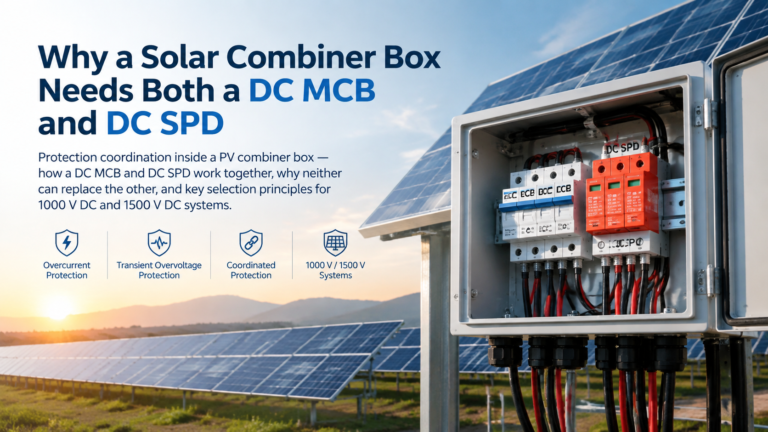
Why a solar combiner box needs both a DC MCB and a DC SPD: the division of labour between overcurrent and transient overvoltage protection, why neither device can substitute for the other, how they coordinate on the DC bus including the SPD backup protection requirement, and how the pairing changes between 1000 V DC and 1500 V DC systems.
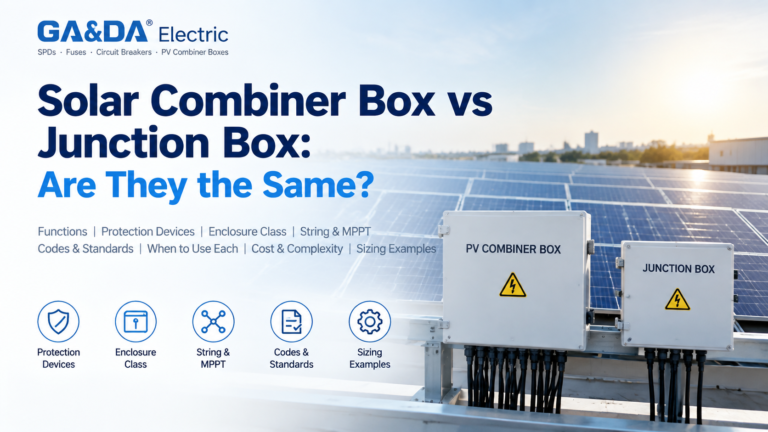
“Combiner box vs junction box” is one of the most common points of confusion in PV design, and it is not a cosmetic one. The two enclosures look similar on a wall, are both described loosely as “the box where the strings are terminated”, and are not interchangeable. A junction box is a passive termination […]
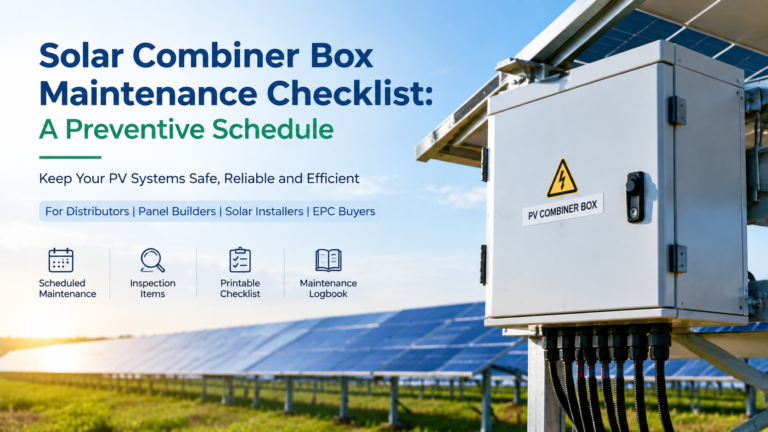
Solar combiner box maintenance is the cheapest protection a PV asset can buy. A short scheduled inspection finds a hardening door gasket, a slack terminal or a saturated desiccant while they are still minor defects; the same three found two years later are an earth fault, a discoloured busbar and a lost production week. This […]