PV Combiner Box for Commercial Solar: Design, Protection and Project Selection
Published: Author: Rachel
A combiner box that works perfectly on a small PV array may be a poor fit for a commercial rooftop.
The difference is not simply that commercial projects use more solar panels. More strings mean more DC circuits to organize, higher combined current, longer cable routes, more demanding outdoor conditions, and a larger maintenance burden when one circuit begins to underperform.
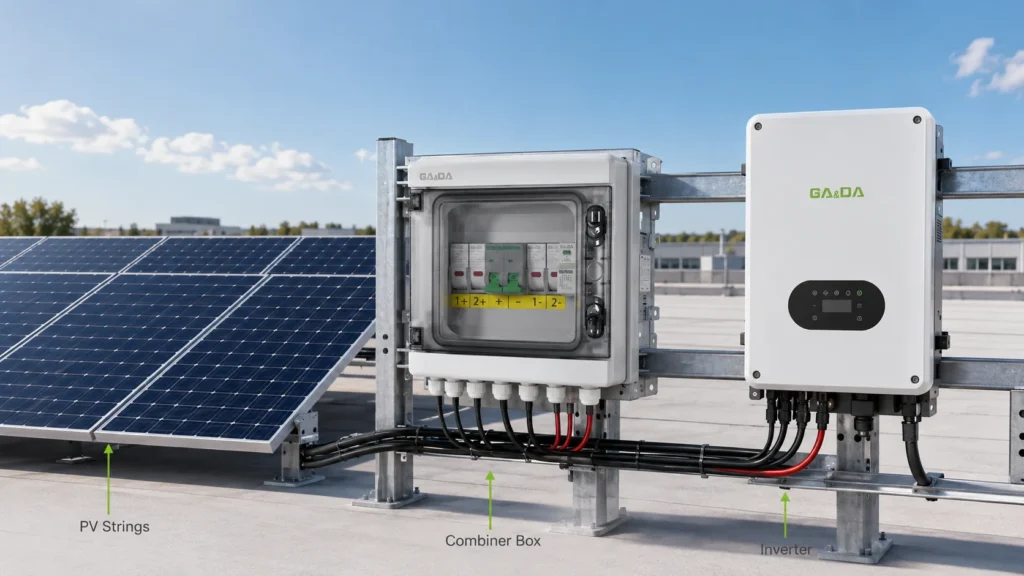
There is also the inverter architecture to consider. Sixteen strings on a drawing do not necessarily belong in one 16-input combiner box. They may be divided between different MPPT channels, different inverter sections, or even different physical areas of the array.
For EPC contractors and technical buyers, selecting a PV combiner box for commercial solar is therefore a system-design decision rather than a matter of finding a box with enough input terminals.
The right starting point is the PV array, inverter and operating environment—not the combiner box catalogue.
Why Commercial PV Projects Need a Different Approach
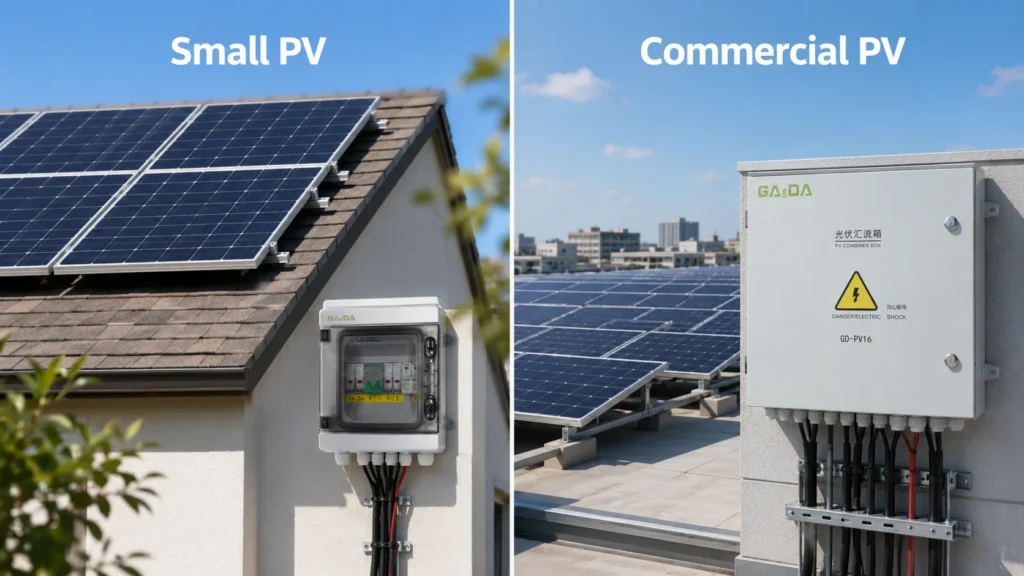
Commercial PV covers a wide range of projects: factory rooftops, warehouses, shopping centers, carports, industrial facilities and larger ground-mounted arrays.
Their electrical architectures vary, but they often introduce more complexity on the DC side than small systems.
More Strings Mean More Than More Inputs
Imagine a factory rooftop divided into several module blocks.
Each block may contain multiple series-connected PV strings. Those strings then need to be assigned to the appropriate inverter MPPT inputs.
As string quantity increases, designers have to consider:
String grouping
Combined DC current
Cable routing
Fuse protection
Surge protection
Disconnecting points
Output conductor capacity
Maintenance access
Fault identification
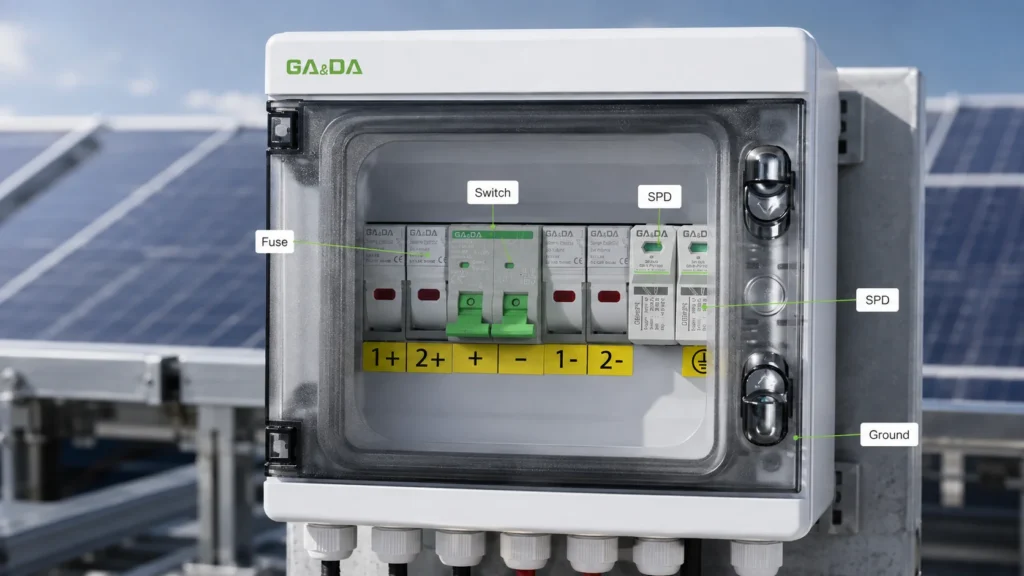
A PV combiner box for commercial solar helps centralize some of these functions, but only when its architecture matches the array.
It should not be used simply to reduce the number of cables without considering what those cables represent electrically.
Project Scale Changes the Maintenance Question
In a small installation, tracing a few PV strings is relatively straightforward.
On a commercial rooftop with dozens of strings spread across different roof sections, identifying one abnormal circuit can take much longer.
That makes details such as string labels, organized cable entry, accessible protection devices and optional monitoring more valuable.
For larger PV installations, commercial combiner products are available with functions including string collection, overcurrent protection, surge protection, isolation and string-level monitoring. Weidmüller’s PV DC combiner solutions, for example, integrate protection with optional monitoring of current, voltage, temperature, SPD status and switch-isolator status.
Matching the Combiner Box to the Commercial PV Architecture
The first question should not be:
How many inputs does the box have?
It should be:
How is this array electrically divided?
String Count and MPPT Grouping
Suppose a project has sixteen PV strings.
At first glance, a 16-string combiner seems obvious.
But now suppose the inverter requires:
8 strings → MPPT group A
8 strings → MPPT group B
Those circuits should not automatically become one common DC output simply because the enclosure has sixteen available inputs.
The combiner arrangement must preserve the inverter architecture.
Real SCB product specifications reflect this relationship. Phoenix Contact, for example, specifies products by parameters such as string count, MPP voltage, supported MPP tracker count, surge protection and internal equipment rather than by string quantity alone.
For a PV combiner box for commercial solar, that means the following information should be understood together:
Number of PV strings
Strings per electrical group
Inverter model
Number of MPPTs
Strings allocated to each MPPT
Number of combiner outputs
This is why two commercial projects with the same number of modules can require completely different combiner configurations.
1000V and 1500V DC Systems
Commercial and large-scale PV projects may use different DC voltage architectures.
The important point is not whether 1000V or 1500V sounds more advanced. The entire array must be designed for the selected voltage level.
A PV combiner box for commercial solar needs the appropriate voltage capability across the complete assembly, including relevant:
Fuse holders
Fuses
SPD
DC switch-disconnector or breaker
Busbars
Terminals
Insulation system
Connectors
Commercially available SCBs demonstrate this clearly. Phoenix Contact currently lists 1500V DC configurations with 16 or 20 strings, fuse holders, surge protection and DC disconnecting equipment.
The project engineer should determine the required voltage class from the maximum expected array voltage and applicable design requirements rather than from nominal terminology alone.
Protection Inside a Commercial PV Combiner Box
The protection system should be designed around the PV circuit rather than treated as a collection of optional accessories.
IEC 62548-1:2023+Amd1:2025 addresses PV array design requirements including DC array wiring, electrical protection devices, switching and earthing provisions.
String Protection
Where overcurrent protection is required, individual PV strings may use appropriately specified fuses or another approved protection arrangement.
The design has to consider:
Module electrical characteristics
Number of parallel strings
Possible reverse current
Module maximum series fuse rating
Cable capacity
DC voltage
Protective-device rating
This becomes especially relevant in commercial arrays where many strings are connected in parallel.
A fuse position should not be specified merely because the enclosure has room for one.
Surge Protection and Isolation
Commercial PV installations can include long DC cable routes between module fields, combiner boxes and inverters.
The project’s surge-protection strategy therefore needs to consider the location and characteristics of the array as a complete system.
String combiner boxes are commonly available with integrated surge protection and DC disconnecting functions. Phoenix Contact describes its SCBs as solutions for collecting and protecting PV strings, protecting against surge voltage and disconnecting the PV system from the power source.
The main disconnect also has a different job from the string fuse.
A fuse protects a defined circuit against specified overcurrent conditions. A DC switch-disconnector provides a defined switching or isolation function when selected and applied correctly.
One should not be treated as a substitute for the other simply because both are installed inside the same box.
Output Design Becomes More Important as String Count Grows
One of the easiest procurement errors is focusing heavily on the input side while barely specifying the output.
The output is where the parallel string currents come together.
Busbars, Terminals and Output Conductors
Consider a commercial array with twelve or sixteen parallel strings.
Each input circuit may use a relatively modest PV cable, while the common output must handle the aggregated current from the designated string group.
That affects:
Busbar rating
Main switching device
Output terminal
Cable lug
Output conductor
Cable gland
Thermal performance
Current commercial SCBs illustrate how substantial this output side can become. One 16-string, 1500V Phoenix Contact configuration specifies DC output conductor capability up to 300 mm², showing that large string aggregation involves far more than adding extra input terminals.
A PV combiner box for commercial solar should therefore be specified from both directions:
Input: What does each individual PV string require?
Output: What must the common circuit handle after those strings are combined?
Ignoring either side can result in a poorly matched system.
Outdoor Design Is Part of the Electrical Project
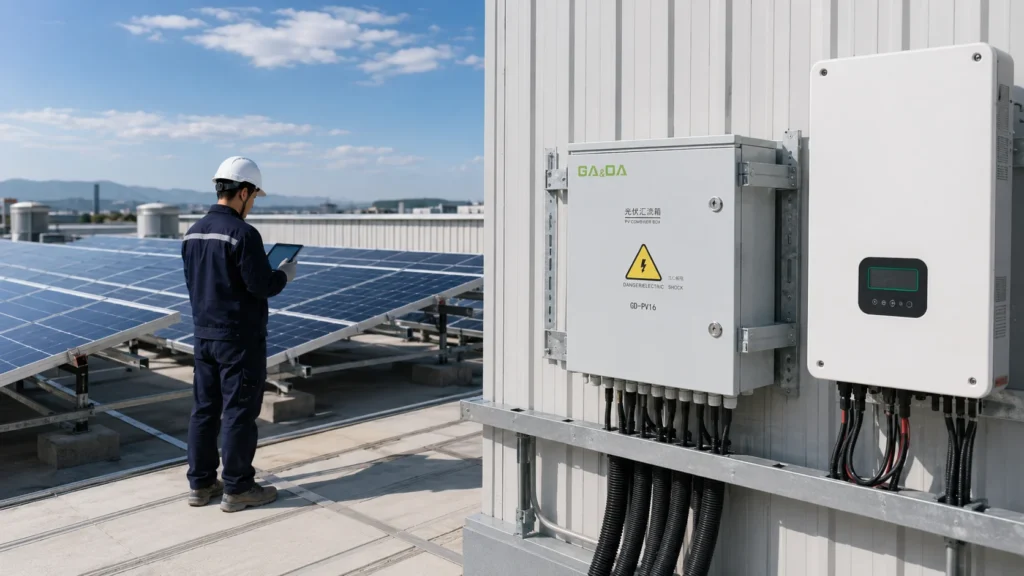
A commercial combiner box may spend years on a factory roof or in an exposed ground-mounted array.
The enclosure is therefore not just packaging around the electrical components.
Water, Dust and Cable Entry
A suitable IP rating is important, but enclosure performance depends on the completed installation as well.
Cable glands, unused openings, door seals and installation orientation all affect environmental protection.
Commercial arrays may require many incoming cables, so the cable-entry arrangement should be planned before procurement.
Questions worth confirming include:
Bottom or side cable entry?
Number of incoming cables?
Input cable diameter?
Output cable diameter?
Required gland sizes?
Space for cable bending?
Spare entries required?
Poor cable-entry planning can leave installers modifying an enclosure on site, which may compromise sealing and make the finished installation less consistent.
Heat, UV and Corrosion
A box mounted on an exposed roof can experience conditions very different from laboratory ambient temperature.
The project team should consider:
Direct sunlight
Ambient temperature
UV exposure
Humidity
Condensation
Salt-laden air
Industrial pollution
Dust
Corrosion
Material choice should follow the environment.
A plastic enclosure may be appropriate for one project while a metal enclosure is preferred for another. The correct question is not “Which material is always better?” but “Which enclosure is appropriate for this installation environment and electrical configuration?”
When Does String Monitoring Become Worthwhile?
This is one area where a PV combiner box for commercial solar can differ significantly from a basic box.
String monitoring is not automatically necessary simply because the project is commercial.
Its value depends on the size of the array and the O&M strategy.
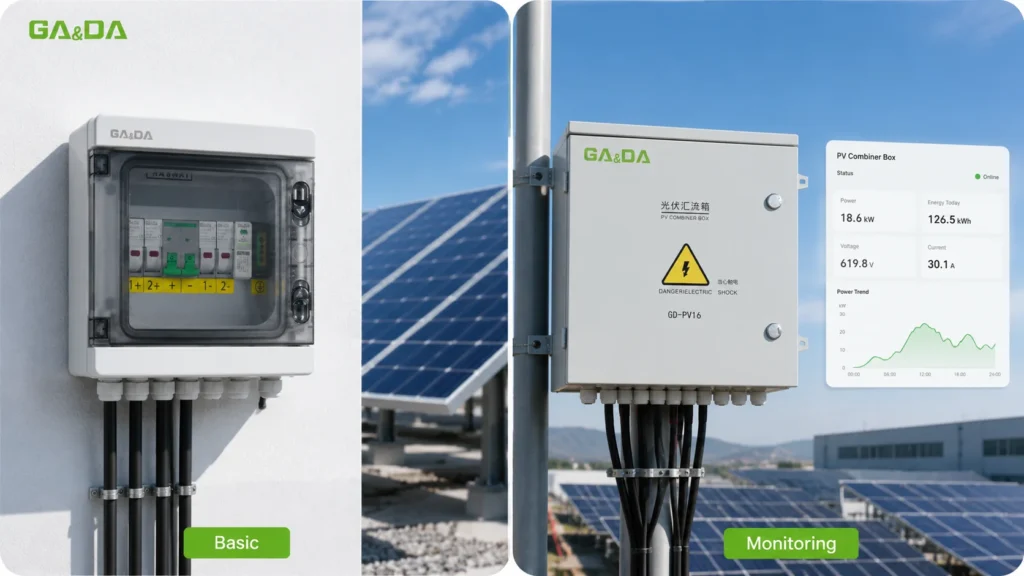
Basic Combiner Box
A conventional configuration may concentrate on:
Collecting PV strings
String protection
Surge protection
Main disconnection
Safe DC output
For many projects, that may be sufficient.
Combiner Box with Monitoring
For larger installations, monitoring can provide visibility at string level.
Depending on the equipment, monitored information may include:
String current
System voltage
Temperature
SPD condition
Switch status
Weidmüller’s current utility-scale DC combiner solutions support monitoring of current, voltage, temperature and protective-device status, while Phoenix Contact offers 20-string, 1500V SCBs capable of measuring string currents and system voltage.
The practical benefit is fault localization.
If one string starts producing significantly less current than neighboring strings under comparable conditions, monitoring can help maintenance teams identify where to investigate instead of checking every circuit manually.
For a large commercial or utility-scale project, the reduction in diagnostic work may justify the additional equipment.
For a smaller system, the added cost and complexity may not.
Example: Commercial Factory Rooftop Project
Consider a factory rooftop divided into two major PV sections.
The preliminary design contains:
16 PV strings
8 strings assigned to one MPPT group
8 strings assigned to another MPPT group
Outdoor installation
Long-term rooftop exposure
String protection
DC surge protection
Main isolation
Optional string monitoring
The project should not begin by ordering one generic 16-input combiner.
Instead, the EPC should work through the architecture.
Electrical Grouping
First determine whether the two eight-string groups need independent outputs.
If they feed separate MPPT channels, the combiner design should maintain those electrical groups.
Protection and Output
Next determine the appropriate:
Maximum DC voltage
String protection
SPD configuration
Combined current
Output switching
Output cable capacity
Installation Requirements
Finally define:
Enclosure material
Environmental protection
Cable-entry direction
Mounting position
Labeling
Monitoring
Communication requirements
The final PV combiner box for commercial solar specification may therefore be a standard model, a multi-output configuration, or a project-specific assembly.
The project determines the box—not the other way around.
What EPCs and Buyers Should Send to the Manufacturer
For commercial projects, “16-string combiner box, please quote” does not provide enough information for a reliable configuration.
A better RFQ contains the following:
Project Information
What to Provide
PV module
Model or datasheet
Number of strings
Actual project quantity
Modules per string
Series configuration
Module Voc
Datasheet value
Module Isc
Datasheet value
System voltage
Project design
Inverter
Brand and model
MPPT architecture
Strings per MPPT/group
Inputs/outputs
Required configuration
Input cable
Type and size
Output cable
Type and size
String protection
Required arrangement
SPD
Project requirement
Main disconnect
Required arrangement
Monitoring
Required/not required
Enclosure material
Plastic/metal/project specification
IP requirement
Project specification
Environment
Rooftop/coastal/desert/industrial/etc.
Certification
Destination/project requirements
Providing these parameters does two things.
First, it reduces the chance of receiving a quotation for a box that only matches the string count.
Second, it makes OEM or project customization much more efficient because the manufacturer can evaluate the actual electrical and installation requirements.
Questions to Check Before Approving the Final Configuration
Before the project team approves a PV combiner box for commercial solar, it is worth reviewing several practical questions.
Does the input count match the actual string grouping—not merely the total number of strings?
Does the voltage rating cover the maximum calculated PV voltage?
Can the common output safely carry the combined design current?
Does the arrangement preserve the inverter’s MPPT architecture?
Are the fuse, SPD and disconnect specifications appropriate for the DC system?
Can the input and output cables physically fit the terminals and cable glands?
Is the enclosure suitable for the project environment?
Will the equipment remain accessible for inspection and replacement?
If monitoring is included, what data will the O&M team actually use?
If these questions have clear answers, the project is usually much closer to a technically meaningful specification than one built from a model number alone.
FAQ About PV Combiner Boxes for Commercial Solar
What size PV combiner box is used for commercial solar?
There is no universal commercial size. The required configuration depends on string count, MPPT grouping, maximum DC voltage, combined current, inverter inputs, protection requirements and project environment.
How many strings can a commercial PV combiner box handle?
Products are available with different input counts, including 16- and 20-string configurations and other arrangements. The correct number depends on the PV and inverter architecture rather than on selecting the largest available enclosure.
Does every commercial solar system need a separate combiner box?
No. The need depends on inverter topology and the way PV strings are collected and protected. Some inverter architectures can accept strings directly, while other projects benefit from centralized aggregation, protection, isolation or monitoring.
Is 1500V better than 1000V for a commercial PV combiner box?
Not automatically. The voltage architecture must match the complete PV design, including module strings, inverter capability and all relevant DC components. A higher equipment rating alone does not make a system better.
Does a commercial PV combiner box need string monitoring?
Not always. Monitoring is most useful when project scale and O&M requirements justify string-level visibility. Current utility-scale products show that string current, system voltage and device-status monitoring can be integrated where the project requires it.
Can a PV combiner box for commercial solar be customized?
Yes, depending on manufacturer capability. Project-specific requirements can include string quantity, outputs, protection devices, enclosure material, cable entry, terminals, monitoring and other configuration details.
Final Thoughts
The best PV combiner box for commercial solar is not necessarily the one with the highest voltage rating, the most inputs or the longest specification sheet.
It is the one that fits the electrical architecture of the project.
Start with the PV strings and inverter MPPTs. Then confirm voltage, current, protection and common output requirements. After that, consider the installation environment, cable arrangement, service access and whether string monitoring adds meaningful value to the O&M strategy.
For EPC contractors and technical buyers, this sequence also improves procurement.
Instead of asking a manufacturer to recommend “a 16-string box,” you can provide a complete project specification and receive a configuration built around the actual array.
That is the difference between buying an enclosure with the right number of terminals and specifying a PV combiner box for commercial solar that genuinely belongs in the system.
Why a solar combiner box needs both a DC MCB and a DC SPD: the division of labour between overcurrent and transient overvoltage protection, why neither device can substitute for the other, how they coordinate on the DC bus including the SPD backup protection requirement, and how the pairing changes between 1000 V DC and 1500 V DC systems.
“Combiner box vs junction box” is one of the most common points of confusion in PV design, and it is not a cosmetic one. The two enclosures look similar on a wall, are both described loosely as “the box where the strings are terminated”, and are not interchangeable. A junction box is a passive termination […]
Solar combiner box maintenance is the cheapest protection a PV asset can buy. A short scheduled inspection finds a hardening door gasket, a slack terminal or a saturated desiccant while they are still minor defects; the same three found two years later are an earth fault, a discoloured busbar and a lost production week. This […]