PV Combiner Box Sizing: How to Calculate Strings, Voltage and Current
Published: Author: Rachel
An 8-input combiner box can still be the wrong choice for an 8-string solar array.
The number of inputs may match perfectly while the voltage rating is too low, the output current is underestimated, or the eight strings actually belong to different MPPT groups. This is why choosing a combiner box from string count alone often creates problems later in the project.
Proper PV combiner box sizing works in the opposite direction. Start with the PV array and inverter, calculate what the DC circuit will actually experience, and then define the box around those conditions.
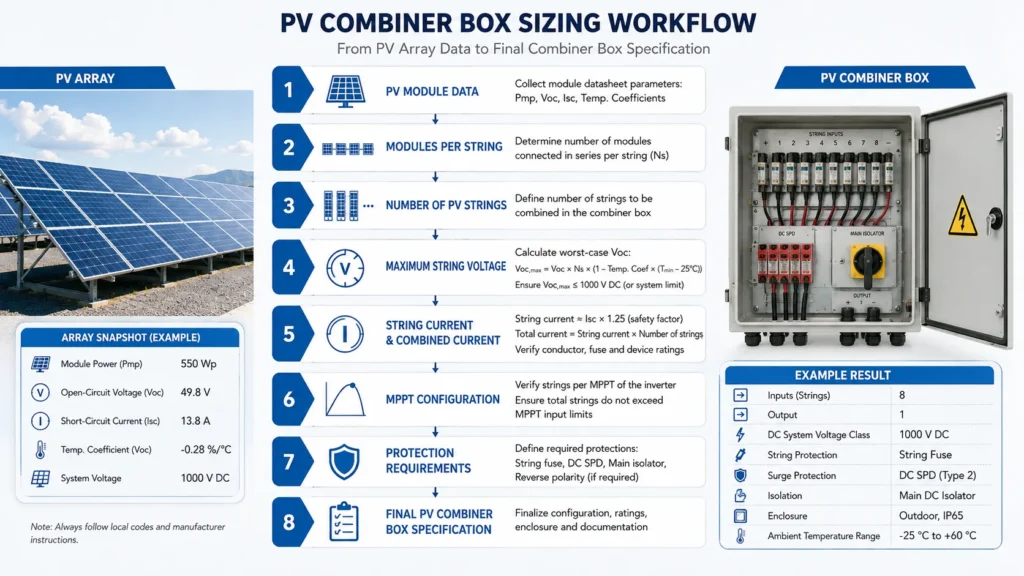
In practice, five questions matter most:
How many PV strings need to be combined?
What is the maximum voltage of each string?
How much current can the parallel strings produce?
How are those strings assigned to the inverter MPPTs?
What must the output and protection devices be rated to handle?
Once these values are clear, the required combiner box specification becomes much easier to define.
What Does PV Combiner Box Sizing Actually Mean?
“Size” does not mainly refer to the physical dimensions of the enclosure.
In PV combiner box sizing, it refers to the electrical capacity and configuration of the complete assembly.
That includes:
Number of string inputs
Number of outputs
Maximum DC voltage
String current
Combined output current
MPPT arrangement
Fuse or other string protection
DC surge protection
Main disconnect or breaker
Busbar and terminal capacity
Input and output cable sizes
The enclosure material, IP rating and physical dimensions come later, once the electrical requirements and installation environment are understood.
IEC 62548-1 takes a similar system-level approach by addressing PV array DC wiring, electrical protection, switching and earthing together rather than as unrelated items.
Step 1: Calculate How Many PV Strings You Have
The first number needed for PV combiner box sizing is not the number of solar panels. It is the number of strings.
A string is a group of modules connected in series.
Suppose a project contains:
144 PV modules
18 modules per string
The string count is:
144 ÷ 18 = 8 strings
So, at first glance, an 8-input combiner box appears logical.
But that is only the beginning.
Panel Count Is Not Combiner Box Input Count
A common misunderstanding is to treat module quantity and combiner box inputs as the same thing.
They are not.
If 160 modules are arranged as:
20 modules/string
8 strings
the combiner sees 8 incoming string circuits, not 160 module connections.
Change the array design to 16 modules per string and the entire string configuration changes even though the total number of modules remains the same.
Check the MPPT Arrangement Before Combining Strings
Now consider those eight strings again.
If the inverter design assigns:
Strings 1–4 → MPPT 1
Strings 5–8 → MPPT 2
it may not be appropriate to combine all eight into one common output.
This is why MPPT architecture has to be considered during PV combiner box sizing.
Real string combiner boxes are specified not only by string quantity but also by MPP voltage and the number of supported MPP trackers. Phoenix Contact, for example, lists those as separate product characteristics in its current SCB range.
The practical lesson is simple:
Count the strings first, then determine which strings are electrically intended to operate together.
Step 2: Calculate the Maximum PV String Voltage
After string count, voltage is the next critical calculation.
Using the inverter’s nominal DC voltage or simply saying “this is a 1000 V system” is not enough.
PV module voltage changes with temperature, and open-circuit voltage generally increases as module temperature falls.
Start with Module Voc
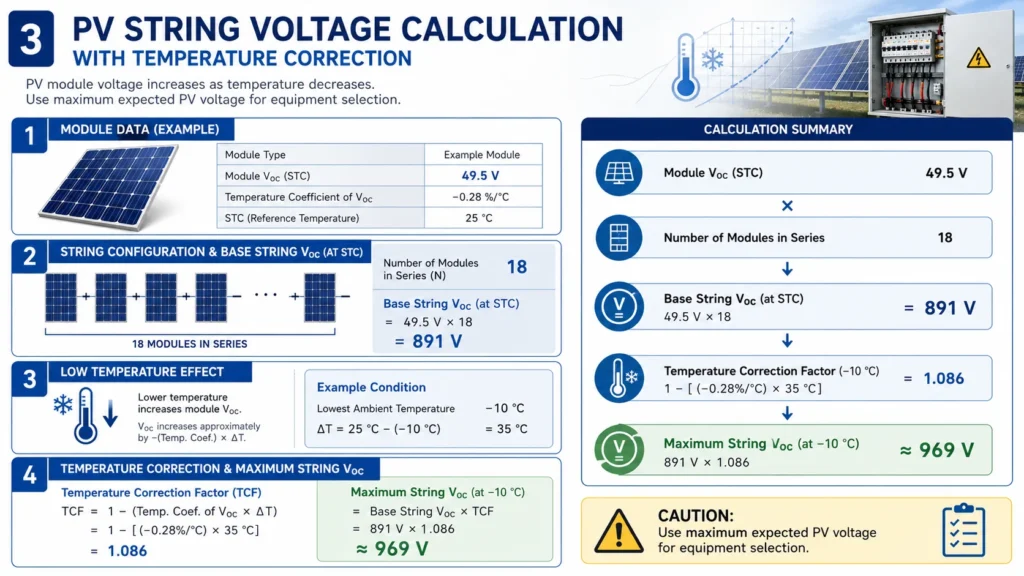
Take an illustrative module with:
Open-circuit voltage (Voc): 49.5 V
Modules per string: 18
At the datasheet reference condition:
49.5 V × 18 = 891 V
So the base string open-circuit voltage is 891 V.
It would be tempting to conclude that a 1000 V combiner box is suitable.
That conclusion is premature.
Include the Low-Temperature Voltage Rise
Assume, purely for illustration, that the module datasheet gives a Voc temperature coefficient of:
−0.25%/°C
If the applicable design method results in a 35°C temperature difference below the datasheet reference condition, the approximate Voc increase is:
35 × 0.25% = 8.75%
The corrected string voltage would then be approximately:
891 V × 1.0875 ≈ 969 V
That leaves far less margin below 1000 V than the original 891 V figure suggested.
This example is deliberately simplified. Actual projects should use the module manufacturer’s data, the applicable design temperature and the calculation method required by the relevant standard or local electrical code.
The important point for PV combiner box sizing is that the voltage rating must be based on the maximum expected PV voltage, not normal operating voltage.
And the rating applies to more than the box label.
The relevant internal components must also be suitable, including:
Fuse holders
Fuses
SPD
DC breaker or isolator
Terminals
Busbars
Connectors
Insulation system
A 1500 V enclosure containing a component rated only for a lower application does not become a properly coordinated 1500 V assembly.
Step 3: Calculate String Current and Combined Output Current
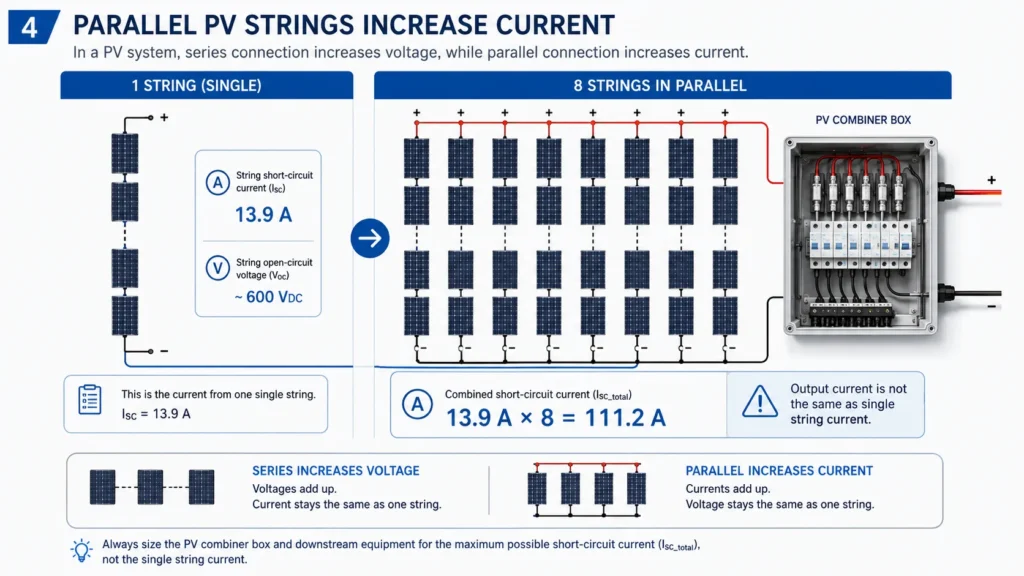
Voltage is mainly influenced by modules connected in series.
Current becomes increasingly important when strings are connected in parallel.
This distinction is fundamental to PV combiner box sizing.
Determine the Current of One String
Suppose our illustrative PV module has:
Isc = 13.9 A
The modules within one series string carry essentially the same string current, so eighteen series-connected modules do not create:
18 × 13.9 A.
The string still has a short-circuit current basis of approximately 13.9 A under the referenced module conditions.
However, the final design current used for protective devices, conductors and equipment must follow the applicable engineering rules and required design factors.
Calculate the Effect of Parallel Strings
Now connect eight comparable strings in parallel.
The simple combined Isc basis becomes:
8 × 13.9 A = 111.2 A
This is why the input side and output side of a combiner box cannot be treated the same.
An individual string circuit may carry roughly one string’s current, while the common parts of the box may carry the contribution of all parallel strings.
That affects:
Common busbars
Main output terminals
DC switch-disconnector
Circuit breaker, where used
Output cable
Cable lugs
Thermal performance
Current sizing tools for PV combiner boxes similarly use parameters such as module Isc, number of parallel strings, voltage, temperature information and conductor capacity rather than string count alone.
Step 4: Match the Protection to the Array
Once string quantity, voltage and current are known, the protection configuration can be specified.
Protection should not be selected independently and added to the box afterward.
String Overcurrent Protection
Where string fuses are required, they must coordinate with the electrical characteristics of the array.
Important inputs include:
String design current
Maximum system voltage
Number of parallel strings
Conductor capacity
PV module maximum series fuse rating
Applicable project requirements
Choosing a fuse simply because its ampere rating is higher than the normal string current is not enough.
The protection has to remain compatible with both the module and the circuit it is intended to protect.
DC Surge Protection
The SPD also has to match the PV voltage architecture and the project’s surge-protection concept.
A 1000 V or 1500 V system requires PV-specific devices whose voltage characteristics are suitable for the actual array.
This makes SPD specification part of PV combiner box sizing, not merely an optional accessory decision.
Step 5: Size the Main DC Output
The output side is one of the easiest parts of a project to underestimate.
Once several strings are combined, the main circuit must safely carry the resulting current toward the inverter.
Check at least:
Busbar current rating
Main disconnect or breaker rating
Output terminal capacity
Cable cross-section
Lug compatibility
Cable gland size
Inverter DC input rating
Temperature limits
One common mistake is assuming that the cable used for an individual PV string can also be used for the combined output.
For a multi-string system, that may be completely inappropriate.
Good PV combiner box sizing therefore works from both ends:
Input side: What does one PV string require?
Output side: What happens after all intended strings are paralleled?
Both have to be correct.
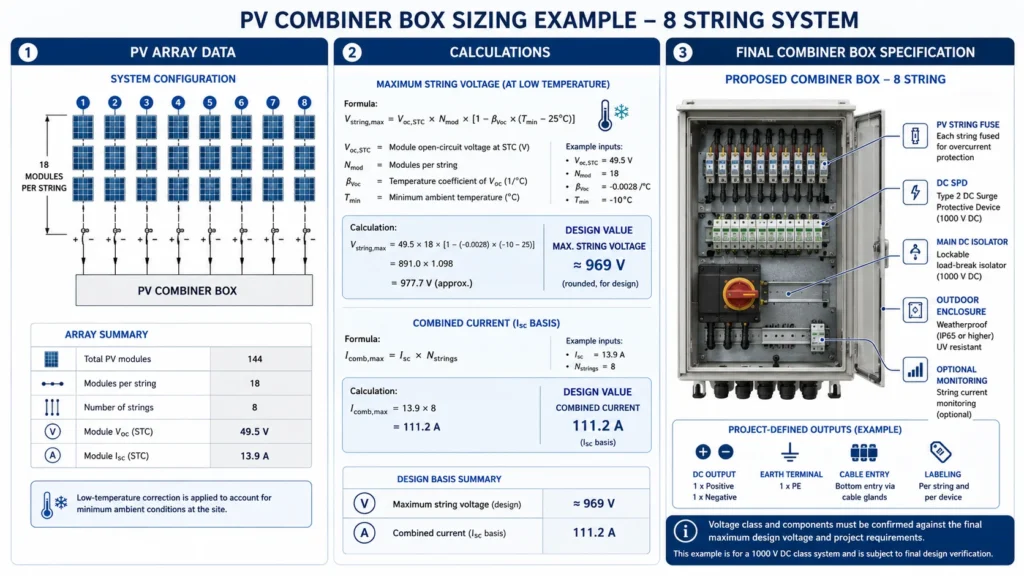
Complete PV Combiner Box Sizing Example
Now bring the calculations together.
Consider this illustrative project:
Project Parameter
Example Value
Total PV modules
144
Modules per string
18
Number of strings
8
Module Voc
49.5 V
Module Isc
13.9 A
Voc temperature coefficient
−0.25%/°C
Installation
Outdoor
Inverter
Multi-MPPT string inverter
1. Determine the String Count
144 ÷ 18 = 8 strings
The project therefore has eight incoming string circuits.
2. Calculate Base String Voc
49.5 × 18 = 891 V
Then apply the required low-temperature correction.
Using the simplified illustrative condition discussed above gives approximately:
969 V
This calculation must then be checked against the voltage ratings of every relevant component.
3. Determine the Combined Current Basis
One string:
13.9 A Isc
Eight parallel strings:
13.9 × 8 = 111.2 A
Applicable design factors are then applied according to the project standard when conductors and equipment are selected.
4. Check the MPPT Layout
Before specifying an 8-in-1-out configuration, confirm whether all eight strings actually belong to the same electrical input group.
If the inverter requires two groups of four strings for two independent MPPTs, the combiner architecture needs to preserve that separation.
5. Define the Required Product
Only now can the purchasing specification begin to take shape:
8 PV string inputs, if appropriate to the MPPT design
Required number of outputs
Correct maximum DC voltage rating
Appropriate string protection
PV DC SPD
Correctly rated main switching device
Busbar capacity for the combined circuit
Suitable input/output cable range
Outdoor enclosure
Project-required IP rating
Notice the sequence.
The model number comes last.
That is the point of PV combiner box sizing.
Typical String Configurations: What Do 4, 8, 16 and 24 Strings Mean?
String quantity is useful when comparing products, but it should not become a shortcut for engineering design.
Configuration
What It Tells You
What It Does Not Tell You
4-string
Up to four designated string inputs
Required voltage/current rating
8-string
Up to eight designated string inputs
Whether all eight belong to one MPPT
16-string
Higher string aggregation capacity
Output conductor or breaker size
24-string
Large number of input circuits
Whether it suits the inverter architecture
Commercial products are available in many combinations of string count, MPP voltage and MPPT support. This is another reason not to treat “8-string” or “16-string” as a complete technical specification.
Common PV Combiner Box Sizing Mistakes
Several errors appear repeatedly during quotations and project reviews.
Choosing by string count only. An 8-string array needs more information than an 8-input enclosure.
Ignoring cold-weather Voc. PV voltage can rise when module temperature falls.
Using operating current instead of considering the complete design current. Protection and conductor sizing must follow the applicable project rules.
Forgetting combined output current. Parallel strings change the demands placed on the common circuit.
Ignoring MPPT assignments. Strings should not be combined merely because spare terminals are available.
Mixing voltage ratings. Fuse holders, SPD, switches and other components need to match the required PV voltage architecture.
Adding future strings without checking output capacity. Spare inputs may be useful, but future strings also mean additional parallel current.
Avoiding these mistakes makes PV combiner box sizing far more reliable than choosing a box from a catalogue table alone.
What Information Should You Send to a Combiner Box Manufacturer?
For a useful quotation, send actual project data.
At minimum, provide:
PV module datasheet
Module Voc
Module Isc
Voc temperature coefficient
Number of modules per string
Total number of strings
Minimum design temperature
Inverter model
MPPT configuration
Required system voltage
Input cable size
Output cable size
Fuse requirements
SPD requirements
Main disconnect requirements
Installation environment
Enclosure material preference
Required IP rating
Monitoring requirements, if any
A manufacturer can then evaluate the electrical configuration instead of guessing what “8-string, 1000 V combiner box” is supposed to mean.
FAQ About PV Combiner Box Sizing
How do I size a PV combiner box?
Start with the PV module and array configuration. Determine the number of strings, calculate maximum string voltage, establish string and combined current, check inverter MPPT assignments, and then coordinate protection and the common output circuit.
How many strings can connect to one PV combiner box?
That depends on the product and system design. Combiner boxes are available for a few strings as well as much larger string counts, but the inverter and MPPT architecture determine which strings should actually be combined.
How do I calculate PV combiner box current?
For comparable strings connected in parallel, their current contributions add at the common output. The final equipment and conductor ratings must then follow the applicable electrical design rules and required safety factors.
Does MPPT affect PV combiner box sizing?
Yes. Strings allocated to different independent MPPT channels should not automatically be combined into one output. The inverter architecture should be checked before the combiner configuration is finalized.
Can I use a combiner box with more inputs than I currently need?
Yes, where the design allows spare inputs for future expansion. But future strings also increase potential combined current, so the busbars, output protection, cables and inverter capacity must support the expanded system.
Should I use a 1000 V or 1500 V PV combiner box?
Choose the voltage class from the maximum calculated PV array voltage and the complete system architecture. A higher voltage rating is not automatically a better choice.
Final Thoughts
The most useful way to approach PV combiner box sizing is to forget the catalogue for a moment.
Start with the modules.
Work out how many modules form a string, how many strings operate in parallel, the highest voltage those strings can reach, and the current that appears after they are combined. Then check how the inverter divides those strings across its MPPT inputs.
Only after that should you define the fuses, SPD, busbars, output switch, terminals, cables and enclosure.
This turns the combiner box from a generic accessory into what it actually is: an engineered part of the PV DC system.
And it prevents a surprisingly common mistake—buying a box with exactly the right number of inputs and completely the wrong electrical capacity.
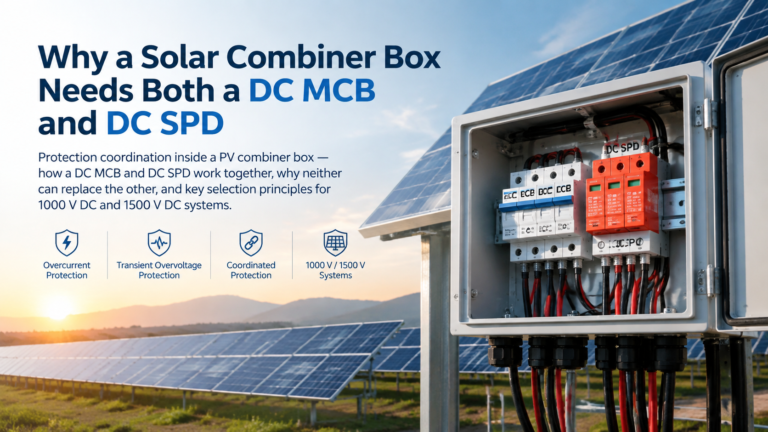
Why a solar combiner box needs both a DC MCB and a DC SPD: the division of labour between overcurrent and transient overvoltage protection, why neither device can substitute for the other, how they coordinate on the DC bus including the SPD backup protection requirement, and how the pairing changes between 1000 V DC and 1500 V DC systems.
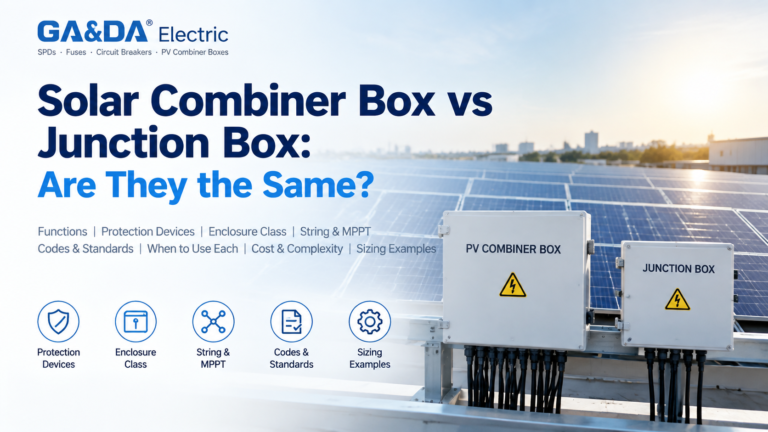
“Combiner box vs junction box” is one of the most common points of confusion in PV design, and it is not a cosmetic one. The two enclosures look similar on a wall, are both described loosely as “the box where the strings are terminated”, and are not interchangeable. A junction box is a passive termination […]
Solar combiner box maintenance is the cheapest protection a PV asset can buy. A short scheduled inspection finds a hardening door gasket, a slack terminal or a saturated desiccant while they are still minor defects; the same three found two years later are an earth fault, a discoloured busbar and a lost production week. This […]