Metal vs Plastic PV Combiner Box: Material Selection Guide
Published: Author: Rachel
Choosing between a metal vs plastic PV combiner box is not a cosmetic decision. The enclosure material sets the corrosion life of the box, the internal temperature the devices inside will actually see, the weight the mounting structure must carry, how the box is earthed, and how easily an installer can add a gland or a spare string in the field. Choose badly and the consequences appear years later as rusted gland plates, cracked covers, condensation, or a temperature rise that quietly shortens the life of the fuses and SPDs inside.
This guide compares the five materials you are most likely to be offered across the factors that decide real projects. For the wider function of the box itself, see what is a solar combiner box; this article covers material selection only, in depth.
The five materials you will be offered
Material
Typical construction
Where it wins
Main limitation
Powder-coated steel
Sheet steel, usually 1.2–2.0 mm, pre-treated and polyester powder coated
Lower stiffness than steel; fastener selection critical
ABS/PC thermoplastic
Moulded UV-stabilised blend
Non-corroding, insulated, light
Low heat conduction; tooling cost; UV depends on grade
GRP / polyester
Glass-reinforced polyester (SMC/DMC or lay-up)
Non-corroding; ideal for large/low-volume shapes
Not recyclable; brittle under impact
Corrosion and coastal / salt performance
This is normally the deciding factor, and the gap between materials is wide.
Powder-coated steel depends entirely on its coating. Once the film is breached — by a scratch in transit, a hole drilled on site, or a fixing that cuts the coat — corrosion begins at that point. In salt-fog environments, edges, seams and fixing points fail first.
Stainless steel needs no coating, which is why it performs best in chloride exposure. Grade matters: 316/316L is the usual choice near salt; 304 is adequate for many inland industrial sites. Ask which grade is used and whether the box is passivated.
Aluminium forms its own oxide layer and does not rust, and performs well in many coastal builds. Its weakness is galvanic — aluminium in contact with stainless or copper in a wet, salty environment corrodes faster, so fasteners and separators must be selected for it.
ABS/PC does not corrode. Failures in plastic boxes appear instead as UV embrittlement and deterioration of the gasket, hinges and latches rather than as rust on the wall.
GRP/polyester is inherently non-corroding and suits aggressive chemical or marine sites. Its weak points are the same as any plastic: the sealing system, the hardware and impact damage.
A corrosion claim without a stated coating build-up, stainless grade or exposure reference is not a specification. Ask for it in writing.
UV and thermal ageing
Metals do not degrade from UV. What ages is the coating or finish — powder coats chalk, fade, and can lose adhesion at edges if pre-treatment was poor.
Unstabilised thermoplastics go brittle under UV. A UV-stabilised ABS/PC grade with the right pigment behaves very differently from a generic grade, and the difference is invisible on a quotation. Ask for UV-ageing test data, not a colour sample.
GRP resists UV reasonably well but relies on its gel-coat or topcoat; once that surface is damaged, fibre exposure follows.
Thermal cycling matters as much as UV. Enclosure, gasket and metal inserts expand at different rates, which on a plastic box can work gaskets and screws loose over years — a common cause of late water ingress on otherwise well-made products.
Heat dissipation and internal temperature rise
Internal temperature is one of the most under-specified variables in combiner boxes, and it drives the service life of every device inside.
The core difference is thermal conduction. A metal wall conducts heat out, so the interior tracks ambient plus internal dissipation with a modest additional rise. A thermoplastic or GRP wall conducts poorly and behaves more like an insulated box: heat is trapped and the temperature inside rises further for the same device loading.
Metal is not automatically cooler, though. A dark metal enclosure in direct sun gains significant solar heat through its walls, while a light-coloured, shaded or ventilated box runs cooler. The controlling variables are internal dissipation, solar exposure, orientation, ventilation and colour — not material alone.
If the box carries high continuous current, large fuse bodies or SPDs, choose a material and design that can remove that heat, and confirm the expected rise with the manufacturer.
Do not add ventilation in dusty, coastal, desert or ammonia-rich environments without accepting the IP consequence. Filtered vents need maintenance and are a common moisture and dust entry point.
The device temperature rating, not the enclosure, is usually the limit. Check each datasheet’s derating curve against the ambient the box will actually see, including the enclosure’s own contribution.
Where internal rise is critical, ask for the assembly to be verified rather than assumed — temperature-rise verification sits inside the assembly-standard test regime, and a manufacturer should be able to say what was tested.
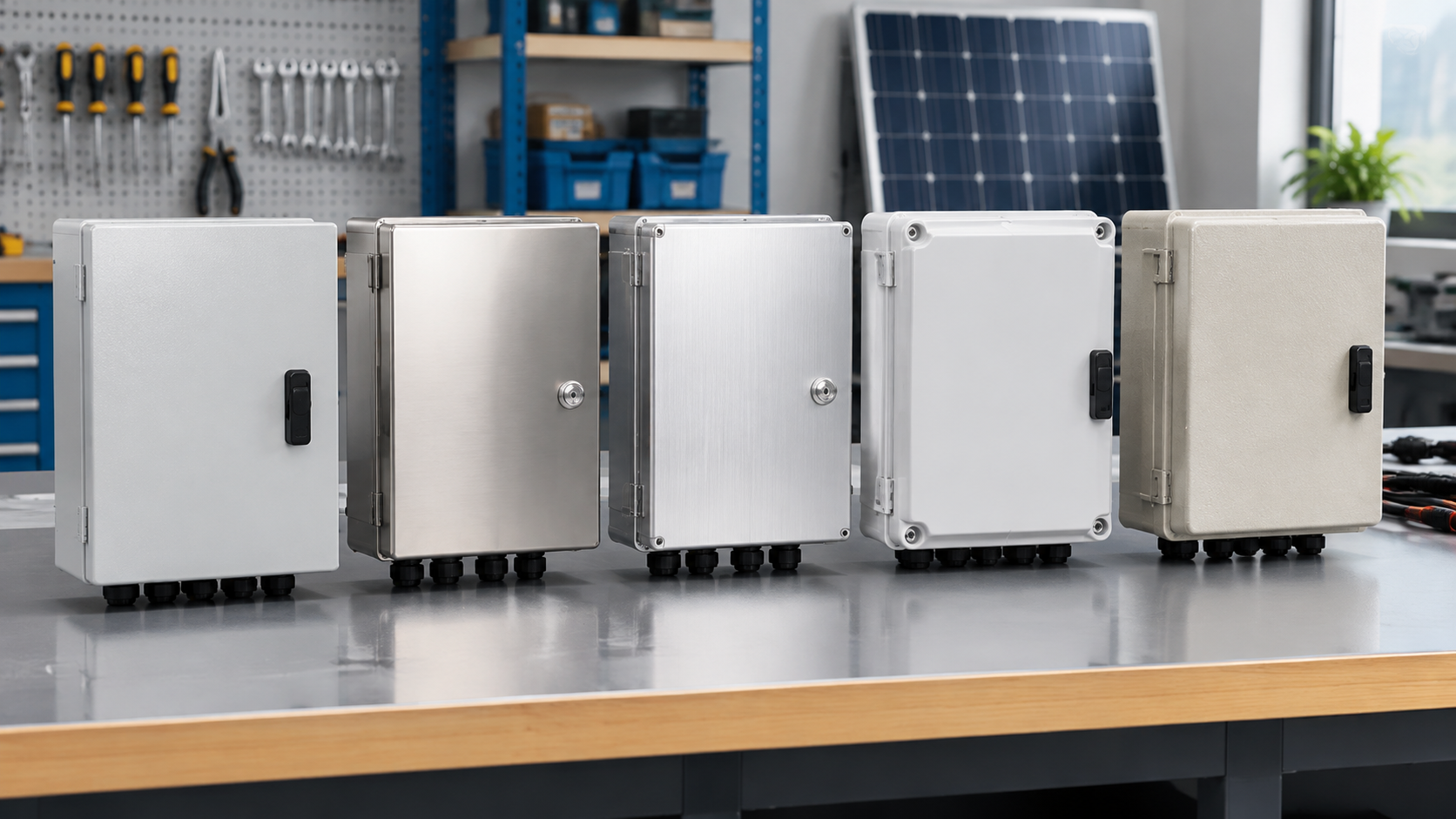
The five common enclosure-material families compared side by side.
Weight and structural strength
Material
Relative weight
Relative stiffness
Practical note
Powder-coated steel
Heavy
High
Best stiffness per unit cost; needs a strong frame
Stainless steel
Heavy
High
Consider gauge before choosing to save weight
Aluminium
Light
Moderate
Good weight saving; may need extra stiffening
ABS/PC thermoplastic
Light
Moderate to low
Large covers can flex unless ribbed
GRP/polyester
Moderate
Moderate
Can be moulded thick where stiffness is needed
Weakness shows up as a door that no longer seals, a bowed cover that lets water past the gasket, or a wall that flexes when conduit is levered into position. On large boxes, stiffness — not just material — is what protects the IP rating over time.
Drilling and field modification
Sooner or later someone adds a gland, a breather, a spare string or a sensor. How the material behaves at that moment matters.
Metal cuts and drills predictably, and a hole saw leaves a clean, strong edge. But every new hole damages the coating, so the exposed edge must be re-treated, and swarf must be kept out of the box.
Thermoplastics drill easily but crack or craze when a hole is cut too close to an edge or the saw binds. Wall thickness limits gland thread engagement, so glands and adaptors must be matched to the wall. Over-tightening a gland or cover screw distorts the wall and can break the seal.
GRP/polyester produces dust rather than swarf, and cut edges expose glass fibre that should be sealed. Large boxes in this material are often supplied with pre-moulded gland plates to avoid field cutting.
Plan cable entries on the drawing rather than in the field, and specify glands, adaptors and blanking plugs with the box.
Earthing and bonding requirements
This is the section most often mis-stated online, and precision matters because getting it wrong is a safety issue.
A metal enclosure is normally bonded to the protective earthing system. A conductive enclosure can become live if a conductor inside comes loose and touches it, and it can carry fault or induced current. Any removable conductive part — a door, a gland plate, a mounting plate — must maintain bonding continuity through its hinge, its fixings or an explicit bonding strap. Metallic glands are bonded too, because they are part of the path that earths cable armour or screen.
A non-metallic enclosure behaves differently. The wall does not conduct, so it cannot carry fault current and does not become live in the same way. That does not mean earthing is unnecessary. The protective conductor must still be carried inside the box to the devices and to any conductive parts mounted in it. Metal mounting plates, DIN rail brackets, earthing bars, gland plates and metallic glands all still need bonding, because a metal part inside an insulated box can still become live. On a non-metallic enclosure a metallic gland often needs an explicit bonding connection precisely because the wall cannot complete the path.
Two things follow:
Material choice does not remove the need for earthing design. A metal box and a plastic box both need a correctly designed protective conductor; they differ in how the enclosure participates in it, not in whether one is required.
Requirements are jurisdiction- and project-specific. Some installations rely on protective bonding, others permit or require double-insulated construction, and rooftop, ground-mount, tracker and building-mounted systems are treated differently. Confirm against the local wiring code, the project specification and the assembly standard the box is built to, and follow the manufacturer’s bonding instructions for that product.
As with all work on a combiner box: isolate, verify dead, wear appropriate PPE, and never work on energised PV strings. PV arrays are live whenever there is daylight.
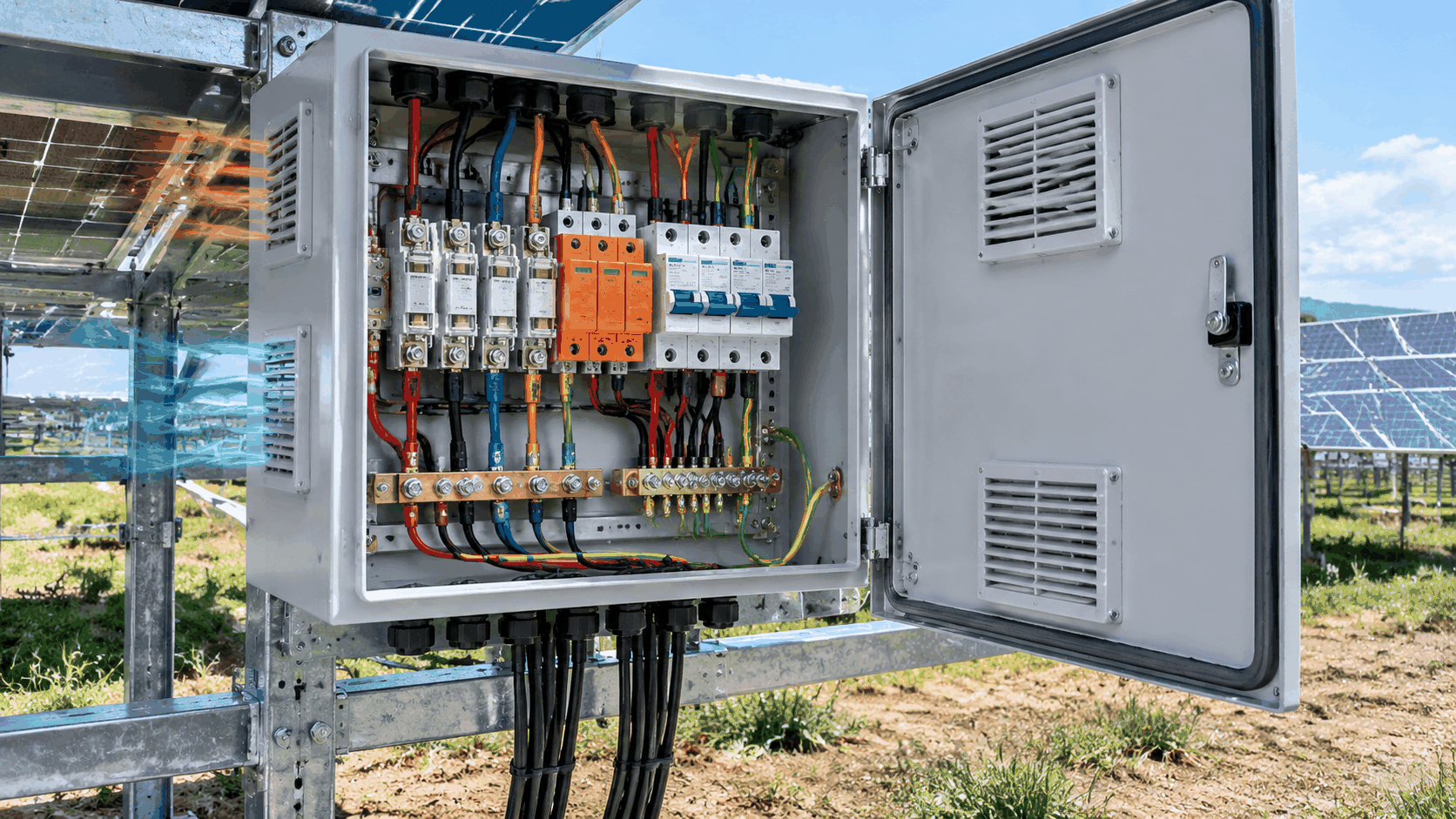
Internal temperature rise and the earthing system follow from how the box is built, not only from the wall material.
IP rating and gasket compatibility
An IP rating belongs to the finished enclosure and its sealing system, not to the raw material. Two boxes in the same material can carry very different ratings depending on gasket design and door hardware. IP codes are defined in IEC 60529; confirm any claimed rating against the standard’s test conditions and the manufacturer’s test report.
Common gasket materials are polyurethane, EPDM and silicone. Silicone tolerates higher temperatures and ages better in strong UV; EPDM is a solid general-purpose outdoor choice; polyurethane performs well in many industrial settings. Grade matters more than family name.
The gasket must suit both the enclosure material and the temperature range on site. A gasket chosen for a mild climate can harden and take a set on a hot rooftop, after which the seal no longer recovers.
Compression is the real issue. Metal holds even gasket compression well. Thermoplastic can creep under load, and a warped cover loses compression unevenly — the usual mechanism behind a box that passed an IP test in the factory but leaks after a season outdoors.
Foam and adhesive seals have limited outdoor service life and should be treated as a maintenance item, not a permanent seal.
Glands matter as much as the gasket. A correctly rated box with an undersized or unsealed gland entry is not watertight.
Flammability and standards
For empty enclosures, IEC 62208 covers general requirements for low-voltage switchgear and controlgear enclosures, including material properties for metallic, insulating and composite types.
Where the combiner box is supplied as a complete assembly, the applicable framework is commonly the IEC 61439 series for low-voltage switchgear and controlgear assemblies, covering construction, insulation and temperature rise. Confirm with the manufacturer which parts of that framework the specific product is designed and verified to.
Plastics are assessed by tests such as the UL 94 classification and glow-wire testing in the IEC 60695 series. A UV-stabilised ABS/PC enclosure is normally expected in a suitable flammability grade — ask for the actual class rather than accepting the phrase “flame retardant”.
Metal is non-combustible and cannot propagate fire, which is why some projects and some local codes require metal in particular locations. Where fire resistance is a project requirement, verify it in the local code before selecting a material.
Do not assume a certification because a catalogue shows a logo. Ask for the declaration of conformity and the standard the product is actually verified to.
Lead time and cost
Powder-coated steel is normally lowest cost and fastest, with widely available sheet, standard fabrication and short lead times for standard or custom sizes.
Stainless steel carries a significant material premium and longer lead times, and fabrication is slower because the material work-hardens. It is justified where corrosion life is the priority.
Aluminium sits between the two on cost and lead time, with fastener and separator selection as an added consideration.
ABS/PC has a different cost structure: existing moulds give low unit cost at volume, but a new shape needs tooling, which adds cost and lead time before the first unit ships. A standard catalogue size is often the commercially sensible choice unless volumes are high.
GRP/polyester suits low-volume or large custom shapes because tooling is cheaper than injection moulding, but unit cost and cycle time are higher than for moulded thermoplastic.
Compare total installed cost, not unit price. A cheaper box that needs a stronger frame, extra earthing hardware or earlier replacement can cost more over the life of the plant.
Recyclability and end of life
Steel, stainless steel and aluminium have established recycling streams with real scrap value, and the material separates easily at decommissioning.
Thermoplastics such as ABS/PC are recyclable in principle, but a real enclosure is a mixed assembly — wall, gasket, screws, threaded inserts and labels — and that mixture limits what a recycler can recover. Designing for disassembly helps.
GRP/polyester is a thermoset: it cannot be re-melted and is not effectively recyclable with current commercial processes, so end-of-life units typically go to landfill or energy recovery. Where an end-of-life or green procurement policy applies, this is a genuine selection criterion.
Environment-based selection matrix
Use this as a starting point, then confirm the specific product’s rating, gasket and bonding arrangement with the manufacturer.
Environment
Powder-coated steel
Stainless steel
Aluminium
ABS/PC
GRP/polyester
Inland, sheltered, low humidity
Suitable
Good but often unnecessary
Good
Good
Good
Coastal / salt fog
Not preferred
Preferred
Good with correct fasteners
Good
Good
High UV, desert or high altitude
Coating must suit UV
Preferred
Preferred
UV-stabilised grade only
Good if gel-coated
High internal heat load
Preferred
Preferred
Preferred
Verify rise
Verify rise
Agricultural ammonia / chemical
Coating at risk
Preferred
Check compatibility
Check compatibility
Preferred
Weight-critical (rooftop, tracker)
Heavy
Heavy
Preferred
Preferred
Moderate
Heavy field modification expected
Easy; re-treat edges
Easy
Easy
Care at edges
Pre-mould entries
Metal required by local code
Preferred
Preferred
Preferred
Not applicable
Not applicable
End-of-life recycling priority
Preferred
Preferred
Preferred
Partial
Poor
Typical use cases
Utility-scale and coastal ground-mount: stainless steel or aluminium, chosen for corrosion life and stiffness, with bonding designed explicitly and documented at handover.
Commercial and industrial rooftop: powder-coated steel where weight is not critical; aluminium or UV-stabilised ABS/PC where roof loading and handling matter. For array-level design beyond material, see PV combiner boxes for commercial solar .
Residential and small commercial rooftop: UV-stabilised ABS/PC is common — light, non-corroding and easy to mount, provided the temperature rise is acceptable.
Tracker installations: aluminium or thermoplastic, because weight and stiffness on a moving structure both count.
Harsh chemical, marine or offshore: 316/316L stainless or GRP/polyester, with all hardware matched to the environment.
General LV distribution and panel building: metal remains the default where fault levels are high and bonding requirements strict. The same material logic runs across the wider range — see our electrical distribution box range.
Once the material is fixed, the remaining questions are mechanical and electrical. You can see the enclosure platforms we build on in our solar combiner box range, and if you want help matching a material and gasket specification to a specific site, contact our engineering team with the environment, internal heat load and bonding requirement.
FAQ
Is a plastic PV combiner box worse than a metal one?
No — it is different. Plastic does not corrode and is lighter, but it conducts heat poorly and its seal depends on a cover that must not creep or warp. For a low-to-moderate dissipation box in a moderately hot, salt-exposed location, a UV-stabilised thermoplastic enclosure can be the better engineering choice. For high continuous currents and high ambient, metal usually removes heat more effectively.
Does a non-metallic enclosure need to be earthed?
The wall does not need bonding as a conductive part, but earthing is still required. The protective conductor must be carried inside to the devices, and all conductive parts mounted in or on the box — mounting plates, DIN rail brackets, earthing bars, metallic glands — must be bonded. Confirm the exact requirement for the project against the local code and assembly standard.
Will a powder-coated steel box survive at the coast?
It depends on the coating system and how well it survives transport and installation. Coated steel is generally the least preferred option in chloride-rich environments, because every scratch, fixing point and untreated drilled edge becomes a corrosion initiation site. If it is used, specify the coating build-up, protect cut edges and re-treat every field modification.
Which material gives the longest service life?
There is no single answer, because service life is set by the weakest part of the assembly — gasket, seals, hardware and coating all age independently of the wall. A stainless enclosure with a poor gasket can fail sooner than a well-designed thermoplastic box. Ask for the ageing and UV data behind any claim, and inspect gaskets and glands at every maintenance visit.
Can a GRP/polyester enclosure be recycled?
Not in practice. GRP is a thermoset — once cured it cannot be re-melted and commercial-scale material recycling is not widely available, so decommissioned units typically go to landfill or energy recovery. For projects with an end-of-life policy, that is a real disadvantage against steel, stainless steel or aluminium.
Does the enclosure material change the IP rating I can achieve?
Indirectly, yes. IP belongs to the finished box and its sealing system, and the same material can achieve very different ratings depending on gasket and hardware design. Material affects how well gasket compression survives years of thermal cycling and solar exposure, and how well the box tolerates field modification. Confirm the claimed rating against IEC 60529 and the manufacturer’s test data.
Why a solar combiner box needs both a DC MCB and a DC SPD: the division of labour between overcurrent and transient overvoltage protection, why neither device can substitute for the other, how they coordinate on the DC bus including the SPD backup protection requirement, and how the pairing changes between 1000 V DC and 1500 V DC systems.
“Combiner box vs junction box” is one of the most common points of confusion in PV design, and it is not a cosmetic one. The two enclosures look similar on a wall, are both described loosely as “the box where the strings are terminated”, and are not interchangeable. A junction box is a passive termination […]
Solar combiner box maintenance is the cheapest protection a PV asset can buy. A short scheduled inspection finds a hardening door gasket, a slack terminal or a saturated desiccant while they are still minor defects; the same three found two years later are an earth fault, a discoloured busbar and a lost production week. This […]