¿Cuáles son los diferentes tipos de sistemas de protección contra los rayos?
Publicado: Autor: info@cngdfl.com
There are four types of lightning protection system in common use: the Franklin rod, the meshed cage, the catenary (taut wire) system, and the early streamer emission (ESE) air terminal. The first three are passive — they present a preferred strike point and let the lightning find it. The fourth is active — it tries to launch an upward streamer earlier than the surrounding structure would.
That is the short answer. The longer answer is that the choice between them is not a matter of brand preference. It follows from three things: the protection level your structure needs under IEC 62305, the geometry of the building, and which standard the local authority actually enforces. A system that is correct in France may be rejected in the United States, and a system that looks adequate on a small house is not adequate on a 60 m warehouse.
This guide covers all four types, the protection levels that determine their size, the three design methods used to lay them out, and the part most articles skip — the surge protection that has to sit behind the air termination, because a lightning protection system without SPDs still lets induced surges destroy the equipment inside.
Types of Lightning Protection Systems
Conventional Systems (Standard NF EN 62-305)
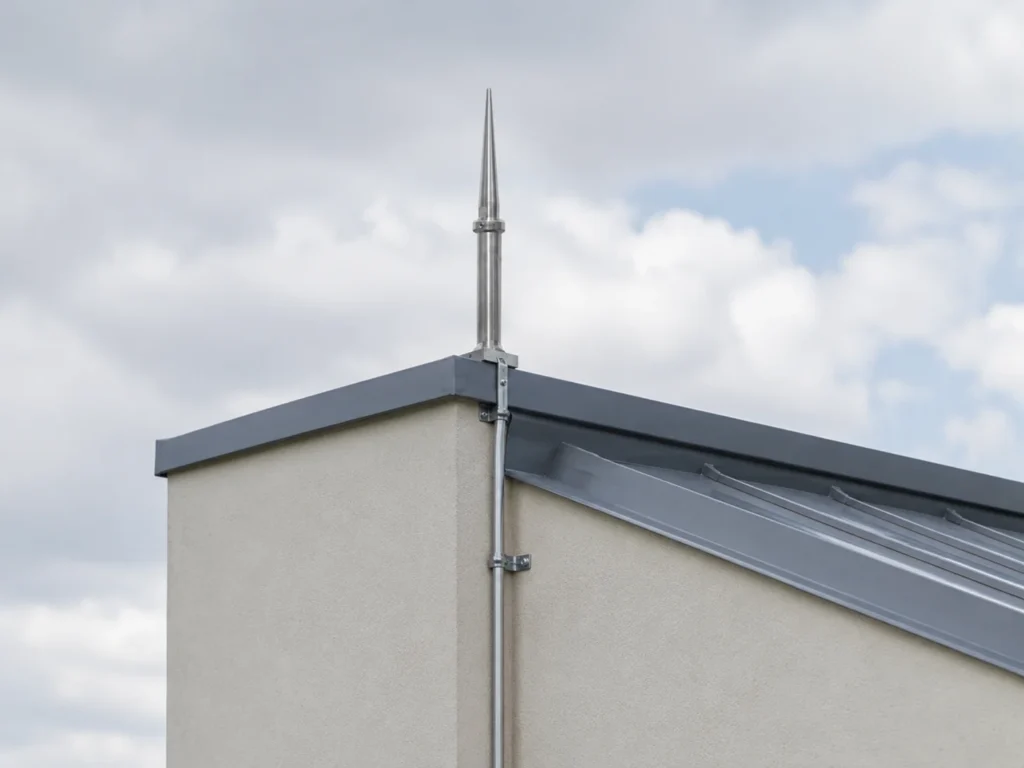
1. Franklin Rod Developed by Jacques de Romas and Benjamin Franklin, the Franklin rod is a traditional lightning protection method. It consists of a metal rod installed at the highest point of a building and connected to the ground via down conductors.
Its protection zone is not a fixed radius. Under IEC 62305-3 the zone is derived from the protection level and the rod height — a 5–6 m mast on a house under LPL III typically covers something in the order of ten metres of radius, not the flat “30 m” figure that gets repeated in a lot of online material. Height buys you coverage, but with diminishing returns, and each added metre is another metre of mast that has to survive wind load.
Advantages:
Simple installation
Cost-effective for small projects
Can be integrated discreetly in some structures
Disadvantages:
Limited coverage — the protected zone shrinks as the structure gets wider
Needs one rod (or a small cluster) per protected zone, so a large roof needs many
Mast strength and wind loading become the limiting factor on tall exposed sites
Best for: Antennas, small houses, small churches, chimneys, single tanks
Standards: IEC EN 62561 (components), IEC EN 62305-3 (installation)
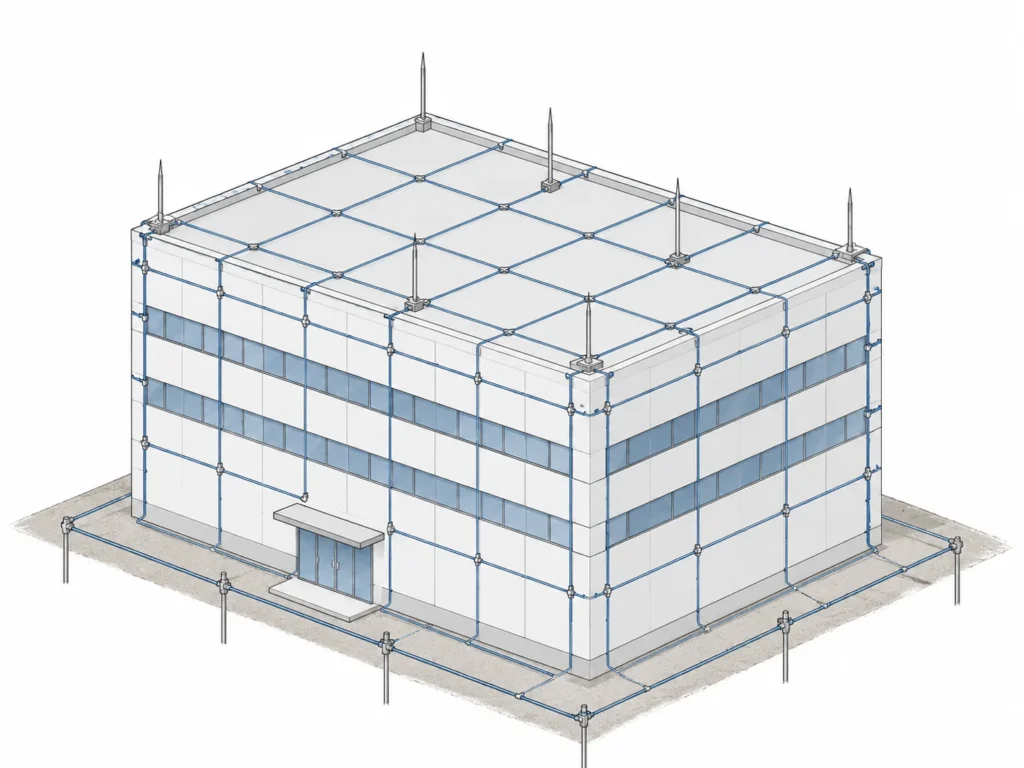
2. Meshed Cage Based on the Faraday cage principle, this system surrounds the building with a conductive mesh on the roof and walls. It is connected to grounding loops, and lightning rods may be placed at strategic points. Smaller mesh sizes provide higher levels of protection.
Advantages:
Reduces electromagnetic effects inside the building
Maintains equipotentiality between the structure and earth
Works on any footprint, including complex or stepped roofs
Disadvantages:
Complex installation
Higher material and labor costs
Visually prominent on finished facades unless designed in from the start
Best for: Data centers, sensitive electrical installations, laboratories, ammunition and hazardous stores
Standards: IEC EN 62561, IEC EN 62305-3
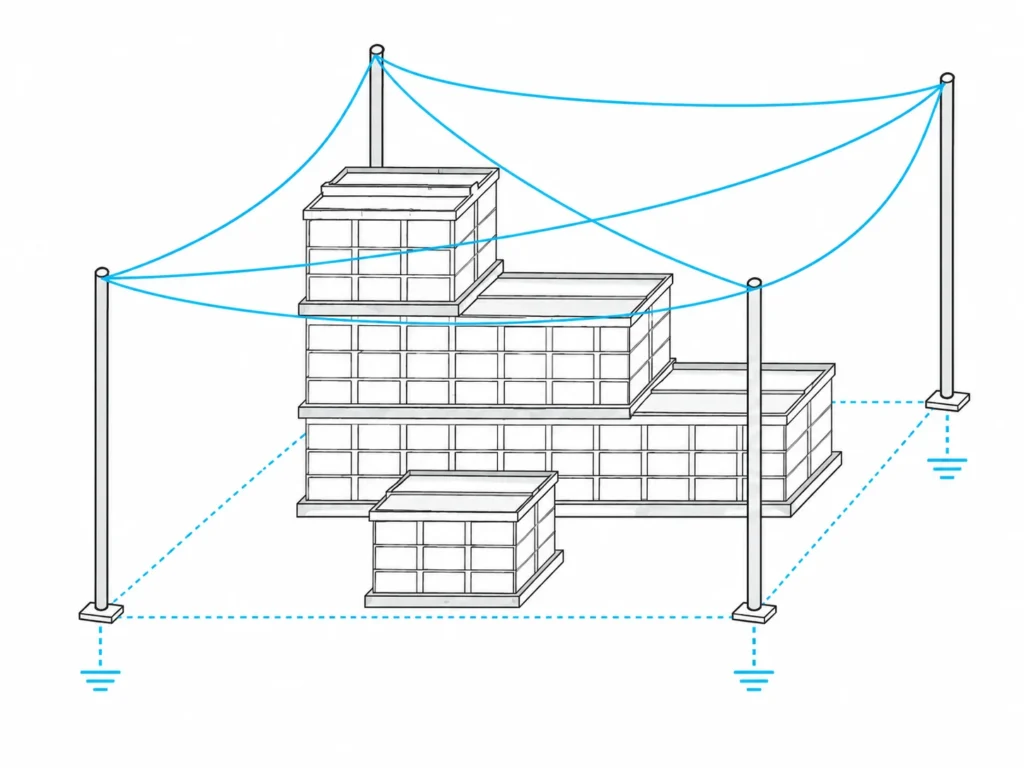
3. Catenary (Taut Wire) Lightning Conductors These systems function similarly to meshed cages but are installed above the building, at a distance. Conductive wires are held under tension and connected to grounding points, capturing lightning before it reaches the structure.
Advantages:
Reduces electromagnetic impact inside the building
Protects open areas that have no roof to mount a rod on
Maintains equipotentiality
Disadvantages:
Installation complexity
Higher costs
Visually more noticeable
Best for: Outdoor storage, tank farms, industrial yards, launch pads, substation switchyards
Standards: IEC EN 62561, IEC EN 62305-3
Modern Systems (NF C 17-102)
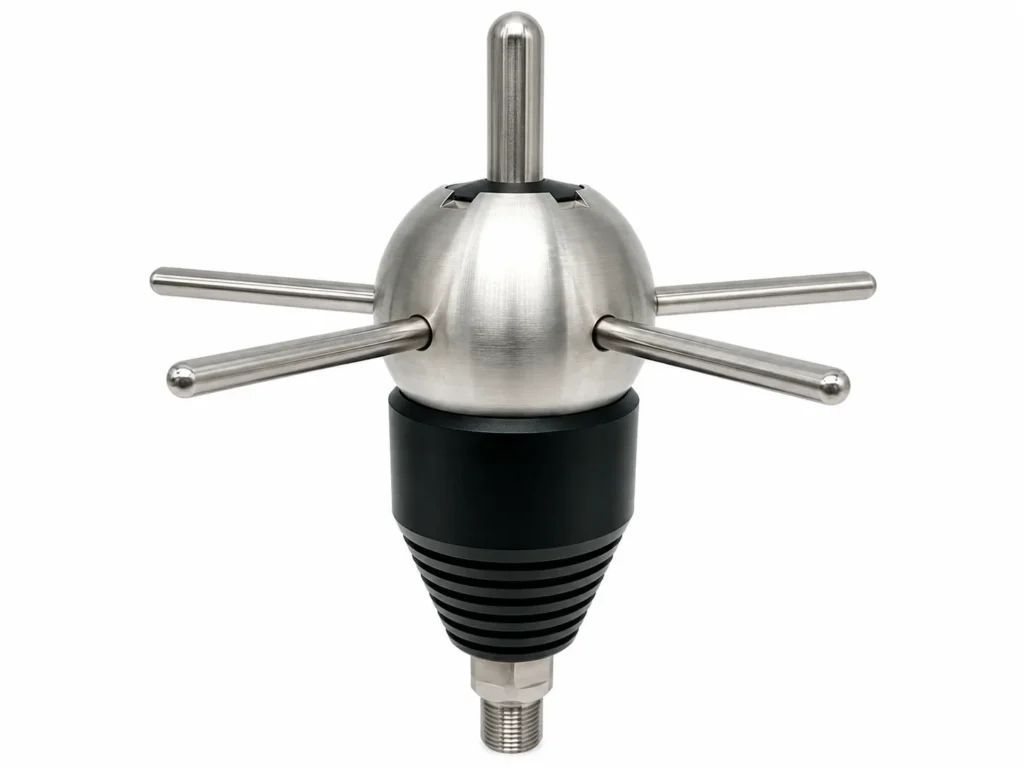
Early Streamer Emission (ESE) Air Terminal Originating in France in the 1980s, the ESE system generates an ascending electrical streamer that triggers a lightning strike earlier. This allows the terminal to capture lightning at a higher point and protect a larger area.
There are two types: electronically triggered, which ionizes the air to attract lightning, and geometrically triggered, which relies on the terminal’s shape to guide strikes.
Advantages:
Captures lightning sooner
Covers a larger protection area per terminal, so fewer masts on a large roof
Suitable for taller or complex structures
Disadvantages:
Small projects are slightly less economical
Strict requirements for the grounding system (ground resistance typically below 10 Ω)
High requirements for structural mechanics
Not recognised everywhere. ESE is covered by NF C 17-102 in France and UNE 21186 in Spain. IEC 62305 and UL 96A do not adopt the enhanced protection radius, so a project in the US or one specifying IEC only will normally be designed with passive air termination instead
Standards: NF C 17-102, UNE 21186
Lightning Protection Systems Comparison Table
Tipo de sistema
Principio de funcionamiento
Advantages
Disadvantages
Best Use
Normas
Franklin Rod
Metal rod captures strikes at building apex
Simple, cost-effective, discreet
Limited coverage, needs many masts on wide roofs
Small houses, antennas, chimneys
IEC EN 62561, IEC EN 62305-3
Meshed Cage
Conductive mesh surrounds roof/walls
Reduces electromagnetic effects, maintains equipotentiality, works on any footprint
Complex, high cost, visually prominent
Data centers, sensitive equipment, hazardous stores
IEC EN 62561, IEC EN 62305-3
Catenary / Taut Wire
Elevated wires above building
Protects open areas, maintains equipotentiality
Complex, costly, visually prominent
Outdoor storage, tank farms, switchyards
IEC EN 62561, IEC EN 62305-3
ESE Air Terminal
Creates early ascending streamer
Captures lightning earlier, covers large area per terminal
Ground resistance below 10 Ω, not accepted under IEC 62305 or UL 96A
Tall or complex structures in NF C 17-102 markets
NF C 17-102, UNE 21186
What a Complete System Has to Do
Air terminals are the visible part, but they are only one of five elements. IEC 62305 treats lightning protection as a system, and leaving out any one of the five is how buildings end up with a rod on the roof and a burnt-out BMS in the basement.
Air termination — rods, mesh or catenary wires that intercept the strike.
Down conductors — the path from the air termination to earth. Spacing is set by the protection level: roughly 10 m for LPL I and II, 15 m for LPL III, 20 m for LPL IV.
Earth termination — a ring or rod electrode system. IEC 62305-3 works to a low earthing resistance, and a common project target is 10 Ω or less; NF C 17-102 makes 10 Ω a firm requirement for ESE.
Equipotential bonding — tying metallic services, cable shields, pipes and structural steel to the same earth so that no dangerous potential difference appears inside the building.
Surge protective devices — the part that handles what bonding alone cannot. This is covered further down.
When a client asks for a quote on “lightning protection”, the useful question is which of these five already exist. Replacing or extending a partial system is a different job from building one from scratch, and the material list looks nothing alike.
IEC 62305 Protection Levels: LPL I to IV
IEC 62305 does not define “good” and “bad” protection. It defines four lightning protection levels, and the level decides how dense the air termination and down conductor network has to be. The level is chosen from a risk assessment — structure height, occupancy, consequence of failure, and local flash density.
Protection level
Rolling sphere radius (m)
Mesh size for a cage (m)
Typical down conductor spacing (m)
LPL I
20
5 × 5
10
LPL II
30
10 × 10
10
LPL III
45
15 × 15
15
LPL IV
60
20 × 20
20
Two practical consequences. First, “we installed a lightning rod” says nothing about protection level — a single rod on a 40 m wide roof is not an LPL II design no matter how tall the rod is. Second, the same building can justify LPL II in one country and LPL III in another, because the risk assessment inputs differ. That is why the risk calculation, not the drawing, is the document that decides the bill of materials.
Three Design Methods in IEC 62305-3
There are three accepted ways to position air terminations. They are not interchangeable on the same structure — each suits a different geometry.
Rolling Sphere Method
A sphere of radius r (from the table above) is rolled over the structure. Any surface the sphere can touch needs protection; anything it cannot reach is inside the protected volume. This is the most general method and the one that works for irregular shapes, because it accounts for strikes entering from the side as well as from above.
Protection Angle Method
A protected cone is drawn under each air terminal, with the half-angle α taken from the standard for the given protection level and height. It is quick to apply on simple, compact structures. It has a hard limit: above a certain height the angle becomes unusable, which is why the standard caps its application and requires the rolling sphere method instead on tall masts.
Mesh Method
Conductors are laid in a grid over the roof surface at the spacing given for the protection level. It is the most predictable method for flat and low-pitch roofs, and it is the method behind the meshed cage type described earlier. A designer can mix methods — mesh on the flat roof, rolling sphere to check the plant room and the lift overrun.
Direct Strike vs Induced Surge: Why You Need SPDs Too
A lightning protection system solves one problem: it stops a direct strike from setting the structure on fire or killing someone. It does not stop the second problem.
When lightning strikes the ground or a nearby structure, the electromagnetic field couples a surge onto every conductor in the area — mains, data, telephone, CCTV, the 24 V supply to a PLC. A building with a perfectly installed Franklin rod and no surge protection will still lose drives, controllers and power supplies, and the failure pattern usually looks random: the same line fails every storm season while the equipment next to it survives.
That is why IEC 62305-4 exists as a separate part of the standard. It introduces lightning protection zones (LPZ): the further a conductor runs into the building and the more boundaries it crosses, the more the surge energy has to be stepped down. In practice that means a SPD tipo 1 at the service entrance where the incoming line enters LPZ 1, SPD de tipo 2 at distribution boards, and Tipo 3 at sensitive equipment.
For the device side — Type 1/2/3 selection, current ratings, and how the SPD coordinates with the upstream breaker — the surge protection device range covers AC and DC versions for panel, DIN-rail and photovoltaic use, and the Type 1, 2 and 3 guide walks through the selection criteria in detail.
Matching the System to the Building
Structure
Usual choice
What drives it
Single-family house
Franklin rod + Type 2 SPD at the consumer unit
Low exposure, small footprint, cost sensitivity
Apartment or office block
Mesh on the roof, rods at plant rooms, Type 1 + Type 2 SPDs
Shared services, many cable entries, occupied floors
Factory or warehouse
Mesh or catenary over the roof, Type 1 at the main board
Large flat roof, overhead supply, motor loads
Data centre
Mesh cage, LPL I or II, full Type 1/2/3 cascade
Downtime cost, low Up requirement, strict bonding
Tank farm / open yard
Catenary wires on masts
No roof, large open area, flammable contents
Telecom tower or mast
Rod at the top, catenary down the structure, SPDs at every cable entry
Height, coax and power entries, remote site
Solar farm
Catenary or rod on the array perimeter, DC SPDs in the combiner boxes
Exposed terrain, long DC runs, inverter cost
Common Design and Installation Mistakes
Sizing the rod by height instead of by protection level. A taller rod is not a better design; the protection level decides the zone, and past a certain height the angle method no longer applies at all.
One down conductor on a wide roof. Down conductors are spaced by protection level. A single conductor on a 30 m roof means the current has a long, inductive path with a large potential difference along it.
Forgetting to bond the incoming services. Water, gas, telecom and the cable shield all enter the building. If they are not bonded to the same earth, the strike voltage appears between them and the equipment they connect to.
Treating SPDs as optional. The most expensive failures are rarely the direct strike — they are the induced surges that a rod was never designed to stop.
No inspection interval. Conductors corrode, clamps loosen, and SPD cartridges reach end of life silently unless the status window is actually read. An annual check is the normal baseline, and a system that has taken a strike should be checked immediately.
Standards Reference
Estándar
Covers
IEC 62305-1
General principles, lightning current parameters
IEC 62305-2
Risk management — how the protection level is chosen
IEC 62305-3
Physical damage to structures — air termination, down conductors, earthing
IEC 62305-4
Electrical and electronic systems — LPZ concept and SPD coordination
Low-voltage surge protective devices connected to power distribution systems
NF C 17-102
ESE air terminals (France); UNE 21186 is the Spanish equivalent
UL 96A
Installation of lightning protection systems (United States)
Preguntas frecuentes
Which lightning protection system is best for my home?
For most residential buildings, a Franklin rod combined with a surge protection device provides sufficient protection. The rod handles a direct strike; the SPD handles the induced surge that comes in on the supply.
Is ESE better than a traditional Franklin rod?
Not universally. ESE terminals are covered by NF C 17-102 and UNE 21186 and can cover a larger area per terminal, which suits tall or complex structures in those markets. IEC 62305 and UL 96A do not adopt the enhanced radius, so projects specifying those standards are normally designed with passive air termination.
How often should lightning protection systems be inspected?
Annually as a baseline, checking conductors, clamps, earthing and air terminals against the design. A system that has taken a strike should be inspected immediately, and SPD status indicators should be read at every maintenance visit.
Do I need surge protection if I have a lightning rod?
Yes. Lightning rods prevent direct strikes. SPDs protect electrical circuits from induced surges, which arrive on the supply and data cables whether or not the building is struck directly. Both are needed for full protection under IEC 62305.
What is the difference between LPL I and LPL IV?
They are protection levels in IEC 62305. LPL I uses a 20 m rolling sphere, 5 × 5 m mesh and down conductors at roughly 10 m; LPL IV uses a 60 m sphere, 20 × 20 m mesh and conductors at roughly 20 m. LPL I gives the tightest protection and the highest material cost.
What decides the cost of a lightning protection system?
Protection level, roof area and geometry, the number of down conductors and their routing, earthing conditions on site, and whether the work has to be done on an occupied building. The air terminal itself is a small part of the total.
Can I use a meshed cage on an existing building?
Yes, but the mesh has to be laid on the roof and down the facade, so cable routing and visual impact on a finished building are the main constraints. Retrofits are usually a mix of mesh on accessible roof areas and rods at plant rooms.
GA&DA Electric manufactures surge protective devices and circuit protection for AC distribution and photovoltaic systems. If you are specifying the electrical side of a lightning protection scheme, send the system voltage, earthing arrangement, protection level and the equipment you need to protect — we will return a Type 1 / Type 2 combination that matches, with the ratings written out.
Un SPD que ha fallado no es necesariamente un mal dispositivo. La mayoría de los dispositivos de protección contra sobretensiones están diseñados para ser sacrificables: absorben la energía de las sobretensiones, pierden un poco de su capacidad cada vez y, con el tiempo, llegan a un estado en el que ya no pueden limitar la sobretensión de forma eficaz y deben retirarse del servicio. Pregúntate por qué […]
Si preguntas cuándo hay que sustituir un SPD, la mayoría de las respuestas se limitan a la ventana de estado. Ese es un indicador, pero por sí solo es poco fiable: muestra que un dispositivo ha llegado al final de su vida útil, pero nunca que siga siendo apto para su uso. Un SPD puede estar agotado eléctricamente aunque la ventana siga […]
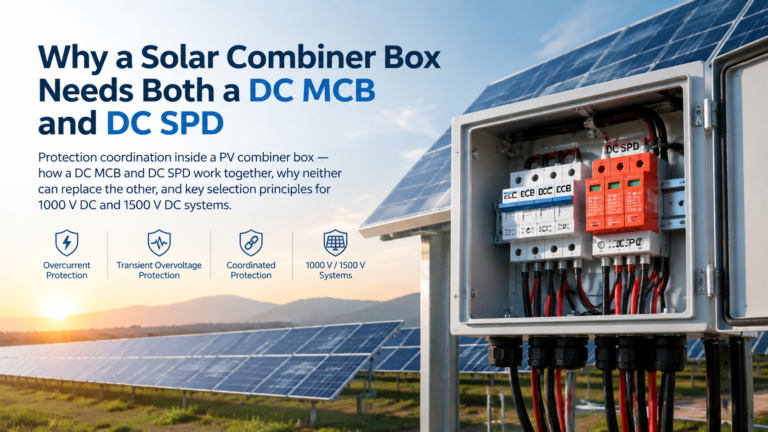
Por qué una caja combinadora solar necesita tanto un MCB de CC como un SPD de CC: la división de funciones entre la protección contra sobrecorriente y la protección contra sobretensiones transitorias; por qué ninguno de los dispositivos puede sustituir al otro; cómo se coordinan en el bus de CC, incluyendo el requisito de protección de respaldo del SPD; y cómo cambia esta combinación entre sistemas de 1000 V CC y 1500 V CC.