Industrial AC Surge Suppressor Type 1, 2 and 3 Explained
Publicado: Autor: info@cngdfl.com
When a buyer asks me for an industrial AC surge suppressor, they almost never say, “Please quote Type 1, Type 2 and Type 3 SPDs with coordinated protection per IEC 61643-11.” They say: “Boss, factory keeps tripping, PLC sometimes dies, give me a surge protector that works.”
So in this article, I’ll break down the difference between Type 1, Type 2, and Type 3 devices in simple, practical language. We’ll talk about where to put them, how to connect them, and which type to choose for different AC distribution levels – from main switchboard to final equipment.
And yes, if you like a specific configuration, you can always send me your single-line diagram and let me help you match a Industrial AC Surge Suppressor model and a price.
In the IEC 61643-11 world, Type 1, Type 2 and Type 3 surge protective devices are not marketing names; they tell you where the SPD goes and how much energy it can eat without dying. Think of them as three filters in series on your AC power system: the first catches the big stones, the second catches the gravel, and the last one takes out the dust.
Core differences at a glance
Below is a quick engineering view for industrial AC surge suppressor selection.
Artículo
SPD tipo 1
SPD tipo 2
SPD tipo 3
IEC class
Class I
Class II
Class III
Main threat
Direct lightning current
Induced lightning, switching surges
Residual low-energy surges
Test waveform
10/350 μs Iimp
8/20 μs In / Imax
1.2/50 or 8/20 μs low energy
Typical Iimp / Imax
12.5–100 kA 10/350 μs
20–100 kA 8/20 μs
≤10 kA 8/20 μs
Installation zone
Service entrance (LPZ 0→1)
Distribution boards (LPZ 1→2)
Point-of-use (LPZ 2→3)
Standalone use
Sí
Yes (most common)
No, needs upstream Type 2
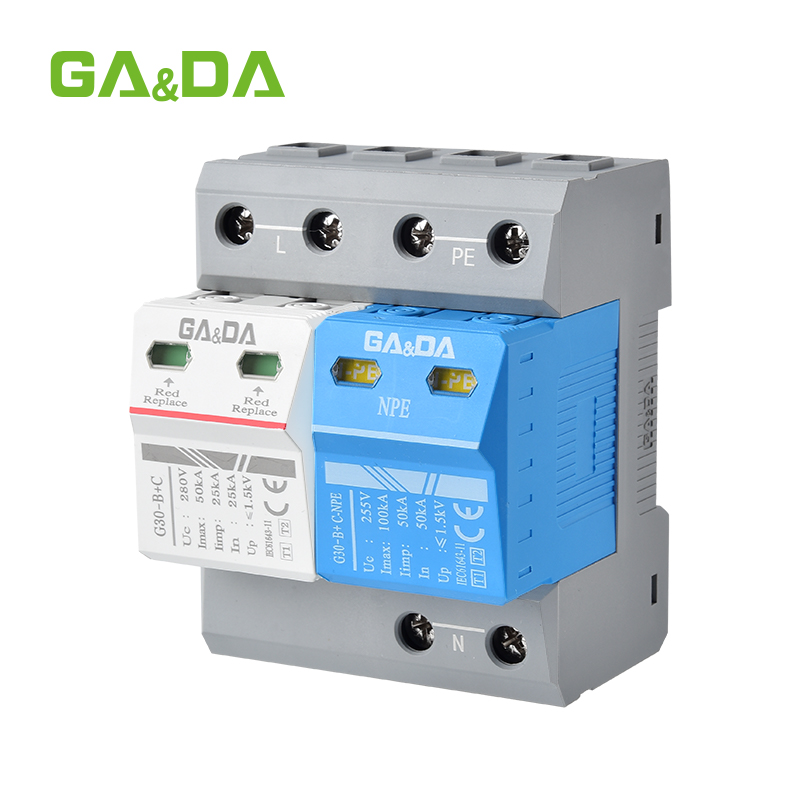
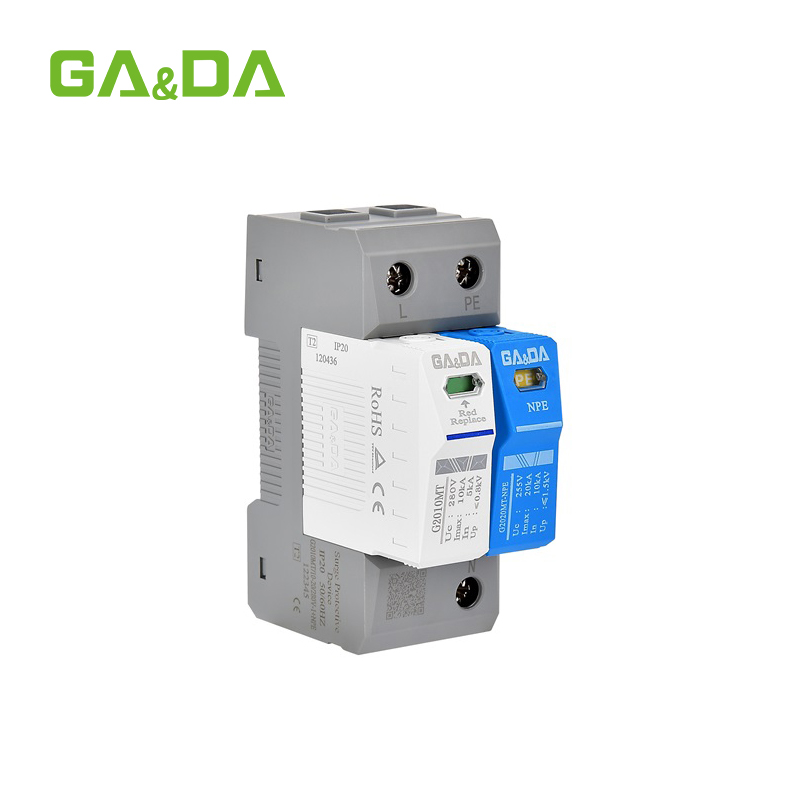
Type 1 and Type 2 SPDs often live inside or next to switchgear, MCCs, or main distribution boards in industrial buildings. Type 3 SPDs are usually integrated into socket strips, device-level modules, or small DIN-rail units inside a PLC control cabinet, VFD panel, or server rack.
Now let’s go category by category and talk about how to connect y how to choose.
Type 1 SPD: Your First Line Against Lightning
If your facility has overhead lines, an external lightning protection system, or sits in a lightning-prone area, a Type 1 industrial AC surge suppressor at the incoming panel is non-negotiable. Its job is simple: when lightning dumps huge current into your system, it pushes that energy into the earth instead of into your main breaker busbars.
Where and how to connect Type 1 SPD
For a typical low-voltage industrial AC system (TN-S, TN-C-S, or TT), a Type 1 SPD is installed at the service entrance o main distribution board, right where utility power enters the building.
Basic wiring approach for a 3-phase + N system:
Connection point
Install the Type 1 SPD on the busbars or via short copper conductors between phases (L1, L2, L3), neutral (if required), and PE.
Keep the total lead length (from bus to SPD, SPD to earth) as short and straight as possible, ideally under 0.5–1 m equivalent length.
Configuration
TN-S / TN-C-S: Use L–PE o L–N–PE Type 1 SPD depending on your grounding scheme.
TT: Often requires L–N plus separate N–PE protection due to higher earth impedance; many industrial AC surge suppressor products offer dedicated TT versions.
Overcurrent coordination
Many modern Type 1 SPDs for mains panels are tested to be installed without an upstream external fuse (they coordinate with the main breaker or have built-in protection).
If an external breaker is required, follow the Imax/Iimp and manufacturer’s recommended breaker rating.
You don’t need fancy wiring tricks. You just need: short leads, solid earth, correct type for your system, and proper breaker coordination.
How to choose a Type 1 industrial AC surge suppressor
Typical use-case phrases you might see in RFQs or search terms:
“Type 1 SPD for 400V TN-S main incoming panel”
“Industrial AC surge suppressor 10/350 μs 50 kA Iimp”
“Service entrance lightning surge protective device for factory”
If your line is overhead, or the building has a lightning protection system, go straight for a solid Type 1 SPD at the service entrance. If the line is fully underground and the risk is low, some customers choose to start with Type 2 only at the main panel – we’ll talk about that next.
And of course, if you want me to sanity-check your lightning risk and propose a Type 1 size, just send the site location and main switchboard data.
Learn how to pick, wire, and spec the right Industrial AC Surge Suppressor for industrial and commercial projects.
If Type 1 is the bodyguard at the gate, Type 2 surge protective devices are the guards in every building. In many industrial RFQs, the keyword is simply “Type 2 SPD for distribution board” because this is the most common industrial AC surge suppressor in day-to-day projects.
Type 2 SPDs handle induced surges and switching transients – the events that actually happen frequently inside an industrial plant: motor switching, transformer energizing, VFD operations, and nearby lightning.
Where and how to connect Type 2 SPDs
You typically install a Type 2 SPD in each sub-distribution board o final distribution panel that feeds critical loads: production lines, data center loads, HVAC, building automation, etc.
Wiring guidelines:
Location in the panel
Connect the SPD to the busbars or feeder terminals, again with short leads from L1, L2, L3 (and N, if required) to the SPD, and then to PE.
Install as close as possible to the main breaker of that board to minimize the protected “loop”.
Coordination with upstream devices
If you already have a Type 1 SPD at the service entrance, keep a minimum cable length between Type 1 and Type 2 (often ≥10 m) or use an inductive element to help coordination.
Many Type 2 SPDs include internal disconnectors, but often are backed by a dedicated MCB or fuse sized per the SPD datasheet.
AC vs DC
For a normal industrial AC surge suppressor, confirm the SPD is rated for the correct AC voltage and earthing system.
Do not use DC PV SPDs on AC distribution boards; they are tested differently.
How to select a Type 2 industrial AC surge suppressor
Here’s what I usually check when I help a buyer choose a Type 2 surge protective device for distribution panel.
Parámetro
Typical industrial value
Por qué es importante
Tensión del sistema
230/400 V, 400/690 V
Must match system
Imax 8/20 μs
40–80 kA per pole
Capacity for big surges
In (nominal)
20–40 kA
For frequent, smaller surges
Arriba
1.2–1.5 kV for 230/400 V
Protection level at that board
Tiempo de respuesta
ns level (varistor-based)
Fast clamping
Pluggable modules
Yes / No
Easy maintenance and replacement
Remote alarm contact
Often required in B2B
Integration with SCADA/BMS
Common B2B keywords around this level include:
“Type 2 surge protective device for MCC”
“Industrial AC surge suppressor for machine control panel”
“8/20 μs 40 kA Type 2 SPD for factory distribution board”
If you only install one SPD level in a facility, it’s usually Type 2 at the main distribution board or major sub-boards, because it gives a good balance between cost and protection. But if you have sensitive gear (PLCs, DCS, servers, precision instruments), then we add Type 3 at point-of-use for fine protection.
If you send me your load list and panel layout, I can help you decide which boards absolutely need Type 2 and which can be skipped for budget optimization.
Type 3 surge protective devices are the last barrier in your industrial AC surge suppressor system. They sit right next to sensitive equipment – think PLC racks, servo drives, laboratory analyzers, industrial PC, network switches, or LED lighting controllers.
IEC 61643-11 is very clear: Type 3 SPDs cannot be used standalone. They must always be installed after upstream Type 2 protection, because their energy handling is much lower. They are designed for residual surges, the leftovers that have already been reduced by Type 1 and Type 2 stages.
Where and how to connect Type 3 SPDs
Type 3 devices can appear in different form factors:
DIN-rail modules inside PLC control panels
In-line modules feeding a specific VFD o robot controller
Outlet-level surge strips for servers, HMI terminals, or workstations
Connection basics:
Physical position
Place the Type 3 SPD as close as possible to the sensitive device – typically on the same DIN rail, or feeding the same mini-breaker as that device.
Wiring
Connect L–N–PE for single-phase loads and L1–L2–L3–N–PE for three-phase loads, depending on the product type.
Keep the protected conductor loop (SPD and equipment) short; long loops re-introduce inductive voltage during surges.
Coordination
Ensure that the Type 3 SPD’s maximum continuous operating voltage (Uc) and Up coordinate with the upstream Type 2 SPD so they don’t “fight” each other.
Install them only where an upstream Type 2 SPD is present in the distribution chain.
How to choose a Type 3 surge protective device for PLC/IT loads
When customers talk about Type 3 point-of-use SPD for PLC control panel, this is the checklist we walk through.
Parámetro
Typical choice
Notes
Load type
PLC, IPC, HMI, server, sensor PSU
Sensitive electronics
Tensión del sistema
230 V single-phase or 24 V AC
Match device supply
Uc
Slightly above nominal (e.g. 275 V for 230 V)
Avoid nuisance operation
Arriba
As low as possible (e.g. <1.2 kV)
Tight protection window
Energy rating
Lower than Type 2, but enough for residuals
Not for direct strikes
Integrated filter
Sometimes included
Extra EMI/RFI filtering
Form factor
DIN-rail or inline
Depends on panel design
Search terms you might see:
“Type 3 SPD for PLC cabinet 230 V”
“Point-of-use surge protective device for industrial PC”
“Industrial AC surge suppressor for sensitive equipment”
Whenever a customer tells me their PLC power supplies “randomly die every storm,” my first question is: “Do you have Type 2 at the sub-board and Type 3 inside the PLC panel?” If the answer is no, that’s usually our first upgrade path.
How to Build a Three-Stage Industrial AC Surge Protection Scheme
Most modern factory and building projects use a coordinated SPD system – Type 1 at the service entrance, Type 2 at key distribution boards, and Type 3 at critical equipment. This is often called a three-stage protection o cascade SPD system.
Here is a typical industrial AC surge suppressor strategy:
Level
SPD Type
Location
Main purpose
Level 1
Tipo 1
Service entrance / main LV switchboard
Handle direct lightning and high-energy surges
Level 2
Tipo 2
Sub-distribution boards, MCCs, floor panels
Protect branch circuits and general loads
Level 3
Type 3
PLC panels, server racks, sensitive loads
Fine protection for electronics
Key design tips:
Always start from the top: check if Type 1 is required by risk level, utility type, or local code.
Make sure every path from grid to sensitive load passes at least one Type 2 SPD and, for really critical loads, a Type 3 SPD.
Maintain coordination distances and follow the SPD manufacturer’s instructions, especially for Type 1–Type 2 separation.
If you’re planning a new line or upgrading an old plant, you can send your main SLD and list of critical loads; I can help you map which panels need Type 1, which need Type 2, and where Type 3 gives the best cost–benefit.
And yes, that usually leads to a very practical quote request like: “Please provide industrial AC surge suppressor set: 1× Type 1 for main board, 6× Type 2 for sub-boards, 20× Type 3 for PLC panels.”
How to Decide: Type 1 vs Type 2 vs Type 3 in Real Projects
Let’s put ourselves in the shoes of a purchasing manager. You don’t want a textbook; you want to know what to buy y where to put it.
Typical scenarios and choices
Scenario
Recommended SPD choice
Notes
Factory with overhead lines, frequent storms
Type 1 at main, Type 2 in key boards, Type 3 for PLC/servers
Full three-stage protection
Urban building, underground LV supply
Type 2 at main, Type 2 at important sub-boards, optional Type 3
Lightning risk lower, focus on switching surges
Retrofit, limited budget
Type 2 at main switchboard
Start with best ROI level
Data center or control room
Type 1 at entrance, Type 2 in UPS boards, Type 3 for racks
High criticality, tight Up values
Machine builder (OEM) exporting equipment
Type 2 SPD inside machine panel, optional Type 3 at sensitive modules
Assume site may or may not have Type 1
Those are buyers who already understand they need specific levels, not just a generic surge strip.
If you’re unsure, you can literally copy–paste your scenario (voltage, earthing, presence of overhead lines, key loads) into an email and ask: “Which surge protection device type do I need here?” I’ll reply with a combo like “1× Type 1 50 kA at main, 3× Type 2 40 kA at MCCs, 10× Type 3 low-Up for PLCs” and then help you match that to specific products.
What is the main difference between Type 1 and Type 2 SPDs?
Type 1 SPDs are installed at the service entrance to handle direct lightning current with a 10/350 μs impulse waveform (Iimp up to around 25–100 kA). Type 2 SPDs are installed at distribution boards and tested with the 8/20 μs waveform (In/Imax typically 20–75 kA) to handle induced surges and switching transients.
Can I use a Type 3 SPD alone as my only protection?
Officially, no. IEC 61643-11 considers Type 3 SPDs as point-of-use devices for residual surge protection, and they must be used in combination with upstream Type 2 devices. Using only a Type 3 surge suppressor without a Type 2 upstream leaves your system exposed to higher-energy surges than Type 3 is designed to handle.
Do I always need Type 1 SPDs?
You need Type 1 SPDs when your facility is exposed to direct lightning effects, such as overhead supply lines or an external lightning protection system connected to the electrical installation. If your supply is fully underground and your risk assessment shows low lightning exposure, many sites start with Type 2 industrial AC surge suppressors at the main switchboard instead.
How do I know what rating (kA) my SPD should have?
You choose kA rating based on lightning density, system fault levels, and installation point: Type 1 at the entrance usually has higher Iimp (often ≥25–50 kA per pole), while Type 2 at distribution boards often has Imax around 40–80 kA 8/20 μs. For Type 3 SPDs, the energy rating is much lower because they only handle residual surges filtered by upstream devices.
What standards should industrial AC surge suppressors comply with?
For low-voltage power SPDs, the core standard is IEC 61643-11, which defines Type 1, Type 2 and Type 3 classifications, test waveforms, and performance requirements. In some markets, SPDs must also comply with regional codes (for example, UL 1449 in North America) or specific national wiring rules that may mandate Type 1 or Type 2 at certain installation points.
Where should I put Type 3 SPDs in my industrial plant?
Install Type 3 SPDs close to sensitive equipment such as PLCs, DCS controllers, industrial PCs, measurement equipment, and telecom gear. They usually sit in the same cabinet feeding that equipment or at the outlet level, always downstream of a Type 2 SPD in the distribution chain.
How many SPDs do I really need?
You need at least one SPD at each key boundary where surge levels should be reduced: service entrance, key distribution boards, and critical equipment points. In practice, that can mean: 1× Type 1, several Type 2 industrial AC surge suppressors for sub-boards, and a handful of Type 3 SPDs for the most sensitive loads.
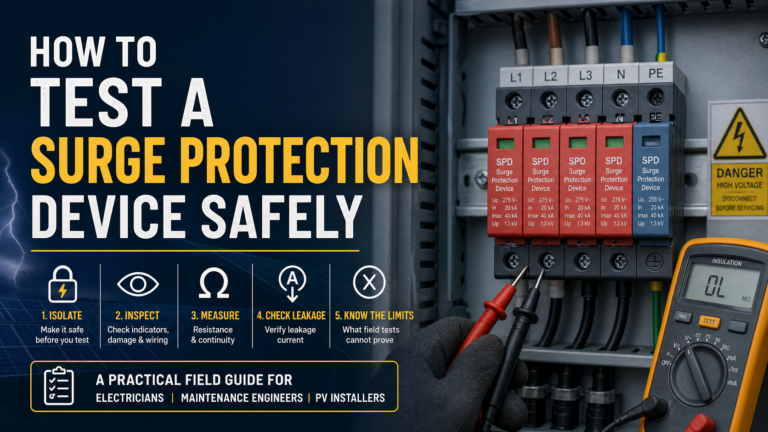
Un procedimiento práctico sobre el terreno para comprobar un dispositivo de protección contra sobretensiones: aislamiento seguro, comprobaciones visuales, mediciones de resistencia y de corriente de fuga, cómo interpretar los resultados y los límites de las pruebas in situ.
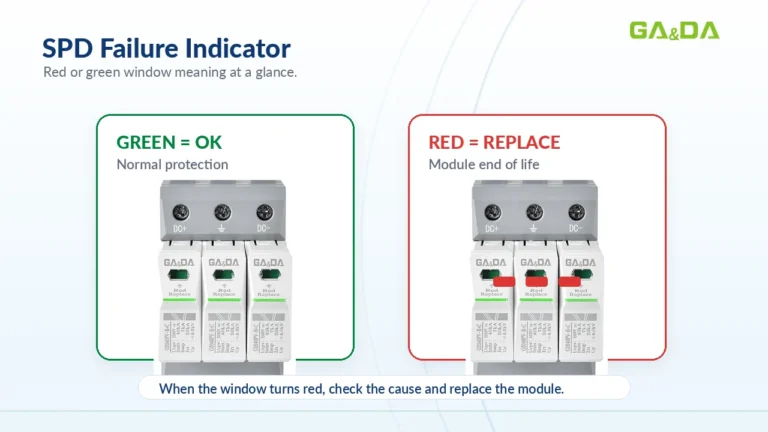
En este artículo se explica el indicador de avería del SPD, el significado de las ventanas roja y verde, las causas más comunes de avería, los pasos para su sustitución y los contactos de señalización remota.
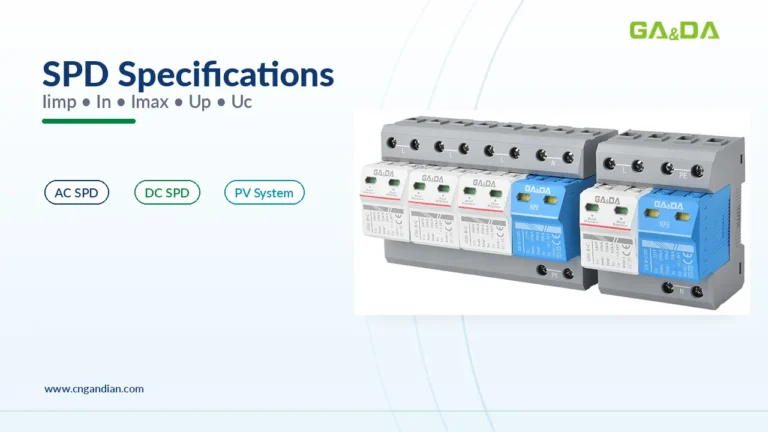
Esta guía explica las especificaciones de los dispositivos de protección contra sobretensiones (SPD), incluyendo Iimp, In, Imax, Up y Uc, lo que ayuda a los compradores a comparar con mayor precisión los SPD de CA, CC y fotovoltaicos.