AC Fuse Base Explained: Types, Ratings, and Selection
Published: Author: Rachel
If you build or maintain low-voltage distribution panels, you mount fuses all the time. But the component that holds each fuse — the AC fuse base — receives far less attention than the fuse link itself, even though the safety of the whole circuit depends on it. This guide explains what an AC fuse base is, the common types you will encounter, the ratings that matter, and how to choose the right one for a control panel, switchboard, or distribution box.
What Is an AC Fuse Base?
An AC fuse base is the fixed mounting and connection component that holds a fuse link in an alternating-current circuit. It secures the fuse link in place, carries the load current through its terminals, and allows a blown fuse to be replaced quickly without rewiring the circuit.
It helps to separate the two parts of a fuse system. The fuse link is the replaceable protective element: it contains the melting element that interrupts a fault. The fuse base is the durable hardware around it — the body, contacts, and screw terminals that keep the fuse link connected to the wiring. The fuse link is a consumable; the base is normally installed once and stays in service for years.
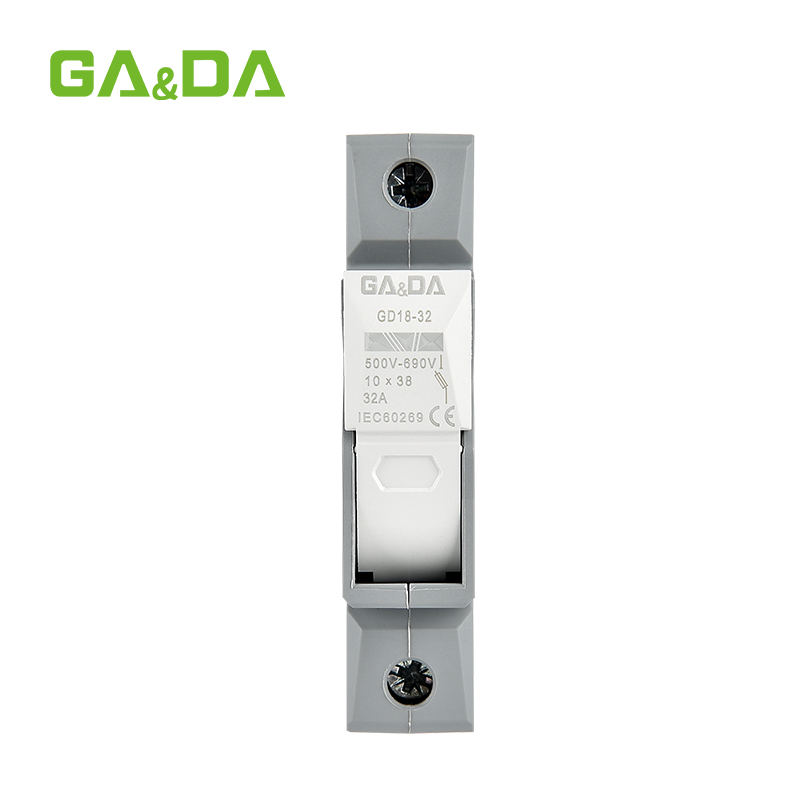
A typical industrial AC fuse base, such as the GA&DA alternating current fuse base, is rated for 690V AC circuits at 32A or 63A, accepts NH/NH00 fuse links and standard 10x38mm cylindrical fuse links, and mounts on a 35mm DIN rail or directly on a panel. The body is flame-retardant thermoplastic with screw terminals and an operating range of -25°C to +55°C, built to IEC/EN standards.
How Does an AC Fuse Base Work?
In normal operation, current flows from the incoming conductor, through the base terminal, across the contact and the fuse link, and out through the second terminal. The base does not interrupt anything by itself — it simply provides a stable, low-resistance current path and keeps the fuse link firmly seated.
When an overload or short circuit occurs, the fuse link melts and opens the circuit at that point. The base then holds the blown fuse safely in position, contains any heat or arc energy, and lets an electrician swap in a new fuse link in seconds.
Many modular bases also add practical functions beyond holding the fuse:
Isolation: grouped 1P/2P/3P bases make it possible to isolate a complete circuit. For applications where you need a full switching function, see what a fuse disconnector is .
Blown-fuse indication: indicator versions show a visible or LED signal when a fuse has operated, which speeds up troubleshooting in dense panels.
Touch protection: finger-safe covers and carriers let fuses be changed without exposure to live parts.
Common Types of AC Fuse Base
AC fuse bases are grouped mainly by the fuse link family they accept and by how they mount:
Cylindrical bases are the default choice inside modern control cabinets because they snap onto a 35mm DIN rail and accept standardized cartridge fuse links in gG (general purpose) or aM (motor circuit) classes. NH-style bases handle higher currents — for example, an NH00 base works with fuse links such as the GA&DA NT00 series AC fuse link rated 160A to 400A. Where a base must also switch and lock out a circuit, a dedicated fuse switch disconnector combines both functions in one unit.
Key Ratings and Specifications to Check
A fuse base is only as safe as its weakest rating. Before specifying one, check these parameters against your circuit:
Parameter
Why it matters
Rated voltage (e.g. 500V or 690V AC)
Must equal or exceed the system voltage; the base must withstand the arc voltage when the fuse clears a fault
Rated current (e.g. 32A, 63A)
Must match or exceed the fuse link rating so the base does not overheat under normal load
Fuse link size and class
The fuse link must fit the contacts exactly — 10×38, 14×51, 22×58 mm, or NH blade sizes, in gG or aM class
Mounting type
DIN-rail and panel-mount bases suit different panel layouts
Terminal type and torque
Screw terminals must suit your conductor cross-section and be tightened to spec
Operating temperature
Confirm the base is rated for the ambient conditions inside the enclosure
Standards compliance
IEC/EN conformity (IEC 60269 family for fuse systems) indicates tested performance
These values interact with the fuse link’s own limits. For a fuller explanation of current, voltage, and breaking capacity values, read the guide to fuse ratings explained.
How to Choose the Right AC Fuse Base
Selection becomes straightforward when you start from the fuse link and work outward:
Define the protection first. Choose the fuse link size, current rating, and class (gG for general distribution, aM for motor circuits) based on the load you are protecting.
Match the base to the fuse link. Confirm the base accepts that exact fuse link size and has a rated current at or above the fuse rating.
Check the voltage rating. A 690V AC base comfortably covers 400V and 230V systems; never use a base rated below your system voltage.
Pick the mounting style. DIN-rail bases speed up panel assembly; panel-mount bases give front access where space is tight.
Verify terminals and conductors. Make sure the screw terminals accept your cable cross-sections at the required torque.
Decide on indication. In panels with many circuits, indicator versions pay for themselves by cutting fault-finding time.
If you are still sizing the fuse itself, the walkthrough on how to select the right fuse rating covers the current and voltage calculations first.
AC Fuse Base vs DC Fuse Base
An AC fuse base cannot automatically be used in a DC circuit. Alternating current passes through zero many times per second, which helps the arc inside a blown fuse extinguish itself. Direct current has no zero crossing, so a DC fault arc can persist much longer and demands contacts, clearances, and arc chambers designed for it.
This is why manufacturers produce dedicated DC fuse bases with higher arc-quenching capability, commonly used in solar and battery systems. The underlying differences are the same ones covered in AC vs DC fuses — and if your project is a PV or battery installation, look at a purpose-built option such as the GDPV-32 direct current fuse base instead of an AC version.
Installation and Safety Practices
Most DIN-rail fuse bases install in a few minutes, but the details determine long-term reliability:
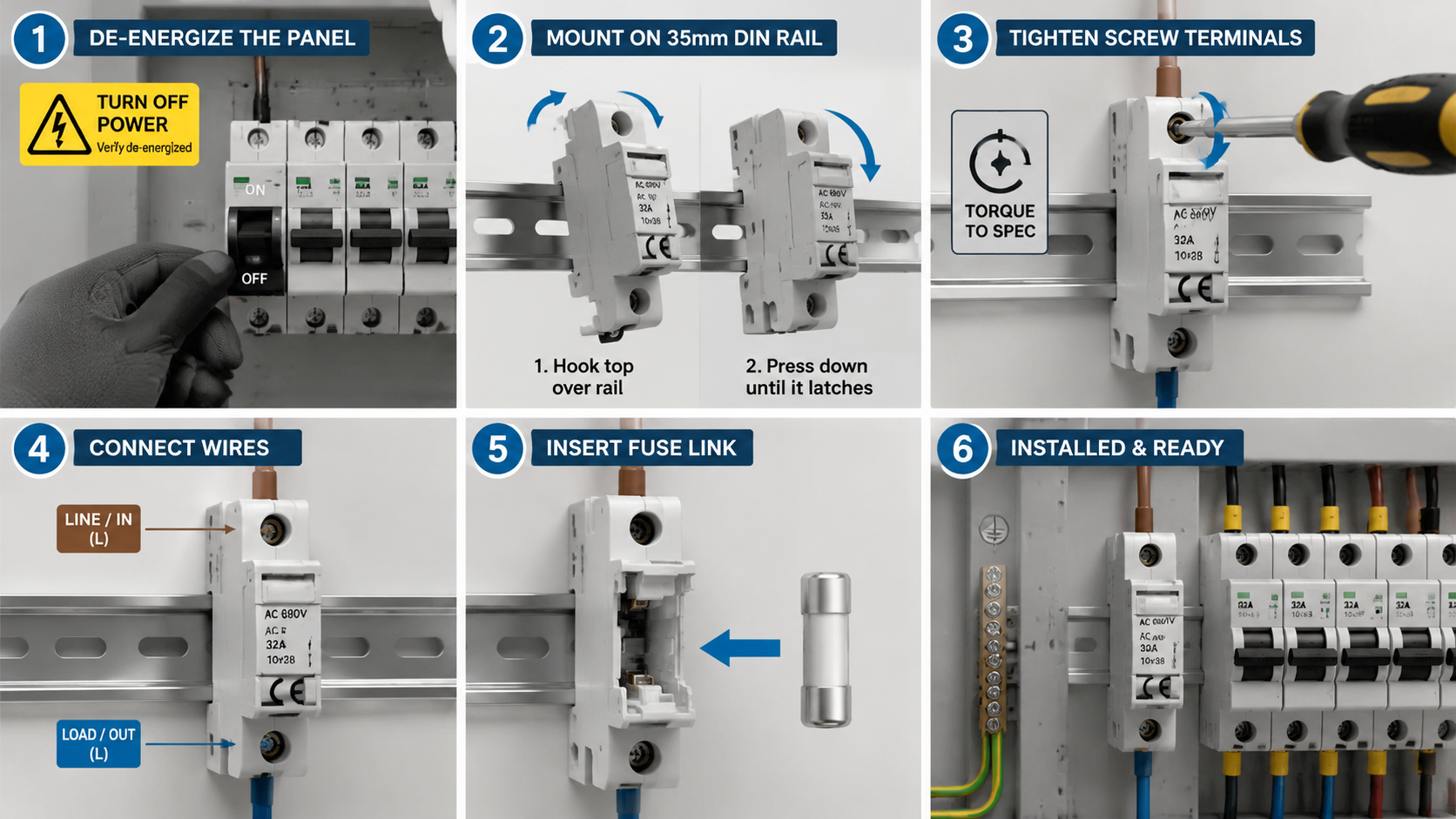
De-energize the panel and verify with a tester before touching any fuse base.
Hook the top of the base over the 35mm DIN rail first, then press the bottom until it latches.
Tighten screw terminals to the manufacturer’s torque value — undertightened terminals are a leading cause of localized overheating.
Seat the fuse link fully in the contacts; a partially seated fuse runs hot and can fail early.
Keep finger-safe covers in place so replacement can be done safely in live panels where regulations allow it.
Common Mistakes to Avoid
Substituting an AC base in a DC circuit. The arc may not clear, creating a fire and shock hazard.
Forcing a mismatched fuse link. A fuse link that does not match the contact geometry creates a high-resistance joint and heat damage.
Ignoring the base’s current rating. A 32A base carrying a 63A fuse link will overheat long before the fuse protects it.
Leaving terminals loose. Vibration and thermal cycling gradually loosen screws; recheck torque during scheduled maintenance.
Overlooking indication. Without an indicator, a single blown fuse in a three-phase circuit can leave a motor running on two phases.
Frequently Asked Questions
What does an AC fuse base do?
It holds a fuse link securely in an alternating-current circuit, provides the electrical connection between the fuse and the wiring, and allows the fuse to be replaced safely and quickly after it blows.
Can I use an AC fuse base in a DC circuit?
Not unless the base is explicitly rated for DC. DC arcs do not self-extinguish at a current zero, so the base must be designed with the arc-quenching capability and clearances required for DC service.
What fuse links fit an AC fuse base?
Each base accepts one family of fuse links — commonly 10×38, 14×51, or 22x58mm cylindrical links on DIN-rail bases, or NH/NH00 blade links on larger bases. The fuse link size, current rating, and class (gG or aM) must match what the base is built for.
How do I know which fuse base rating I need?
Start with the fuse link your circuit requires, then choose a base whose rated voltage and current are equal to or higher than the fuse link’s ratings, and confirm it accepts the same fuse link size and mounting arrangement.
DIN rail or panel mount — which should I choose?
DIN-rail bases are faster to install and reposition, which suits control panels and distribution boards that change over time. Panel-mount bases give front access through the enclosure and suit appliances and equipment where the fuse must be replaced from outside.
The Base Supports the Fuse — Choose It with the Same Care
A fuse link only protects a circuit if its base holds it with firm, low-resistance contacts and carries the load current without overheating. Match the base to the fuse link’s size, class, and ratings, respect the AC/DC boundary, and install it with correct torque, and the fuse system will do its job for years.
If you are specifying fuse bases for a distribution panel or machinery build, you can review ratings and mounting options on the GA&DA AC fuse base product page, or contact the GA&DA team with your panel layout for selection support.
A blowing solar fuse is either a real fault being cleared or nuisance operation. Learn how to tell the two apart, the causes behind each, the measurements that confirm them, and why replacing the fuse without diagnosing is the wrong response.
A DC-specific comparison of fuses and circuit breakers in solar PV systems: arc extinction without a current zero, operating speed, energy let-through, selectivity, reset and maintenance, with a decision matrix for string, combiner box, inverter DC input, battery/BESS and DC main positions.
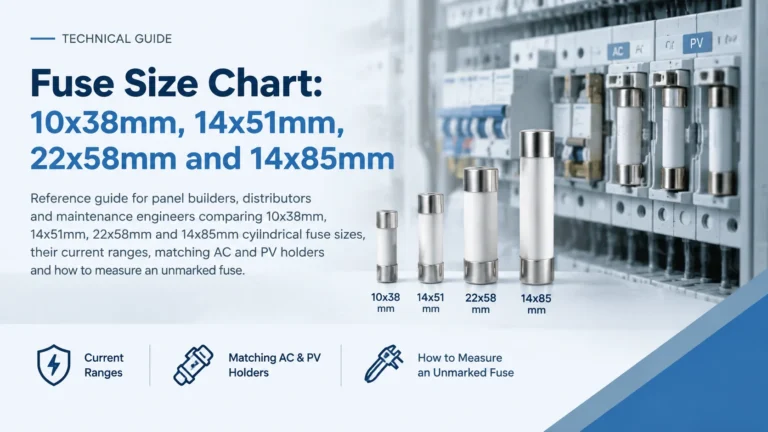
A fuse size chart for 10x38, 14x51, 22x58 and 14x85mm fuses: dimensions, current ranges, matching AC and PV holders, and how to measure an unmarked fuse.