Fuse Size Chart: 10×38mm, 14×51mm, 22×58mm and 14×85mm
Publicado: Autor: Rachel
Quick answer: how fuse size is written
A fuse size chart is really a table of two numbers. Cylindrical fuse sizes are written as diameter × length in millimetres — 10×38 mm, 14×51 mm, 22×58 mm and 14×85 mm are the four you will meet most often in low-voltage distribution and photovoltaic work. Fuse size tells you what fits where, and it is the first thing to confirm when replacing a fuse or specifying a holder.
It is also the most over-trusted number on the fuse. Two fuses with identical dimensions can carry different voltage ratings, different operating classes and different breaking capacities, and swapping one for the other on the basis of size alone is how protection systems quietly stop protecting anything. This chart gives the dimensions and the typical pairings for each size, then sets out what the size does not tell you.
How to read a fuse size and measure one you already have
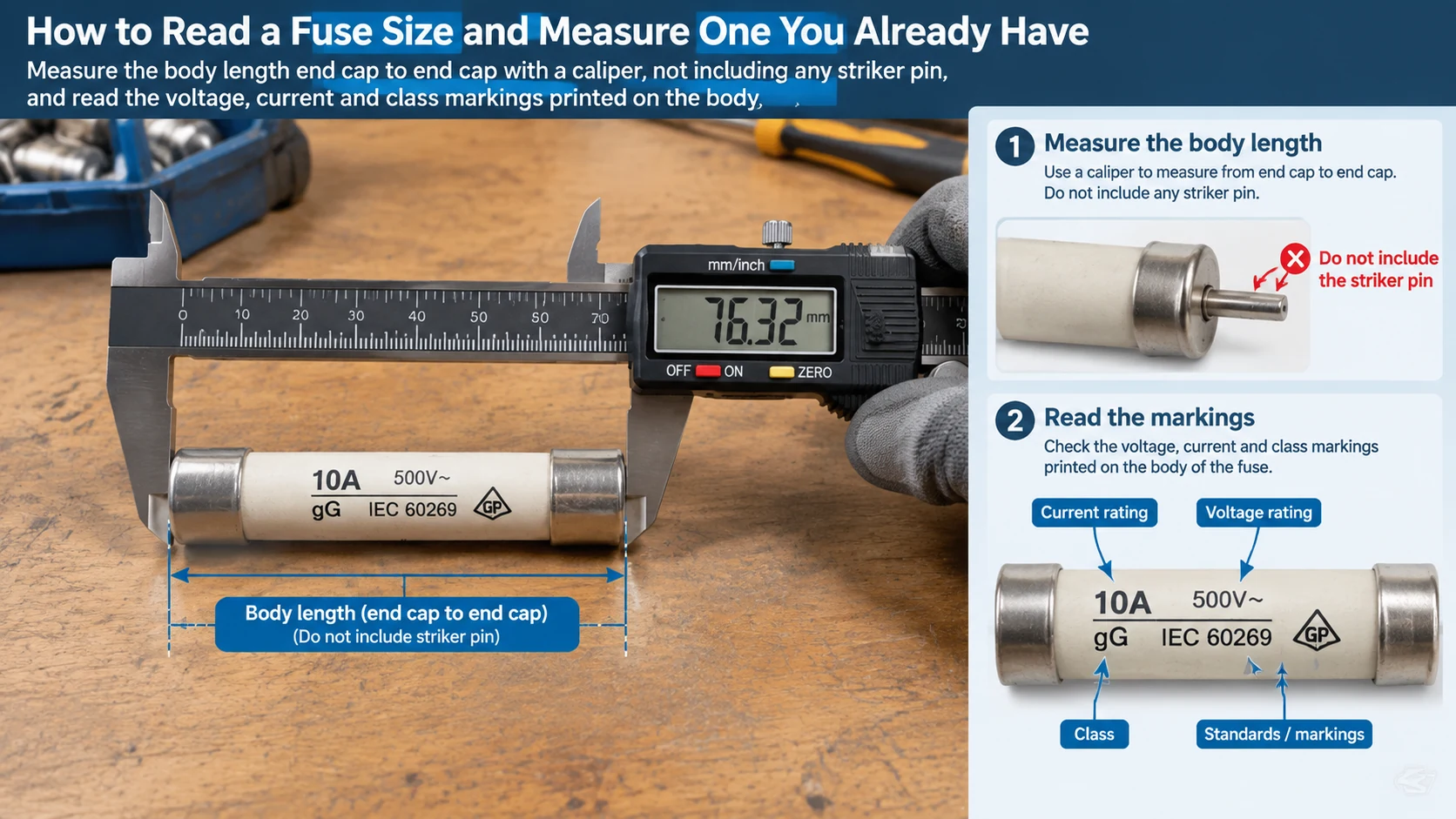
The size designation is diameter × length in millimetres. It refers to the cylindrical body, and the diameter is a nominal figure rather than an exact one. Measure a 10×38 mm fuse across the end cap with a caliper and you will typically read around 10.3 mm, not exactly 10 mm; a 22×58 mm fuse usually measures close to 22.2 mm. This is normal manufacturing tolerance on the cap, and it is the reason a holder designed for one size will not accept the next one up even when the numbers look close.
To measure a fuse you are trying to replace:
De-energise the circuit and confirm it is dead before removing anything.
Use a caliper rather than a rule. A 1 mm difference between 14 mm and 15 mm is within the range where a tape measure is not reliable.
Measure the body length end cap to end cap, not including any striker pin.
Read the markings on the body or cap — voltage, current and class are usually printed there, and they are the values a replacement has to match.
Check the holder as well as the fuse. If the holder is marked, its rating tells you what the circuit is designed to accept.
Modern cylindrical fuse links carry their ratings on the body or on the metal end caps. Those markings are the authoritative source; a size measurement only tells you what will physically fit.
Cylindrical fuse size chart
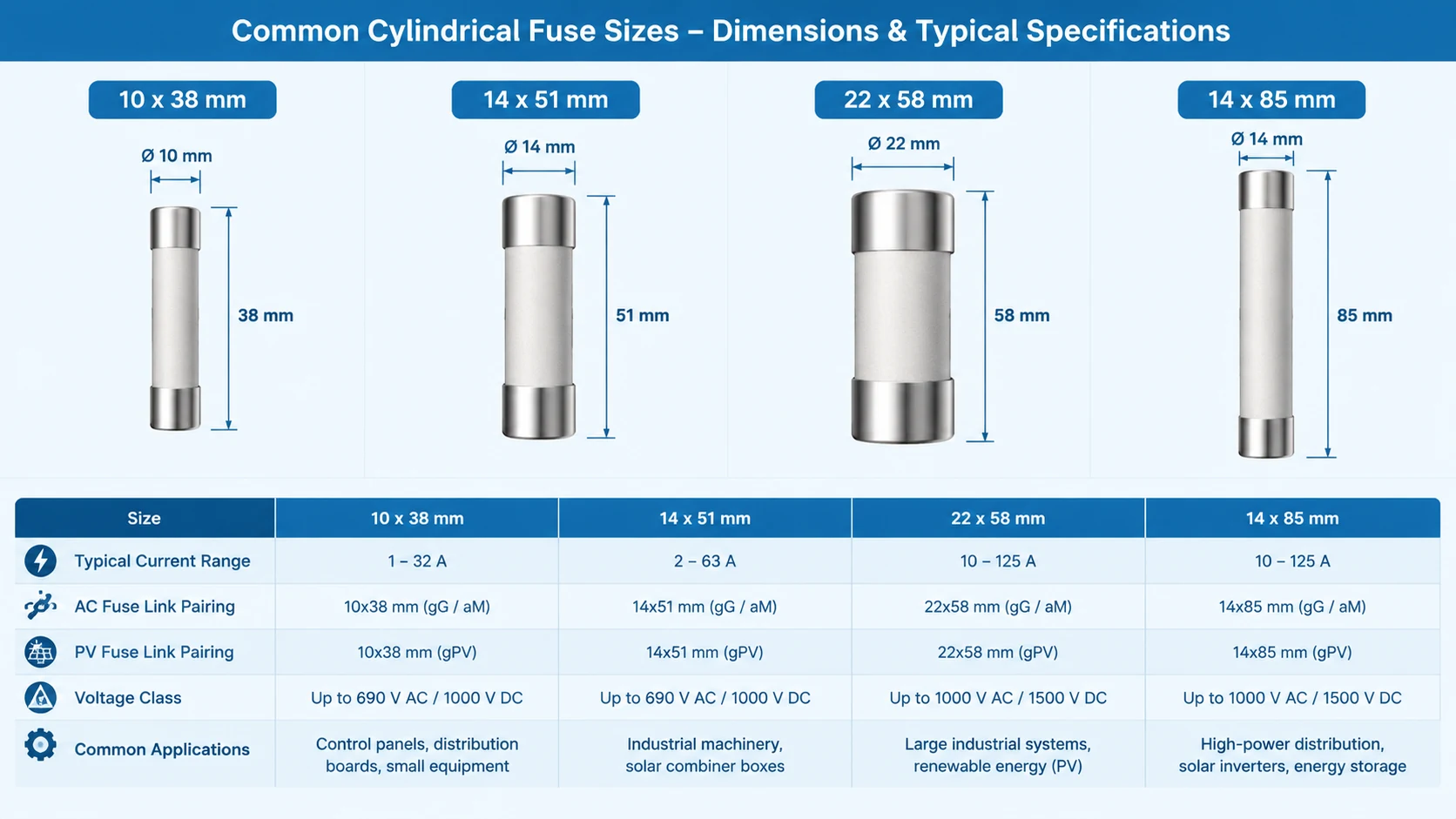
The table below covers the four common cylindrical sizes, the current ranges typically available in each, and the standard pairings used in AC distribution and solar PV work. Ratings shown are typical for these formats rather than a limit on what any particular series offers.
Size (Ø × L)
Typical current range
AC fuse link + holder
PV fuse link + holder
Typical voltage
Uso habitual
10×38 mm
Up to 32 A
RO15 + RT18-32 / GD18-32
GD-10PV / GD-12PV + GDPV-32L
500 V AC · 1000 V DC
Control circuits, small distribution, PV strings
14×51 mm
Up to 63 A
RO16 + RT18-63
GD-14PV + GDPV-50B
500 V AC · 1000 V DC
Distribution and control panels, PV combiner boxes
22×58 mm
Up to 125 A
RO17 + RT18-125
GD-15PV series + GDPV-22B
500 V AC · 1000 V DC
AC main distribution, 1000 V DC array feeds
14×85 mm
Typically 8–50 A in gPV
—
GD-13PV + GDPV-50 series
1500 V CC
High-voltage solar PV strings and combiners
Notice the pattern: the first three sizes appear on both the AC and the PV side, and the fourth is a PV-only format. That overlap is exactly where mismatched substitutions happen, so read the next section carefully.
10×38 mm — the small general-purpose size
At 38 mm long and roughly 10 mm across, this is the most widely used small cylindrical format. In AC work it pairs with RO15 fuse links rated 32 A at 500 V AC in gG class, held in RT18-32 or GD18-32 holders. On the PV side the same body size carries GD-10PV and GD-12PV links rated up to 32 A at 1000 V DC in gPV class, held in a GDPV-32L base.
The 10×38 mm format fits comfortably into dense control panels, which is both its advantage and its risk. Because the holders are small and look similar, an AC holder and a DC holder of the same physical size can sit side by side in the same cabinet and be swapped by someone reading only the size.
14×51 mm — the mid-range size
The longer 51 mm body gives more arc-quenching volume, which supports higher current ratings. In AC service, RO16 links reach 63 A at 500 V AC in gG class, using RT18-63 holders. For PV, GD-14PV links cover 15–50 A at 1000 V DC in gPV class with a GDPV-50B base, and this pairing is common on PV combiner boxes where several strings are grouped.
The jump from 32 A to 63 A between the 10×38 mm and 14×51 mm formats is one of the few places where fuse size correlates strongly with current capability. It is still not a rule you can rely on for voltage.
22×58 mm — the high-current AC format
The largest of the three AC-side formats, 22×58 mm carries RO17 links up to 125 A at 500 V AC in gG class on RT18-125 holders, and it is the size you find on AC main distribution feeders. On the PV side, GD-15PV series links in 30–50 A at 1000 V DC are listed in this format with the GDPV-22B base for 1000 V DC solar protection.
The 85 mm body is noticeably longer than the other three, and that extra length is functional rather than cosmetic. A 1500 V DC arc needs more distance and more arc-quenching fill to extinguish than a 500 V AC arc, so high-voltage PV formats are longer. The GD-13PV 25A 1500 V DC fuse link uses this format in gPV class with a 20 kA breaking capacity, and the series spans 8–50 A.
The 14×85 mm body pairs with the GDPV-50 series of PV fuse bases, which accept both 10×85 mm and 14×85 mm links depending on model and support both 1000 V and 1500 V DC systems. Because two compatible formats exist in the 85 mm length, confirm the diameter as well as the current rating when ordering a replacement.
What fuse size does not tell you
This is the part of the chart that matters most. Size is a mechanical fact; the four values below are electrical, and none of them can be inferred from the dimensions.
Parámetro
Why size cannot substitute for it
Voltage rating
A 10×38 mm link exists in 500 V AC gG and 1000 V DC gPV versions. The bodies are the same; the ratings are not interchangeable.
Operating class
gG, aM and gPV classes share body sizes but interrupt different fault profiles. Using a gG link in a PV string leaves the circuit protected by a device never tested for that duty.
Capacidad de frenado
Two links of the same size can differ substantially in the fault current they can safely interrupt.
Holder rating
A holder of the correct size may still be rated below the fuse link’s current or voltage. The assembled pair performs to the lower of the two.
The four sizes above are the cylindrical family. Two other groups show up regularly in distribution work and should not be confused with them:
Blade-type or NH/NH00 fuses. Rectangular bodies with knife contacts, used from tens of amps into the hundreds. A DIN-rail fuse base of the 10×38 mm family and an NH00 base are not interchangeable in any respect, including physical fit.
Small glass and ceramic formats. 5×20 mm and 6×30 mm fuses appear in instrumentation, control-power and appliance circuits at low currents. They are the same naming convention as the industrial sizes but a completely different application class.
There is also an 8.5×31.5 mm format that predates the 10×38 mm standard and still appears in older equipment. It is shorter than the 10×38 mm body and will not seat correctly in a 10×38 mm holder without modification, which is never an acceptable solution.
Identifying an unmarked fuse
When the body marking is illegible or absent, work through the following before ordering a replacement:
Measure precisely with a caliper and compare against the chart rather than estimating.
Measure the length first. Length separates the families more reliably than diameter, because tolerance on the cap diameter is proportionally larger.
Check the holder. The holder’s model number often reveals the intended fuse size, voltage and class, since a holder is built for one family of links.
Check the circuit. AC or DC, the system voltage and the load current narrow the possible ratings considerably.
Do not substitute by appearance. If the voltage and class cannot be established, replace the holder and fit a known-rated fuse rather than guessing at the link.
Where the fuse protects a solar string, note that AC and DC links of similar appearance are built differently internally even when the body dimensions match — the reasons are set out in our comparison of AC and DC fuse construction.
Frequently asked questions
What do the numbers in a fuse size mean?
The first number is the nominal diameter and the second is the body length, both in millimetres. A 10×38 mm fuse is nominally 10 mm across and 38 mm long between the end caps.
Is a 10×38 mm fuse the same as a 10×38 mm holder?
They are the same size, but that does not make them a valid pair. The holder must also be rated at or above the fuse link’s voltage and current, and must be intended for the fuse link’s operating class. An AC holder of the right size is not suitable for a 1000 V DC gPV link.
What is the largest current available in a 10×38 mm fuse?
Around 32 A is the practical limit for this format in both AC gG and PV gPV versions. Higher currents move up to the 14×51 mm or 22×58 mm formats, which provide more body volume for arc quenching.
Why is a 1500 V DC fuse longer than an AC fuse?
A DC arc has no natural current zero to help extinguish it, and the higher the DC voltage the longer the arc can sustain itself. The extra length gives the fuse more arc-quenching fill and greater separation to interrupt the arc reliably.
Can I replace a 14×51 mm fuse with a 10×38 mm fuse?
No. The contact geometry differs, so the smaller link will not seat properly and will make poor contact in the holder. Poor contact creates localised heating, which is a common cause of premature fuse failure.
How do I know if a fuse is AC or DC rated?
The marking on the body or end cap states VAC or VDC along with the value and, for photovoltaic parts, the gPV classification. If the marking cannot be read, treat the fuse as unknown rather than assuming it matches the holder.
Confirm the size, then confirm everything else
Fuse size gets you to the right shelf. It does not confirm that the fuse will carry the load, interrupt the fault or survive the system voltage. Measure carefully, read the markings, and check the holder, then verify voltage, current and class against the circuit before you install anything.
The full range of matched fuse links, holders and bases across all four cylindrical sizes — including the 1000 V and 1500 V DC photovoltaic formats — is listed on the GA&DA fuse and fuse holder range. If you need a size that is not listed, send the diameter, length, voltage, current and estimated quantity and the team will confirm availability.
A blowing solar fuse is either a real fault being cleared or nuisance operation. Learn how to tell the two apart, the causes behind each, the measurements that confirm them, and why replacing the fuse without diagnosing is the wrong response.
A DC-specific comparison of fuses and circuit breakers in solar PV systems: arc extinction without a current zero, operating speed, energy let-through, selectivity, reset and maintenance, with a decision matrix for string, combiner box, inverter DC input, battery/BESS and DC main positions.
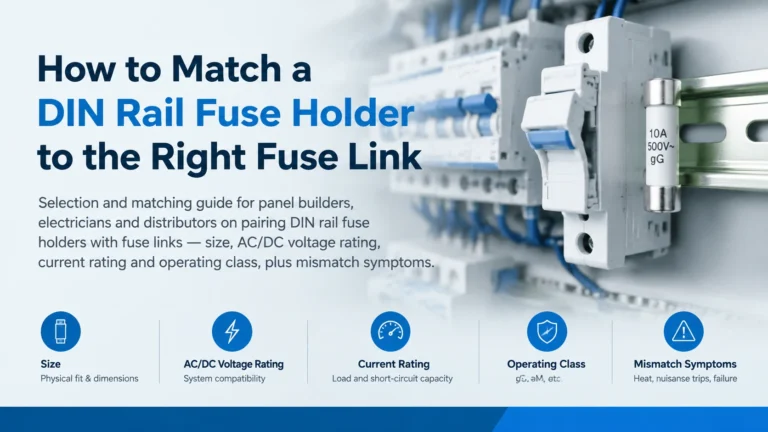
How to choose a DIN rail fuse holder and match it to a fuse link: size, AC or DC voltage, current rating and class, plus the symptoms of a mismatched pair.