Protetor contra picos de tensão vs. fusível: falhas diferentes, proteção diferente
Publicado: Autor: Rachel
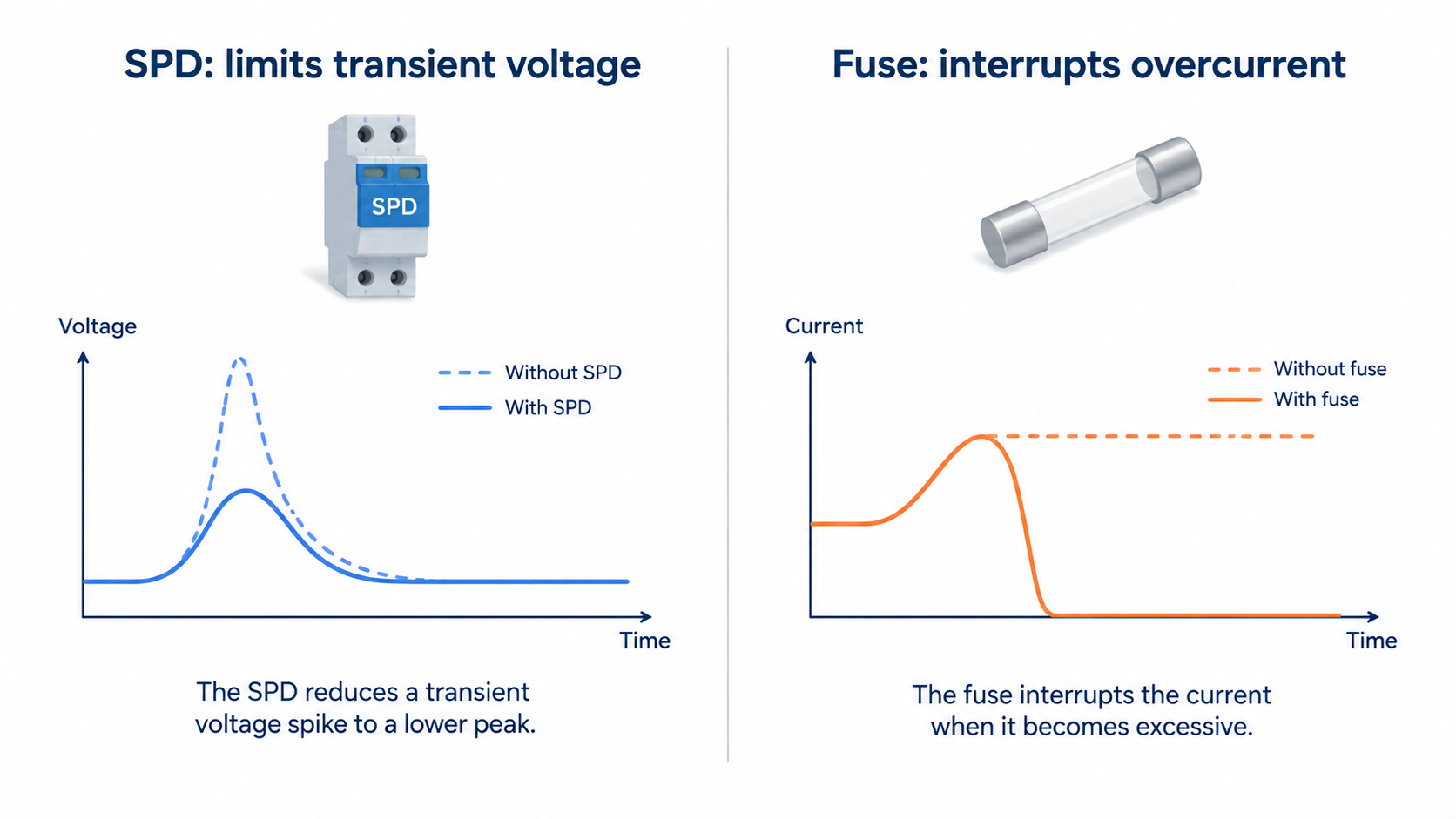
A surge protector limits transient overvoltage; a fuse interrupts excessive current. That is the essential difference in a surge protector vs fuse comparison. They address different electrical stresses, so choosing one does not automatically remove the need for the other. A fused circuit can still need surge protection, and a circuit with an SPD still needs appropriate overcurrent protection.
For a panel buyer or maintenance planner, the useful question is which fault each component covers. This guide compares conventional, one-time overcurrent fuses with power-circuit surge protective devices (SPDs). It also explains why an internal thermal fuse, an SPD backup fuse and a load-circuit fuse should not be treated as interchangeable parts.
Compare the Fault Each Device Is Designed to Handle
Start with the electrical condition rather than the device name. A transient overvoltage is a brief voltage disturbance. An overcurrent is current beyond the circuit’s intended limits, such as an overload or short circuit. One event can involve both, but voltage limiting and current interruption remain separate protection tasks.
Comparação
Surge protective device
Conventional overcurrent fuse
Primary task
Limit transient voltage across protected conductors
Interrupt excessive current through its circuit
Protective action
Conduct surge current through a protective path to limit voltage
Melt its element and clear the resulting arc to open the circuit
Typical arrangement
Power SPDs commonly connect as a parallel protective branch
Connects in series with the circuit it protects
After an event
May remain serviceable within its design limits; check status
An operated one-time fuse requires replacement after the fault is addressed
What it does not establish
Adequate overload or short-circuit protection for the load
A controlled voltage level at sensitive equipment during a surge
Eaton’s surge-protector explanation makes the same functional distinction: fuses and breakers address overcurrent, while surge protectors address voltage spikes. Do not turn that distinction into a blanket claim that one device is “faster” or “better.” Compare each device against the disturbance it is designed to manage.
Conceptual waveforms only; not to scale and not a wiring diagram.
Why a Fuse Cannot Replace Surge Protection
A fuse can open during a disturbance if the current through it is sufficient for its operating characteristic. However, that does not make it a voltage-clamping device. Equipment may experience a damaging transient without an associated current pulse that causes the fuse to clear. An intact fuse therefore does not prove that no surge occurred.
Imagine a control panel that remains powered after a storm but has a failed electronic input. The unbroken fuse only tells you that its element has not opened. It does not establish the voltage that appeared at the input terminals. Equally, the timing of the failure does not prove lightning was the cause; diagnosis still needs evidence.
A second source of confusion is the phrase anti-surge fuse. In fuse terminology this commonly means a time-delay fuse designed to tolerate specified short current pulses, such as startup inrush. It does not mean that the fuse suppresses voltage spikes. Eaton’s fuse FAQs explain the role of time-delay characteristics in avoiding unnecessary opening during permissible inrush.
When reviewing a quotation, ask whether “surge” refers to an allowed current pulse or a transient voltage to be limited. Those are different requirements. Replacing a fuse with another speed characteristic should follow the equipment manufacturer’s specification, not an assumption based on the word “surge.”
Why an SPD Cannot Replace a Load Fuse
Suppose too many loads are connected to a circuit while the supply voltage stays within its normal range. A voltage-limiting SPD is not a device that measures the load current and disconnects that overloaded circuit. A short circuit likewise requires an appropriately selected overcurrent protective device with adequate interrupting capability.
Fuses serve that interruption role. Their performance depends on the particular fuse class, current rating and operating characteristic. Some fuse types provide only part of the required overcurrent protection and must be coordinated with other devices. The Littelfuse fuse fundamentals guide addresses overcurrent protection as a distinct design subject.
A product containing both an SPD and a fuse may provide several functions in one enclosure. The functions come from the components and their verified coordination, not from the enclosure’s name. A fuse inside a surge-protection assembly might protect the SPD branch rather than the downstream load.
For procurement, identify the purpose of the fuse before selecting from an AC or DC fuse range. Record whether it is protecting a load circuit, a component or the SPD itself. A request simply stating “fuse included” leaves that important question unanswered.
How Both Functions Work in One Installation
Separate the Load Circuit from SPD Backup Protection
In a common parallel SPD arrangement, the load receives power through its normal protective circuit while the SPD provides a separate path for surge current. The SPD branch may need backup overcurrent protection to disconnect it if a fault develops. That backup device has a different assigned job from a fuse protecting a load circuit.
Whether a separate backup device is required depends on the SPD’s instructions and the existing protection arrangement. Schneider Electric’s US Type 2 SPD guidance directs installers to the manufacturer’s overcurrent-protection requirements and conductor constraints. Its classification context should not be transferred automatically to every IEC product or installation.
Do not select a backup fuse solely by comparing its ampere rating with a surge-current number on the SPD. Use the specified combination and applicable fault-current conditions. The detailed selection discussion belongs in the existing SPD backup fuse or circuit breaker guide; the key here is recognizing that backup protection and surge suppression complement each other.
Distinguish Thermal Disconnection from Fault Interruption
Many voltage-limiting SPDs use metal-oxide varistors (MOVs). Under certain abnormal sustained-voltage conditions, an MOV can overheat. A thermal disconnector is intended to disconnect an overheating element. It is not automatically a replacement for the load fuse or for every required short-circuit protective function.
Littelfuse’s thermally protected MOV application note explains this thermal-failure mechanism. Its component discussion is useful for understanding the distinction; final assembly requirements still come from the actual SPD documentation.
Some SPDs integrate backup protection as part of a tested design. That can change the need for an external backup device within the stated application limits. It does not authorize removing unrelated load protection. Ask the supplier to identify the internal protection function and the installation conditions it covers.
Use the Fault Scenario to Identify the Protection Gap
The following examples are conceptual review cases, not diagnoses or wiring instructions. They help you ask the right follow-up question before ordering another component.
Equipment fails while the fuse remains intact: investigate possible transient exposure alongside other failure causes. Check whether suitable surge protection was installed and operational. Do not assume a smaller fuse would have prevented the failure.
A fuse opens repeatedly when equipment starts: investigate load behavior, faults and the specified fuse characteristic. A surge protector does not correct an overload. Do not increase the fuse rating or change its speed simply to keep the equipment running.
The load operates but the SPD reports end of life: power availability and surge-protection availability are separate observations. Arrange inspection and restoration of protection according to the device instructions.
For solar or other DC equipment, establish the same functional distinction first, then verify application compatibility. An AC protective device is not acceptable in a DC circuit merely because its printed voltage appears high enough. The required DC ratings, fault conditions and approved connection arrangement must be documented.
This approach also prevents a common specification error: trying to solve an unexplained failure by adding whichever protective device is cheapest. Identify the suspected stress, establish the missing function, and have the selection checked against the installation data.
Check Separate Ratings Before Approving a Specification
A shared unit does not make two ratings equivalent. A fuse’s voltage rating concerns its permitted interruption application; it is not a voltage-clamping threshold. Likewise, the kiloampere figure for an SPD surge test is not interchangeable with a fuse’s short-circuit breaking capacity. Eaton’s fuse technology reference explains fuse voltage, interrupting and time-current characteristics.
Use a specification review with separate evidence for each function:
System data: AC or DC supply, operating voltage, installation location and available fault current.
Overcurrent protection: required fuse class, current rating, time-current characteristic, interrupting rating and equipment instructions.
Surge protection: appropriate system configuration, continuous-voltage capability, protection level and surge-test ratings.
Coordination: the SPD manufacturer’s permitted backup protection and applicable short-circuit conditions.
Maintenance: how the installed assembly indicates loss of protection and which components require replacement.
Does a Fused Power Strip Necessarily Include Surge Protection?
No. A fuse or resettable overcurrent device does not establish that voltage-surge suppression is present. Check the product’s stated surge-protection function and ratings. The number of outlets, a power switch or a “protected” marketing label alone is insufficient evidence.
Is a Green Power Light Proof That the SPD Still Works?
Only if the manual identifies that indicator as monitoring the relevant protective function. A power-present light and a protection-status indicator can mean different things. The SPD failure indicator guide explains why the model-specific meaning matters.
Does a Higher Fuse Voltage Rating Provide Better Surge Suppression?
No. It does not add a clamping function. Select the fuse voltage rating and other characteristics for its approved application; select surge protection separately for the transient-voltage requirement.
Will Either Device Correct a Sustained Abnormal Supply Voltage?
Do not assume so. Sustained overvoltage is a separate problem from a brief transient or an overcurrent. A design may require voltage monitoring and disconnection in addition to surge and overcurrent protection. Any combined product must explicitly provide the required function.
Specify Complementary Protection
The surge protector vs fuse decision starts with two questions: what limits transient voltage at the equipment, and what interrupts unacceptable current? A complete specification answers both, identifies any SPD backup protection, and defines how a failed component will be detected and replaced.
A maioria das caixas de distribuição de corrente contínua solar (DCDBs) está equipada com um dispositivo de proteção contra sobretensão (SPD) de corrente contínua do Tipo 2, classificado para correntes de sobretensão de 8/20 µs; é necessário um SPD de corrente contínua do Tipo 1+2 quando o circuito de corrente contínua está exposto a descargas atmosféricas diretas ou quando o local não dispõe de um sistema externo de proteção contra raios. Este guia explica como decidir […]
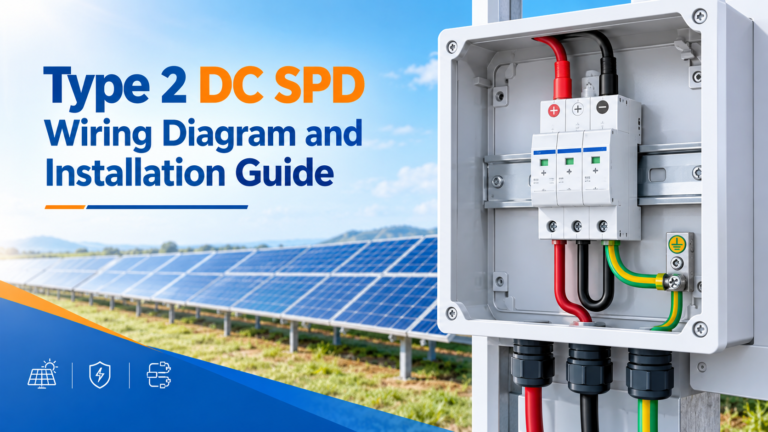
Como ligar e instalar um dispositivo de proteção contra sobretensão de corrente contínua do Tipo 2 num sistema fotovoltaico: ligações aos terminais, ligação em paralelo, fusível de reserva ou disjuntor miniatura (MCB), ligação à terra e erros comuns.
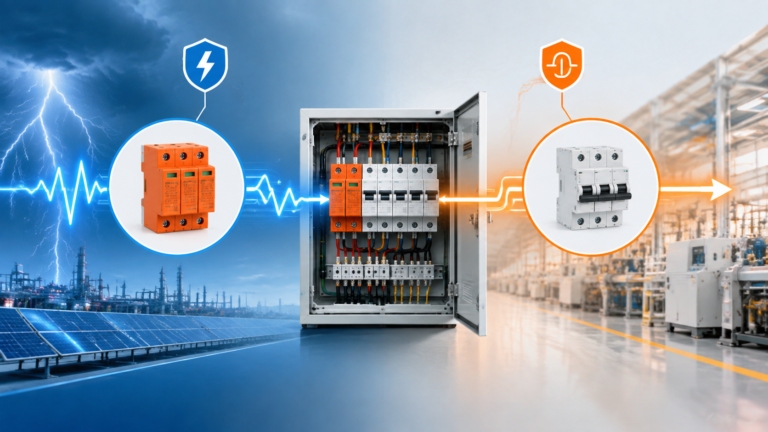
Os pára-raios limitam as sobretensões transitórias; os disjuntores eliminam as sobrecargas e os curto-circuitos. Compare as funções, as aplicações e a coordenação.