IP54 vs IP65 vs IP66 for Outdoor Distribution Boxes
Publicado: Autor: Rachel
An outdoor distribution box fails for reasons that have very little to do with the IP number printed on the lid. Water gets in through a gland that was never tightened, through a knockout that was punched and left open, or as condensation on the inside of a sealed enclosure that never had a chance to breathe. The IP rating tells you what the enclosure survived in a laboratory, and it is the right place to start — but it is only one of five things that decide whether the box is still dry after two winters.
For most outdoor boards, IP65 is the practical minimum. IP54 is adequate only where the box sits under a shelter and never sees a direct jet. IP66 is worth the extra cost where the box will be hosed down, and it is unnecessary where the only water is rain.
What the two digits actually mean
The IP code has two numbers. The first is protection against solids, the second against water. They are independent, so IP65 and IP56 are not on the same scale — the first is dust tight and jet resistant, the second is only dust protected but handles more water.
Code
Solids (first digit)
Water (second digit)
What it survives in practice
IP44
Objects over 1 mm
Splashing water
Indoor bathrooms, sheltered positions only
IP54
Dust protected, limited ingress
Splashing water
Under a roof overhang, away from jets
IP55
Dust protected
Water jets, low pressure
Sheltered outdoor wall, occasional cleaning
IP65
Dust tight
Water jets, 6.3 mm nozzle
Exposed outdoor wall, normal rain and cleaning
IP66
Dust tight
Powerful water jets, 12.5 mm nozzle
Washdown areas, heavy industrial, coastal exposure
IP67
Dust tight
Temporary immersion
Occasional flooding, not typical for wall-mounted boards
The difference between the water digits is more specific than most buyers expect. Level 4 is splashing from any direction. Level 5 is a 6.3 mm nozzle at 12.5 litres per minute from any direction. Level 6 is a 12.5 mm nozzle at 100 litres per minute. Level 6 is not a small step up from level 5; it is roughly eight times the flow.
IP54, IP65, IP66: which one for which position
IP54 is a dust-protected enclosure with splash protection. It suits a box mounted inside a covered walkway, under a canopy, or in a plant room where hoses are not used. It is not adequate on an exposed wall, because wind-driven rain hits at an angle and behaves more like a low-pressure jet than a splash.
IP65 is the default for exposed outdoor mounting. Dust tight means the internal mechanism stays clean, which matters for contacts and for any thermal management that depends on clean surfaces. Jet resistance covers rain driven at an angle and the occasional garden hose. For the majority of residential, commercial and light industrial outdoor boards, this is the right specification.
IP66 is for washdown and heavy exposure: food processing, vehicle workshops, pumping stations, coastal installations where salt spray arrives with force. It costs more and the glands cost more too, which is where the budget usually gets tested.
One thing IP does not cover, and this catches people out: the second digit has nothing to do with corrosion, UV degradation, or condensation. An IP66 polycarbonate box can still fail in three years in a coastal installation if the gasket hardens or the mounting screws rust.
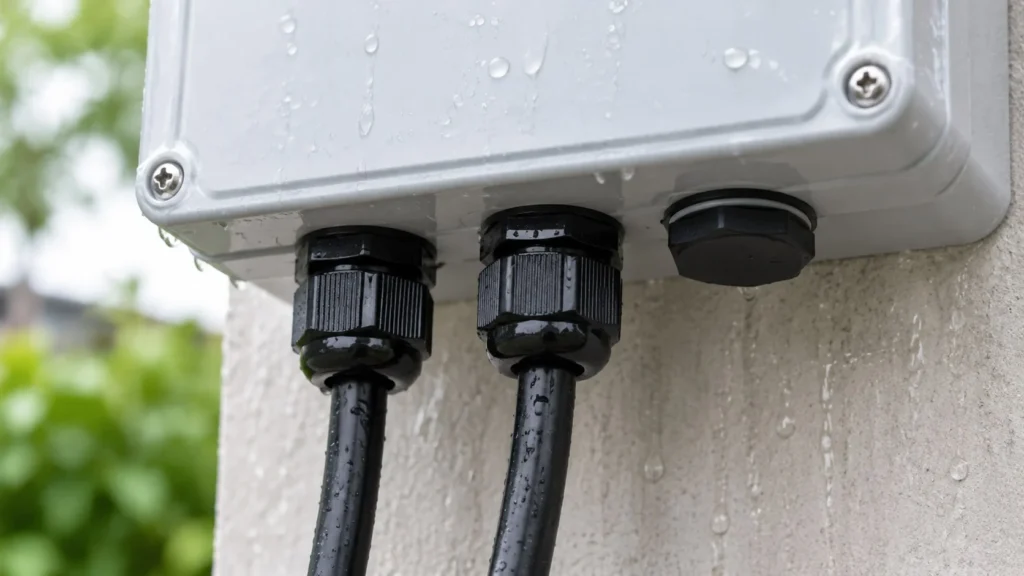
Two glands and one blanked spare entry. Every entry in the bottom face is a potential leak path, and a gland rated below the enclosure sets the rating for the whole box.
Where water actually gets in
In a field failure, the enclosure body is almost never the leak path. The entry points are:
Cable glands. A gland rated lower than the enclosure sets the rating for the whole assembly. An IP65 box with IP54 glands is an IP54 installation.
Knockouts and unused entries. Every open knockout is a direct path. Blanking plugs have to be rated and fitted with a sealing washer.
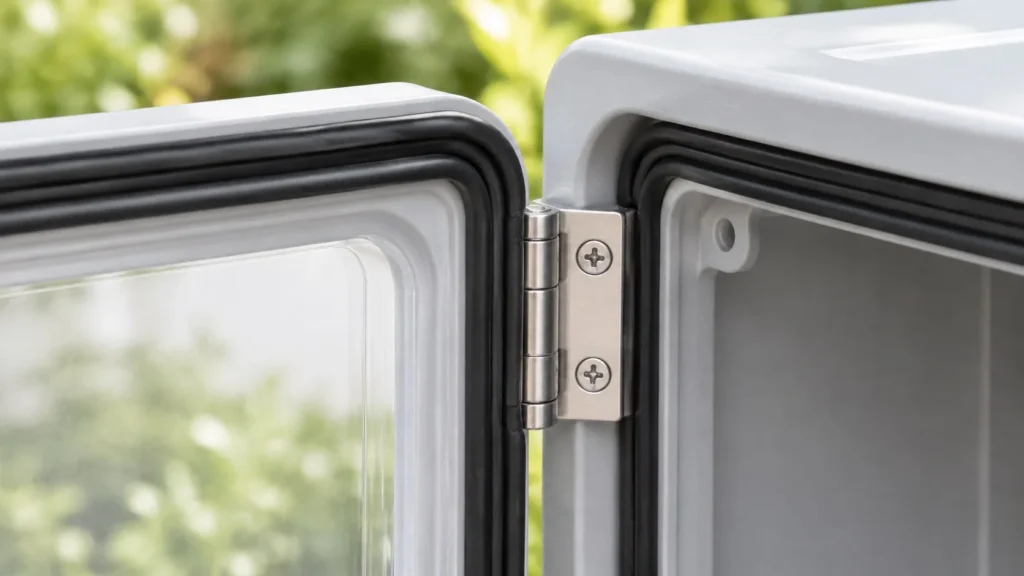
The door gasket. A pinched, painted over or hardened gasket leaks. Gasket material matters more than thickness: EPDM tolerates UV and temperature cycling better than cheap PVC foam.
Condensation. A perfectly sealed box traps the moisture that was in the air when it was closed. Daily temperature cycling drives that moisture onto the coldest surface, which is usually the metal DIN rail and the terminals.
The mounting surface. A box fixed flat against a wall with no air gap keeps the rear face cold. That is where condensation forms first.
Condensation is the reason a fully sealed enclosure is not automatically the better choice. Many outdoor boards use a pressure-compensating breather membrane: it equalises pressure and lets water vapour escape without letting liquid water in. If the board generates heat, a small thermostat-controlled heater is the other common answer.
Material and UV
ABS is cheap, moulds cleanly and is fine indoors, but it degrades under sustained UV. Polycarbonate handles UV and impact better and is the usual choice for exposed outdoor enclosures. Neither is immune: a dark-coloured box in direct sun can reach surface temperatures well above ambient, and the gasket is usually the first component to suffer.
Metal enclosures solve the UV problem and introduce a corrosion one. Powder coating has to be intact at every cut edge and every fixing point, and stainless fixings are worth specifying if the box will be installed anywhere near the coast.
The gasket, not the wall thickness, is what keeps the water out. A pinched or hardened seal leaks at the corner opposite the over-tightened screw.
Installation details that decide the outcome
Mount above the splash zone. Keep the bottom edge clear of standing water and away from the ground line where rain bounces.
Enter cables from below. A cable entering from the top turns the gland into a funnel. If a top entry is unavoidable, use a drip loop.
Leave an air gap behind the box on a bracket rather than mounting flush, so the rear face is not the coldest surface.
Fit the gland to the cable diameter. The seal works on the sheath, not on the conductors, and an oversized gland with a slack seal passes water along the cable.
Torque the lid screws evenly. An over-tightened corner distorts the gasket and opens a gap at the opposite corner.
How to verify a claim
An IP rating on a product page is a claim, not a certificate. Ask for the test report: which laboratory, which digit was tested, and against which edition of IEC 60529. Two further checks are worth making. First, confirm the rating applies to the assembled enclosure with the door closed, not to an empty box. Second, confirm the accessories — glands, breathers, blanking plugs — carry a rating at least equal to the enclosure.
Where the board carries surge protection, the enclosure rating and the SPD’s own protection level interact: a device installed in a humid enclosure with a corroded earth connection will not clamp at its rated voltage. The installation requirements are set out in SPD installation location and wiring coordination.
Perguntas frequentes
Is IP65 enough for an outdoor distribution box?
For an exposed wall with normal rain and occasional hose cleaning, yes. It is not enough for washdown, for direct jet cleaning, or for a position where water can pool around the base.
What is the difference between IP65 and IP66?
Both are dust tight. IP65 is tested against a 6.3 mm nozzle at 12.5 litres per minute; IP66 against a 12.5 mm nozzle at 100 litres per minute. IP66 is the higher water rating.
Does IP67 mean the box is waterproof?
IP67 means it survives temporary immersion under defined conditions. It does not mean waterproof in the everyday sense, and it says nothing about repeated immersion, pressure at depth, or corrosion.
Why does my IP65 box have water inside it?
Almost always condensation, a gland rated below the enclosure, or an open knockout. The enclosure body itself is rarely the cause.
Can I use an indoor ABS box outdoors if I seal it well?
You can seal it, but ABS degrades under UV and the seal does nothing about condensation. A polycarbonate enclosure designed for outdoor use is the more durable answer.
Are you trying to choose the right distribution box for your project, but unsure which specifications or features really matter? Whether you’re working on a residential installation, a commercial building, or an industrial system, the distribution box is one of the most critical components in your electrical setup. A distribution box is not just an […]