1P vs 2P MCB: Which to Use in a Single-Phase Board
Diterbitkan: Penulis: Rachel
Choosing between a 1P and a 2P MCB for a single-phase circuit looks like a simple decision, and in many boards it is. The two devices are not interchangeable in every installation: the right choice depends on the earthing system, on whether the neutral has to be isolated for maintenance, and on what your local wiring code requires for the circuit in question.
The short answer: a 1P MCB protects and switches only the line conductor. A 2P MCB protects and switches both line and neutral. The 1P+N device that sits between them switches the neutral but only protects the line. If the neutral must be broken for safe isolation, 2P or 1P+N both do that job. If the neutral also has to be protected against overcurrent, only 2P does it.
What the P actually counts
The number in front of the P is the number of poles, but “pole” is used loosely in catalogues, and that is where most of the confusion starts. Three figures matter, and they are not always the same:
Modules occupied on the DIN rail, in 18 mm units.
Conductors switched, meaning what opens when you operate the device or when it trips.
Conductors protected, meaning which poles carry a thermal-magnetic overcurrent element.
Perangkat
Modules (18 mm)
Conductors switched
Conductors protected
Typical use
1P
1
Line
Line
Single-phase final circuits where the neutral stays solid
1P+N
2
Line + neutral
Line only
Circuits that need neutral isolation, with a load that does not need neutral protection
2P
2
Line + neutral
Line + neutral
TT systems, generator and temporary supplies, polarity that cannot be guaranteed
3P
3
Three lines
Three lines
Three-phase load without neutral
4P
4
Three lines + neutral
All four
Three-phase plus neutral, or installations that require all-pole isolation
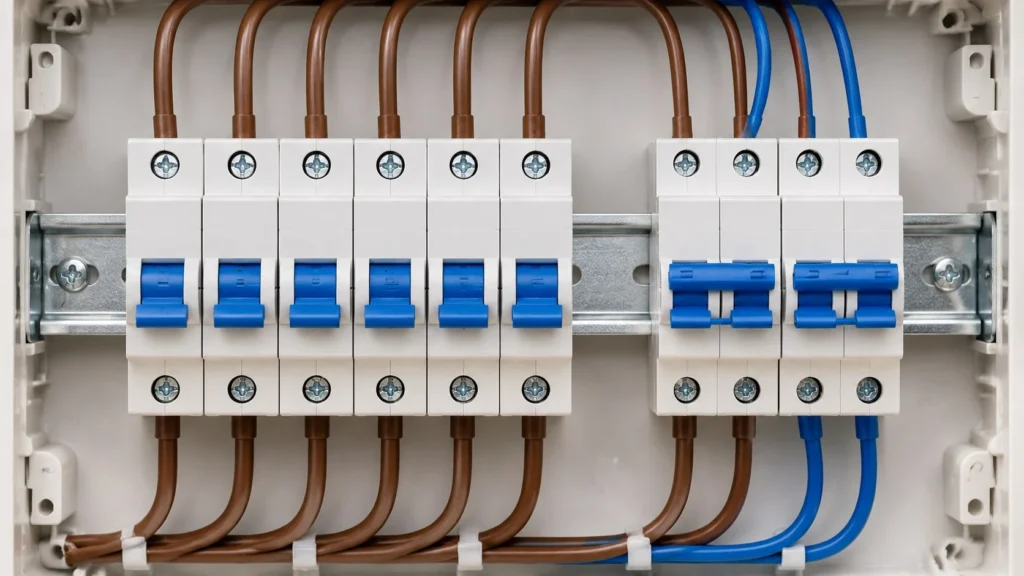
The important row is the second one. A 1P+N takes the same rail space as a 2P and looks almost identical in a photograph, but its neutral pole is a switch contact with no overcurrent element behind it.
On the rail, a 2P device occupies two 18 mm modules — the footprint of two 1P devices, not one.
When a 1P breaker is enough
In a TN-S or TN-C-S installation with a solidly earthed neutral, the neutral sits at earth potential in normal operation. Isolating the line removes the supply from the circuit, which is what a single-phase final circuit usually needs. That is why 1P devices dominate domestic boards in many markets: they are cheaper, take half the rail space, and can share a comb busbar along the whole row.
Two conditions have to hold before you can rely on that. First, the neutral must not be switched or interrupted anywhere downstream in a way that could leave it floating. Second, your local wiring code must accept single-pole isolation for that circuit type. Both are installation-specific, and neither can be assumed from a datasheet.
When you need 2P instead
TT earthing. In a TT system the fault current returns through the general mass of earth, not through a metallic path back to the transformer. During a fault the neutral can rise above earth potential, and if only the line is broken, the circuit is not actually dead. Double-pole isolation is the normal requirement here, and a 30 mA RCD is present anyway for fault protection.
Supplies where polarity is not guaranteed. Plugs that can be inserted either way, shore power connections, generator feeds, and temporary distribution boards all fall into this group. If line and neutral can be swapped upstream, a device that protects only one pole is protecting the wrong conductor half the time.
Neutral used as a current-carrying conductor. Where the neutral carries harmonic current or is shared between circuits, it can be overloaded independently of the line. Only a device with a protective element in the neutral pole will see that.
Codes that require all-pole isolation. Several national codes require both poles to be isolated for certain equipment, certain locations, or certain circuit types. This is the one item you cannot decide from first principles; check the code that applies to the project.
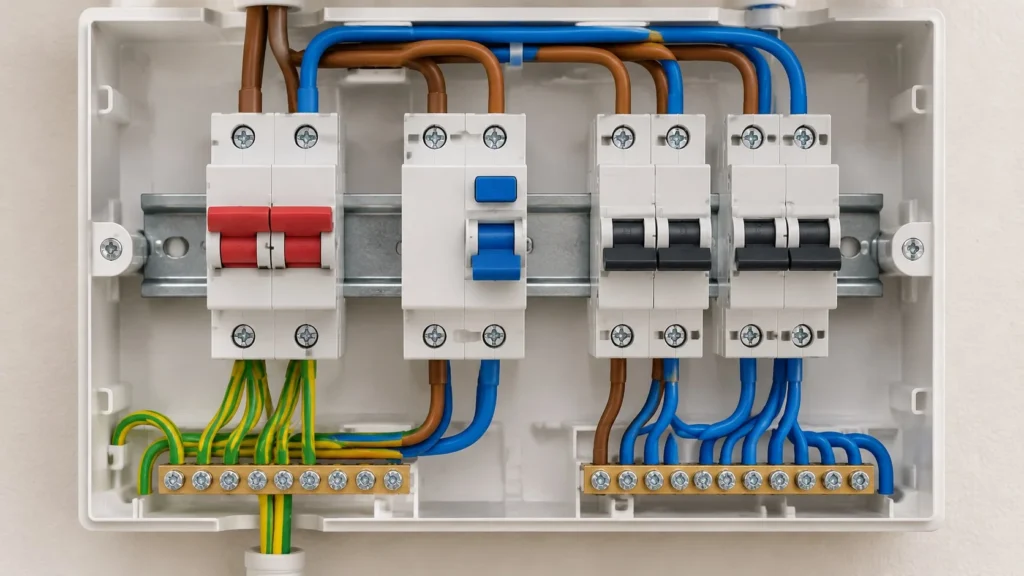
A TT single-phase board: two-pole main switch, 30 mA RCD, and double-pole MCBs on every outgoing way.
1P+N is not a cheaper 2P
Because a 1P+N breaks the neutral, it satisfies the isolation requirement in many installations, and it is often the standard choice for single-phase final circuits in Europe and Australia. It does not, however, protect the neutral. That difference matters in three situations:
Reversed polarity. If line and neutral are swapped at the supply, the 1P+N protects what it thinks is the line — which is now the neutral — and leaves the actual line unprotected.
Neutral overload. Shared neutrals and harmonic-rich loads can overload a neutral with no protective element in it.
Comb busbars. The terminals on a 1P+N are offset, so it cannot sit on a 1P comb busbar. A row of 1P devices with one 1P+N in the middle interrupts the busbar and forces cable links.
If your reason for choosing 2P is neutral isolation alone, 1P+N is a legitimate and cheaper answer. If your reason is neutral protection or uncertain polarity, it is not.
A 2P rating is not double the current
This is a frequent and expensive misunderstanding. A 2P 16 A breaker carries 16 A per pole, not 32 A in total. The two poles are mechanically linked and share one trip mechanism, so the rating applies to each pole individually.
In a single-phase circuit the neutral current equals the line current, apart from harmonic content, so both poles see the same value. Buying a 2P 32 A device to feed a 32 A load does not create margin; it simply protects a 32 A circuit at 32 A, which may be above the cable ampacity. The rating is still selected from the load current, the cable, and the coordination with upstream protection.
What it costs you in board space
On an 18 mm module rail, moving a board from 1P to 2P devices halves the number of circuits that fit. A 24-module enclosure that holds 24 single-pole circuits holds 12 double-pole ones, before the main switch, RCDs and any SPD are counted.
That has a knock-on effect on spare capacity. If you are planning a board with double-pole devices, reserve the spare ways in modules rather than in circuits, and check the count after the main switch and RCDs are subtracted. The arithmetic for that is set out in our guide to distribution box layout and spare module space.
Common mistakes
Fitting 1P devices on a TT system because the board was specified from a TN template.
Assuming 1P+N protects the neutral and then relying on it for a neutral overload.
Mixing 1P and 2P on one comb busbar, which breaks the busbar run and leaves exposed teeth.
Using a 2P device as two separate circuits. Both poles trip together and share one mechanism, so a fault on one circuit takes out the other.
Counting a 2P device as one “way” when the enclosure rating is printed in modules.
How to decide in four questions
Is the earthing system TT? If yes, use double-pole devices.
Does the applicable code require neutral isolation for this circuit? If yes, 2P or 1P+N.
Can line and neutral be reversed at the supply? If yes, 2P only.
Is the neutral carrying harmonic or shared current? If yes, 2P only.
If all four answers are no, a 1P device is adequate and gives you twice the circuits per rail. For three-phase boards the same logic applies with 3P and 4P, and the neutral question becomes more involved; that is covered in 3P vs 4P breakers for three-phase distribution.
Pertanyaan yang Sering Diajukan
Is a 2P MCB safer than a 1P MCB?
It is safer in the specific sense that it isolates both conductors and protects the neutral. Whether you need that depends on the earthing system and the code, not on a general safety ranking. In a TN-S domestic board, a 1P device with RCD protection is a normal and compliant solution.
Can I use a 2P breaker for two separate single-phase circuits?
No. The two poles are mechanically linked and share a common trip, so a fault on either circuit opens both. The device is also rated as one circuit, not two.
Does a 1P+N breaker protect the neutral?
No. The neutral pole is switched but has no overcurrent element. It provides isolation, not protection.
Do I need a 2P breaker for a 230 V single-phase circuit?
Voltage alone does not decide it. A 230 V circuit in a TN system with a solid neutral is commonly protected by a 1P device. The deciding factors are the earthing system, polarity, and local requirements.
What about 1P+N RCBOs?
The same logic applies. A 1P+N RCBO switches both conductors and provides residual current protection, but its overcurrent element is in the line pole only. It is widely used for single-phase final circuits and is not equivalent to a 2P RCBO.
If you are specifying boards for a project, matching the device type to the earthing system before ordering is cheaper than changing it after the first inspection. Our AC MCB range lists single-pole, double-pole and 1P+N versions with their module widths, and the circuit breaker category covers the wider selection including RCBO and RCCB devices.
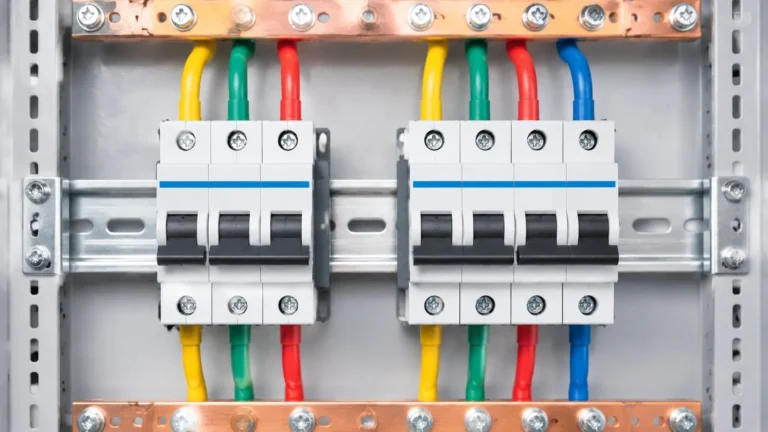
A three-phase board almost always has a mix of three-phase loads and single-phase loads, and that is exactly where the 3P versus 4P decision gets made badly. The two devices look similar, take four modules between them, and are often specified interchangeably — but only one of them switches the neutral, and the consequences of […]
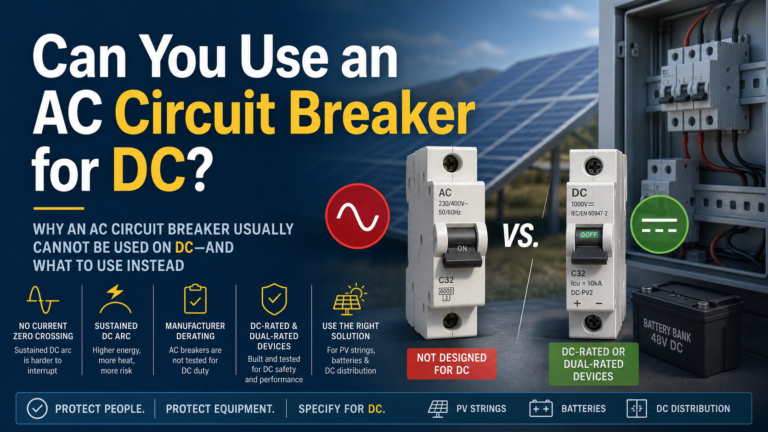
Can an AC circuit breaker be used for DC? Usually no. Unless that specific device carries a declared DC rating — or a dual rating — at your system voltage, an AC-only breaker can fail to open, weld its contacts or destroy itself, because DC has no natural current zero to extinguish the arc. That […]
Perbandingan khusus arus searah (DC) antara sekring dan pemutus arus dalam sistem tenaga surya fotovoltaik (PV): pemadaman busur tanpa titik nol arus, kecepatan operasi, energi yang lolos, selektivitas, pengaturan ulang, dan pemeliharaan, disertai matriks keputusan untuk posisi string, kotak penggabung, input DC inverter, baterai/BESS, dan jalur utama DC.