Cómo elegir un fusible o un disyuntor de reserva para el SPD
Publicado: Autor: Rachel
Elegir el adecuado Fusible de reserva del SPD es uno de los pasos que más se pasan por alto en el diseño de la protección contra sobretensiones. Un dispositivo de protección contra sobretensiones (SPD) desvía las sobretensiones transitorias causadas por rayos, operaciones de conmutación o perturbaciones en la red; pero cuando llega al final de su vida útil o falla en condiciones anormales, es un fusible o un interruptor automático de respaldo correctamente dimensionado lo que evita que la avería se convierta en un riesgo de incendio o en una parada general del sistema.
Esta guía te explica cómo seleccionar unFusible de reserva del SPD o disyuntor para sistemas de distribución de CA, sistemas de CC y aplicaciones fotovoltaicas solares, con reglas prácticas de dimensionamiento y los errores más comunes que hay que evitar. Tanto si eres ingeniero de diseño, fabricante de cuadros eléctricos o profesional de compras, comprender la diferencia entre un fusible de reserva del protector contra sobretensiones Además, un dispositivo de protección contra sobrecorriente de uso general puede ahorrarte tiempo y dinero, y evitarte problemas relacionados con el cumplimiento de las normas de seguridad.
Puntos clave
Un fusible de seguridad del SPD protege la derivación del SPD, no el circuito de carga.
No todos los SPD necesitan un fusible de seguridad independiente: comprueba primero el nivel de protección de la línea de alimentación.
Los fusibles suelen ofrecer una mayor capacidad de corte en un tamaño compacto; los disyuntores ofrecen la comodidad de poder reiniciarse.
Los circuitos de corriente continua y los sistemas fotovoltaicos solares solo requieren una protección de respaldo homologada para corriente continua o para sistemas fotovoltaicos.
Comprueba siempre la intensidad máxima de la fusible de reserva indicada por el fabricante del SPD antes de elegirlo.
¿Qué es un fusible de respaldo SPD?
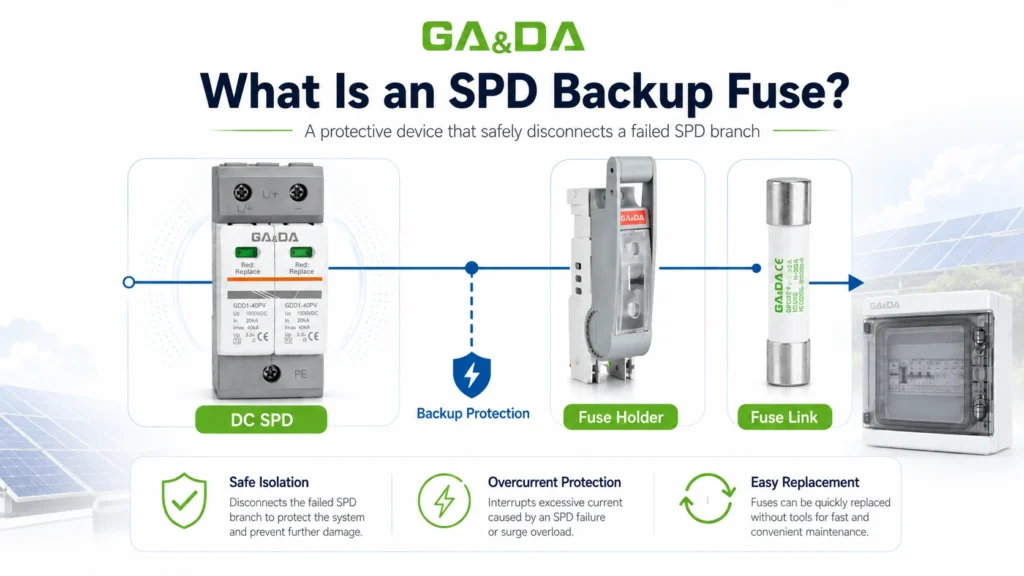
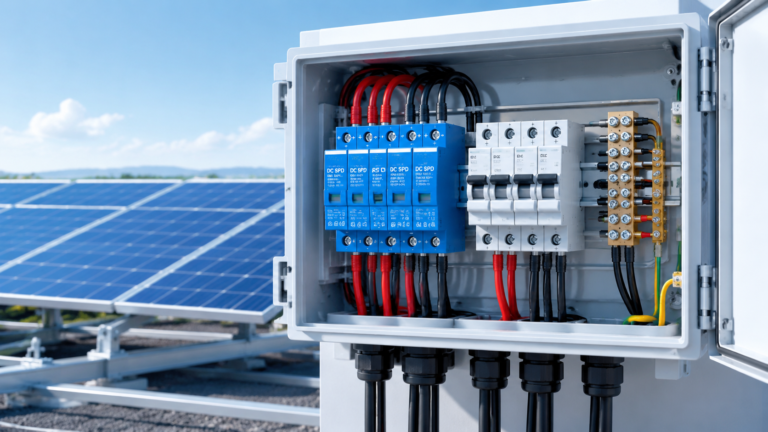
Un Fusible de reserva del SPDEs un dispositivo de protección contra sobrecorriente instalado en serie con la derivación del dispositivo de protección contra sobretensiones. Su función no es sustituir al dispositivo de protección contra sobretensiones, sino proteger la instalación eléctrica en caso de que este falle y se convierta en un riesgo de cortocircuito.
El Fusible de reserva del SPD ayuda a:
Desconecta del circuito un SPD averiado
Evitar que circule una corriente de fallo excesiva por la derivación del SPD
Reducir el riesgo de incendio provocado por un fallo anómalo del SPD
Mantener la coordinación con el dispositivo de protección situado aguas arriba
Mejorar la seguridad durante las tareas de mantenimiento y sustitución
En algunas instalaciones, un disyuntor también puede utilizarse como Protección de respaldo SPD. La elección entre un fusible y un disyuntor depende de la ficha técnica del SPD, la tensión del sistema, la corriente de cortocircuito prevista, el espacio disponible para la instalación, las preferencias de mantenimiento y la normativa eléctrica local.
¿Es necesario que todos los SPD tengan un fusible de reserva?
No siempre.
Algunos SPD no requieren un fusible de respaldo independiente cuando el dispositivo de protección contra sobrecorriente situado aguas arriba ya se encuentra dentro del valor máximo de protección de respaldo especificado por el fabricante del SPD. Por ejemplo, si en la ficha técnica del SPD se indica que el fusible de respaldo máximo es de 125 A y el disyuntor situado aguas arriba es de 63 A, es posible que no sea necesario un fusible de respaldo independiente.
Sin embargo, si la protección aguas arriba es superior al nivel de protección de respaldo permitido por el SPD, se debe utilizar un Fusible de reserva del SPD o suele ser necesario un disyuntor.
Regla de selección rápida:
Si el grado de protección en la parte de entrada es…
Entonces…
≤ Índice máximo de protección de respaldo del fabricante del SPD
Es posible que NO sea necesario un fusible de seguridad adicional
> Índice máximo de protección de respaldo del fabricante del SPD
Es OBLIGATORIO disponer de un fusible o un disyuntor de reserva específico para el SPD.
Consulta siempre las instrucciones de instalación del modelo concreto de SPD antes de tomar la decisión definitiva.
Fusible de respaldo SPD frente a disyuntor: ¿cuál deberías utilizar?
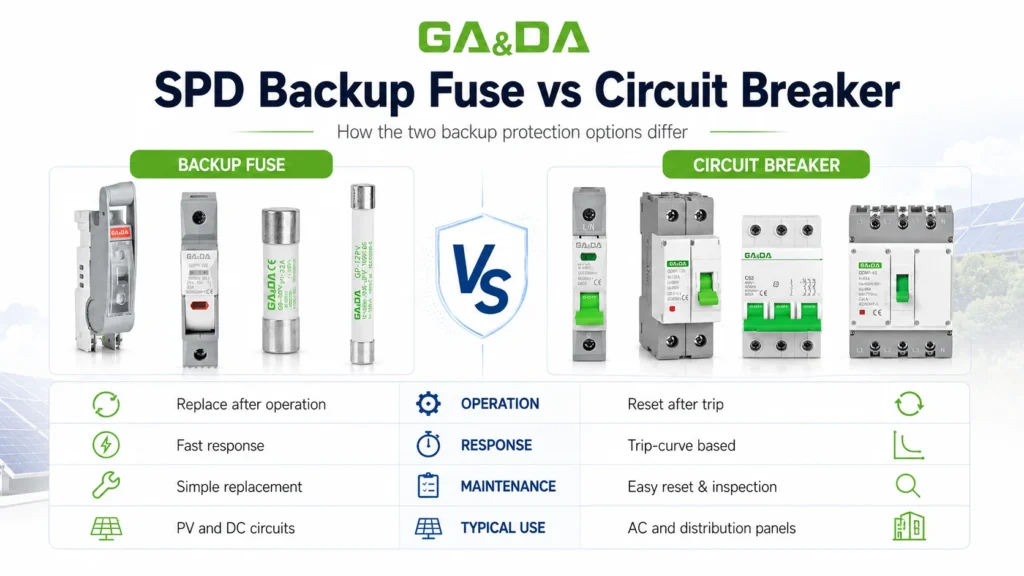
Respuesta breve: Para paneles industriales y cajas de conexión de sistemas fotovoltaicos solares, un Fusible de reserva del SPD suele ser la mejor opción debido a su elevada capacidad de corte y a su tamaño compacto. En el caso de los cuadros de distribución de CA estándar, un disyuntor suele resultar más práctico, ya que puede reiniciarse tras la inspección.
Tanto los fusibles como los disyuntores pueden utilizarse como protección de respaldo, pero su comportamiento es diferente.
Artículo
Fusible de reserva del SPD
Disyuntor de respaldo SPD
Principio de funcionamiento
Se funde y abre el circuito en caso de corriente de fallo
Se dispara automáticamente en caso de sobrecorriente o cortocircuito
Reutilización
Es un uso único; hay que sustituirlo
Se puede restablecer tras la inspección
Velocidad de respuesta
Normalmente es rápido, dependiendo del tipo de fusible
Depende de la curva de disparo y del diseño del disyuntor
Capacidad de frenado
A menudo de gran altura y tamaño compacto
Debe seleccionarse cuidadosamente en función del nivel de corriente de fallo
Mantenimiento
Debe sustituirse tras su uso
Más fácil de mantener de forma habitual
Espacio
Hay disponibles portafusibles compactos
Puede que se necesite más espacio en el carril DIN
Uso habitual
Paneles industriales, cajas de conexión fotovoltaicas, sistemas de corriente continua
Cuadros de distribución de CA y paneles de control
En muchas aplicaciones industriales y fotovoltaicas, se prefieren los fusibles debido a su elevada capacidad de corte y a su tamaño compacto. En los cuadros de distribución de corriente alterna de baja tensión, pueden utilizarse interruptores automáticos miniatura (MCB) o interruptores automáticos en caja moldeada (MCCB) siempre que cumplan los requisitos del fabricante del dispositivo de protección contra sobretensiones (SPD).
Parámetros clave para la selección de un fusible de respaldo para un SPD
1. Intensidad máxima admisible del fusible de seguridad
El primer parámetro que hay que comprobar es el valor máximo del fusible de respaldo que figura en la ficha técnica del SPD.
Este valor indica cuál es el fusible o dispositivo de protección contra sobrecorriente de mayor capacidad que puede proteger de forma segura la derivación del SPD. Puede figurar como:
Fusible de seguridad máximo
Fusible máx.
Protección mediante copias de seguridad
Protección de respaldo contra cortocircuitos
Fusible de repuesto recomendado
No elija un fusible de reserva de mayor calibre que el especificado por el fabricante. Si el fusible es demasiado grande, podría impedir que el SPD se desconecte de forma segura en caso de fallo.
2. Tensión del sistema
El fusible o disyuntor de reserva debe ser compatible con la tensión del sistema.
En el caso de los sistemas de CA, comprueba la tensión nominal, como 230/400 V CA, 277/480 V CA u otras tensiones de distribución locales.
En los sistemas de corriente continua, especialmente en los sistemas solares fotovoltaicos, el fusible o el interruptor de seguridad deben estar homologados para corriente continua. No se debe utilizar un interruptor o fusible estándar de corriente alterna en un circuito de corriente continua, a menos que esté específicamente homologado para esa tensión de corriente continua.
Los sistemas fotovoltaicos suelen funcionar a 600 V CC, 1000 V CC o 1500 V CC. El dispositivo de protección de reserva debe ser adecuado para la tensión máxima del sistema de corriente continua.
3. Intensidad nominal de cortocircuito
El fusible o el interruptor automático seleccionado debe ser capaz de interrumpir la corriente de cortocircuito prevista en el punto de instalación.
Esto es especialmente importante en:
Cuadros de distribución principales
Cuadros eléctricos industriales
Cajas de conexión fotovoltaicas
Sistemas de almacenamiento de energía en baterías
Cuadros de distribución de corriente continua
Lugares cercanos a transformadores o generadores
Si el dispositivo de protección de respaldo tiene una capacidad de corte insuficiente, podría fallar en caso de cortocircuito.
4. Aplicación de CA o CC
Los circuitos de corriente alterna y continua se comportan de forma diferente durante la interrupción de una avería. Esta distinción es fundamental a la hora de seleccionar un fusible de reserva del protector contra sobretensiones o un disyuntor.
En los sistemas de corriente alterna, la corriente cruza naturalmente el cero muchas veces por segundo, lo que ayuda a extinguir el arco. En los sistemas de corriente continua, no se produce un cruce natural por el cero, por lo que la extinción del arco resulta más difícil. Por eso es imprescindible utilizar fusibles y disyuntores aptos para corriente continua en Protección de respaldo del SPD de CC — incluyendo aplicaciones de energía solar fotovoltaica, almacenamiento en baterías y recarga de vehículos eléctricos.
En aplicaciones fotovoltaicas solares, utilice únicamente dispositivos de protección de respaldo diseñados y homologados específicamente para circuitos fotovoltaicos de corriente continua.
5. Tipo de SPD y capacidad de descarga
La protección de respaldo también debe ser compatible con el tipo de SPD y su capacidad de corriente de sobretensión.
Típico Fusible SPD Entre los tipos se incluyen:
Dispositivo de protección contra sobretensiones (SPD) de tipo 1 para descargas de corriente de rayo
SPD de tipo 2 para sobretensiones de conmutación y sobretensiones inducidas
Type 1+2 SPD for combined lightning and surge protection
DC SPD for solar PV and battery systems
Signal SPD for data, control and communication lines
A Type 1 SPD or Type 1+2 SPD may be exposed to higher surge energy than a Type 2 SPD, so the backup protection must be coordinated with the SPD’s tested capability.
6. Selectivity with Upstream Protection
Good Protección de respaldo SPD should disconnect only the SPD branch during an SPD fault, without unnecessarily shutting down the entire electrical system.
This is called selectivity or coordination.
For example, if a backup fuse is installed in the SPD branch, it should operate before the main breaker trips during an SPD branch fault. This helps keep the rest of the installation energized while isolating the failed SPD.
7. Installation Space and Maintenance
In compact panels, there may not be enough space for a separate fuse holder or circuit breaker. In that case, an SPD with integrated backup protection may be considered.
For maintenance teams, circuit breakers may be more convenient because they can be reset after inspection. However, after a serious SPD fault, the SPD module should still be checked and replaced if the status indicator shows failure.
When to Use an SPD Backup Fuse
Un Fusible de reserva del SPD is often suitable when:
The upstream breaker is larger than the SPD’s maximum backup protection rating
The panel requires high short-circuit breaking capacity
The SPD is installed in an industrial power cabinet
The SPD is installed in a PV combiner box
The circuit is DC and requires reliable fault interruption
Compact protection is needed
Selective disconnection of the SPD branch is required
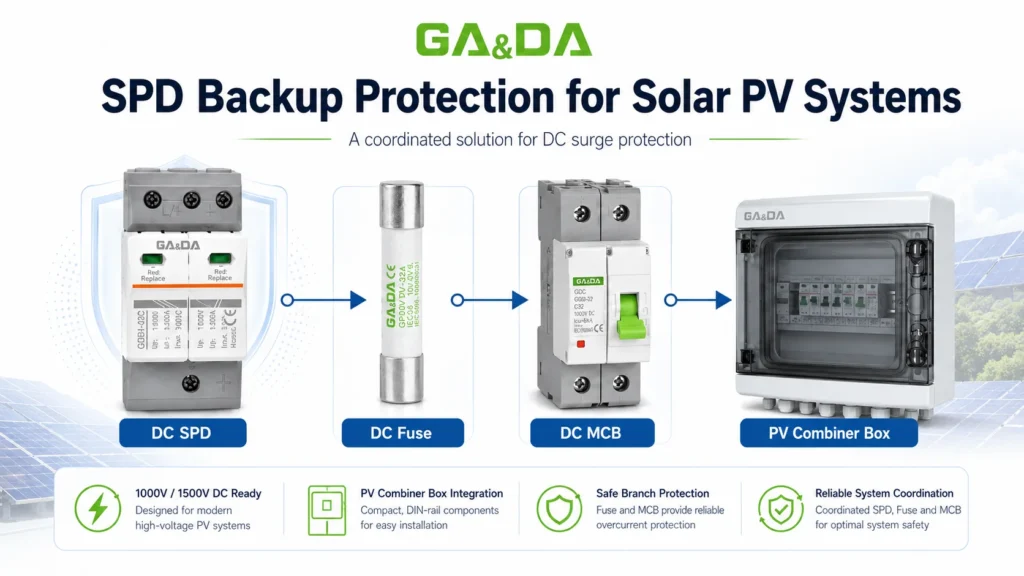
For PV applications, DC fuse links and DC fuse bases are commonly used together with DC SPDs in combiner boxes and PV protection panels.
When to Use an SPD Backup Circuit Breaker
Un SPD backup circuit breaker may be suitable when:
The SPD manufacturer allows circuit breaker backup protection
The breaker has the required voltage and breaking capacity
The installation is an AC distribution board
Maintenance teams prefer resettable protection
The panel design already uses MCB or MCCB protection
The circuit breaker trip curve is appropriate for the SPD branch
For AC systems, MCBs or MCCBs can be practical choices. For DC systems, use only DC-rated breakers that are suitable for the operating voltage and fault current level.
Step-by-Step SPD Backup Fuse Selection Guide
Step 1: Identify the SPD Application
First, confirm where the SPD will be installed.
Common installation points include:
Main AC distribution board
Cuadro de subdistribución
Armario de control industrial
Caja de conexión fotovoltaica
Inverter DC input side
Inverter AC output side
Battery energy storage cabinet
Communication or signal line
The application determines whether you need AC-rated, DC-rated or PV-rated backup protection. If you are unsure which SPD type your installation requires, check our SPD product category comparison for a full breakdown of Type 1, Type 2 and Type 1+2 applications.
Step 2: Check the SPD Datasheet
Find the maximum backup fuse or recommended backup protection value in the SPD datasheet.
Check these items:
Tipo SPD
Rated voltage
Maximum continuous operating voltage (Uc)
Corriente nominal de descarga (In)
Corriente máxima de descarga (Imax)
Lightning impulse current (Iimp)
Short-circuit current rating (SCCR)
Maximum backup fuse rating
Recommended wiring diagram
Never choose backup protection based only on the SPD’s physical size or pole number.
Step 3: Compare with the Upstream Protection
Check the rating of the upstream fuse, MCB or MCCB.
If the upstream protection is within the SPD manufacturer’s allowed backup protection rating, a separate backup fuse may not be required.
If the upstream protection is higher than the allowed rating, install a dedicated Fusible de reserva del SPD or breaker according to the manufacturer’s instructions.
Step 4: Match Voltage and Breaking Capacity
Select a backup fuse or breaker with voltage and breaking capacity suitable for the installation. If you are selecting a surge protective device circuit breaker for an AC panel, match the AC voltage and fault level.
For PV systems, select DC or PV-rated backup protection suitable for the maximum open-circuit voltage (Voc) of the PV array.
Step 5: Confirm Wiring Method
The backup fuse or breaker is normally installed in series with the SPD branch, not in series with the main load circuit.
Keep the wiring short and straight. Long SPD connection leads can increase the let-through voltage and reduce protection performance.
Step 6: Check Status Indication
After installation, make sure the SPD status window is visible. Many SPDs use a green/red indicator to show whether the module is still functional.
If the SPD has a remote signaling contact, connect it to the monitoring system where required. This is useful for industrial panels, PV plants and unmanned sites.
6 Common Mistakes When Selecting an SPD Backup Fuse
Mistake 1: Selecting a backup fuse without checking the SPD datasheet
The backup fuse must match the SPD manufacturer’s recommendation. Using a random fuse size can result in poor coordination or unsafe disconnection.
Mistake 2: Using AC-rated protection devices in DC circuits
DC circuits require DC-rated protection. This is especially important for PV systems and battery systems. AC-rated devices may not interrupt DC fault current safely.
Mistake 3: Oversizing the SPD backup fuse
A larger fuse does not mean better protection. If the fuse rating is too high, it may not disconnect the SPD quickly enough during abnormal failure.
Mistake 4: Ignoring the prospective short-circuit current rating
Every fuse or breaker has a breaking capacity. If the prospective short-circuit current exceeds this value, the protection device may fail during a fault.
Mistake 5: Installing the SPD too far from the busbar
Backup protection is important, but wiring layout is also critical. Long leads increase voltage drop during surge discharge and reduce the actual protection level.
Mistake 6: Confusing load protection with SPD backup protection
The backup fuse protects the SPD branch during abnormal failure. It does not replace the main circuit breaker, load circuit fusing or system-level electrical design.
DC SPD Backup Fuse for Solar PV Systems
Solar PV systems require special attention because the DC side can operate at high voltage and continuous current.
When selecting a DC SPD backup fuse for solar PV systems, check:
Maximum PV system voltage
1000 V DC or 1500 V DC rating
PV string or array configuration
Prospective short-circuit current
SPD type, such as Type 2 DC SPD or Type 1+2 DC SPD
Manufacturer’s recommended backup fuse
DC fuse base and fuse link rating
Combiner box wiring layout
One common error in PV system design is using standard AC-rated gPV fuse links in DC combiner boxes. Even if the physical form factor looks identical, an AC-rated fuse cannot reliably interrupt a DC fault arc at 1000 V DC or 1500 V DC. Always confirm that the fuse link carries an explicit DC voltage rating — this is typically printed on the fuse body and listed in the manufacturer’s datasheet.
Another important consideration: the backup fuse rating must coordinate with both the PV string short-circuit current (Isc) and the SPD’s maximum discharge current capability (Imax). In large PV arrays where multiple strings are paralleled, the available fault current at the combiner box can be significantly higher than a single string’s short-circuit current. Size your DC SPD backup fuse to handle this combined fault level without nuisance operation during normal surge events.
A PV combiner box may include DC SPDs, DC fuses, DC MCBs or DC isolators. These components should be selected as a coordinated system rather than as separate parts.
Recommended GA&DA SPD Backup Protection Products
For projects that require Protección de respaldo SPD and coordinated electrical safety, GA&DA offers a complete range of compatible products:
Surge Protective Devices
Type 1 AC SPD (for service entrance and lightning current)
Type 2 AC SPD (for sub-distribution boards)
Type 1+2 AC SPD (combined lightning and surge protection)
Type 2 DC SPD (for solar PV and battery systems)
Type 1+2 DC SPD (for high-energy PV and storage applications)
PV combiner box (integrates DC SPD, DC fuses and monitoring)
PV lightning protection box
Selecting the SPD together with its backup fuse or circuit breaker from the same product ecosystem helps ensure proper coordination, simplifies ordering and reduces installation complexity. Browse the GA&DA product catalogue or contact our technical team for a recommendation tailored to your system voltage, fault level and SPD type.
Conclusión
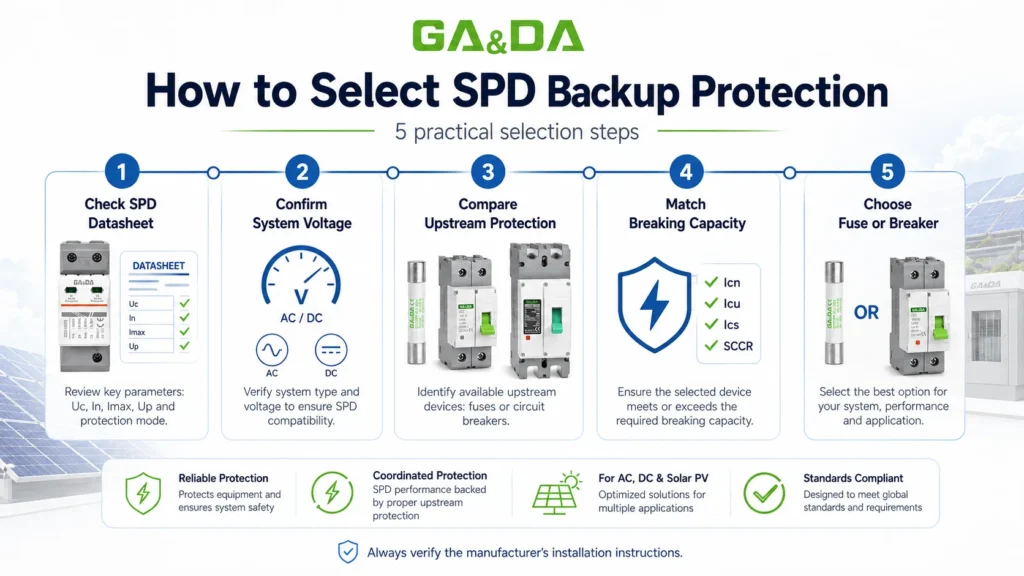
Selecting the correct Fusible de reserva del SPD or circuit breaker is essential for safe and reliable surge protection. The process comes down to five key checks:
Read the SPD datasheet — find the maximum backup fuse rating
Compare with the upstream protection rating
Match system voltage (AC, DC or PV-rated)
Confirm the short-circuit breaking capacity is adequate
Choose the right fuse or breaker type for the specific application
For AC distribution boards, an MCB, MCCB or fuse may be used when it matches the SPD manufacturer’s requirements. For solar PV systems, DC-rated or PV-rated backup protection is critical because DC fault interruption is more demanding than AC interruption.
GA&DA supplies a full range of surge protection devices, backup fuses, circuit breakers and PV combiner box solutions for residential, commercial, industrial and solar applications. Whether you need a DC SPD backup fuse for a 1500 V PV array or an SPD backup circuit breaker for an AC distribution board, our technical team can recommend the right product combination for your project.
Browse our SPD and backup protection product catalogue, or contact us directly with your system voltage, fault level and SPD model — and we will help you find the correct solution.
Preguntas frecuentes
What is an SPD backup fuse?
Un Fusible de reserva del SPD is a fuse installed in series with the surge protective device branch. It disconnects the SPD if the SPD fails and creates a short-circuit risk, preventing dangerous sustained fault current and reducing fire hazard.
Is a backup fuse always required for an SPD?
No. A separate backup fuse may not be required if the upstream protection device is within the SPD manufacturer’s maximum backup protection rating. Always check the SPD datasheet and installation instruction.
Can I use a circuit breaker instead of a fuse for SPD backup protection?
Yes, in some applications. An SPD backup circuit breaker must be allowed by the SPD manufacturer and must match the required voltage, breaking capacity and trip characteristics.
What happens if the SPD backup fuse is too large?
If the backup fuse is too large, it may not disconnect the SPD safely during abnormal failure. This can increase the risk of overheating, equipment damage or fire.
What happens if the SPD backup fuse is too small?
If the backup fuse is too small, it may nuisance-operate during surge events or normal transient conditions, disconnecting the SPD before it is actually damaged. This leaves your system unprotected against the next surge.
What is the difference between an SPD backup fuse and a load fuse?
Un Fusible de reserva del SPD is installed in series with the SPD branch only. It protects against abnormal SPD failure and disconnects the SPD from the system. A load fuse protects the downstream load circuit and operates under overload or short-circuit conditions caused by connected equipment. The two serve different protective functions and should not be combined into a single device unless the SPD manufacturer explicitly allows it.
Can I use a Type B RCD as SPD backup protection?
No. An RCD (residual current device) is designed to detect earth leakage currents and protect against electric shock. It is not designed to handle the fault current levels that can occur during SPD failure. An RCD should not be used as a substitute for an Fusible de reserva del SPD or circuit breaker.
What type of fuse is used for DC SPD in solar PV systems?
For solar PV applications, the fuse should be suitable for DC or PV circuits and rated for the maximum system voltage, such as 1000 V DC or 1500 V DC. This is a critical requirement for any DC SPD backup fuse selection. The final selection should follow the SPD manufacturer’s datasheet.
Should the backup fuse be installed before or after the SPD?
The backup fuse or circuit breaker is normally installed in series with the SPD branch, between the busbar and the SPD. It should be wired according to the SPD manufacturer’s connection diagram.
Can an SPD protect the system after the backup fuse operates?
No. Once the backup fuse operates and disconnects the SPD branch, the SPD is no longer connected to the system. The SPD and the fusible de reserva del protector contra sobretensiones should both be inspected and replaced if necessary before surge protection is restored.
La mayoría de las cajas de distribución de corriente continua solar (DCDB) están equipadas con un dispositivo de protección contra sobretensiones (SPD) de tipo 2 para corriente continua, diseñado para corrientes de sobretensión de 8/20 µs; se requiere un SPD de tipo 1+2 para corriente continua cuando el circuito de corriente continua está expuesto a impactos directos de rayos o cuando la instalación no cuenta con un sistema externo de protección contra rayos. Esta guía explica cómo decidir […]
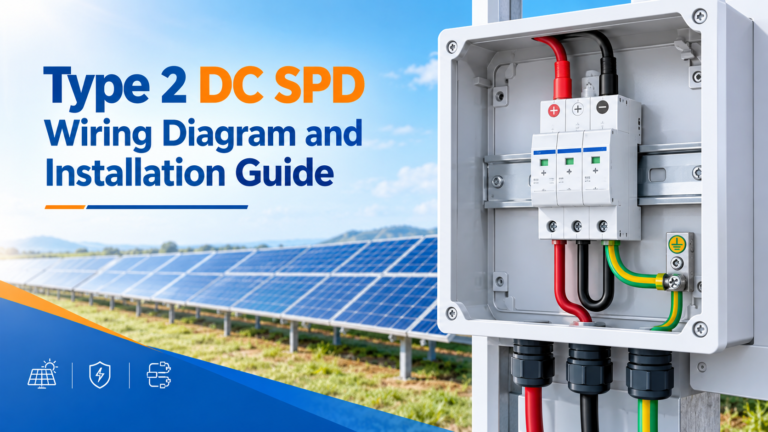
Cómo cablear e instalar un dispositivo de protección contra sobretensiones de CC de tipo 2 en un sistema fotovoltaico: conexiones de los terminales, cableado en paralelo, fusible o interruptor diferencial de respaldo, puesta a tierra y errores habituales.
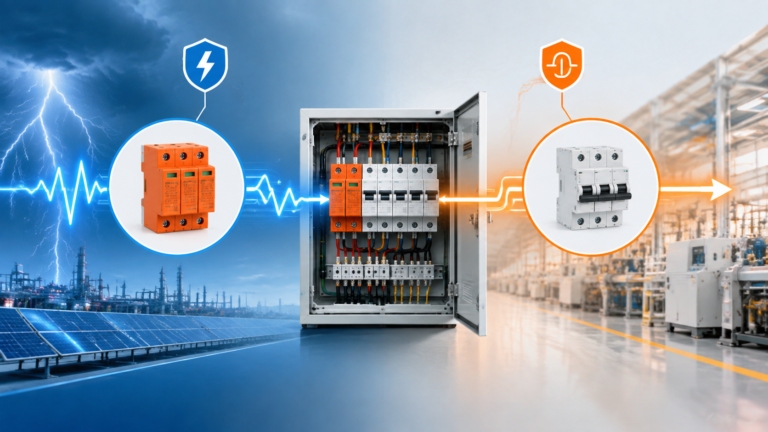
Los descargadores de sobretensión limitan las sobretensiones transitorias; los disyuntores eliminan las sobrecargas y los cortocircuitos. Compara sus funciones, aplicaciones y coordinación.