3P vs 4P Breaker: When the Neutral Must Be Switched
Publicado: Autor: Rachel
A three-phase board almost always has a mix of three-phase loads and single-phase loads, and that is exactly where the 3P versus 4P decision gets made badly. The two devices look similar, take four modules between them, and are often specified interchangeably — but only one of them switches the neutral, and the consequences of getting it wrong range from a failed inspection to an isolation procedure that does not actually isolate.
The short answer: use a 3P breaker when the circuit is three-phase with no neutral, such as a motor, a pump, or a three-phase heater. Use a 4P breaker when the circuit includes a neutral that must be switched and isolated — a mixed three-phase and single-phase distribution board, a TT system, or a circuit feeding equipment with a neutral connection.
Three, four, and the confusing middle
Three device types are sold under two names, and the catalogue entry does not always make the difference obvious:
Dispositivo
Modules (18 mm)
Poles switched
Poles protected
Uso habitual
3P
3
L1, L2, L3
L1, L2, L3
Three-phase load without neutral: motors, heaters, pumps
3P+N
4
L1, L2, L3, N
L1, L2, L3 only
Mixed load where the neutral is switched but not protected
4P
4
L1, L2, L3, N
Depends on the device — check the datasheet
Circuits where the neutral carries current that must be protected
That last row is the trap. A device sold as “4P” is frequently a three-pole breaker with a switched neutral pole — internally a 3P+N. It switches the neutral, which is what most installations need, but it will not detect a neutral overload. If neutral protection is the reason you are buying a 4P device, look for a datasheet that states four protected poles, not four poles.
When a 3P breaker is the correct choice
If the load has no neutral connection, a 3P device is the right answer and adding a fourth pole buys nothing. Motors, three-phase heaters, most pumps, and three-phase transformers fall into this group. The neutral, if one runs to the equipment at all, is there for control or instrumentation and is not part of the load circuit.
There is a second case: a three-phase submain feeding a downstream board that has its own neutral bar and its own neutral disconnection. In that arrangement the neutral is solid at the upstream device and is broken downstream, which is a legitimate design in TN systems. It does mean the upstream device alone does not isolate the submain completely, so the isolation procedure has to name both points.
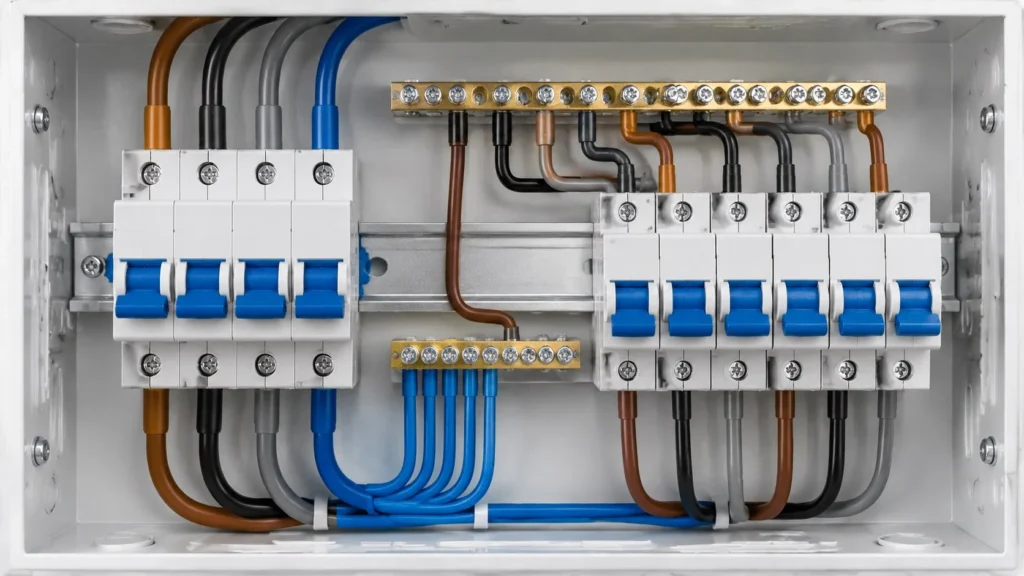
A four-pole main switch in a board that carries both three-phase and single-phase circuits, with the neutral taken to a separate bar.
When the neutral has to be switched
Mixed boards. Once a distribution board carries both three-phase and single-phase circuits, the incoming device has to break the neutral, because otherwise opening the main switch leaves a live neutral connected to every single-phase circuit in the board. A 3P incoming device with a separate neutral bar is common in older installations and is a frequent finding in inspections.
TT systems. The same reasoning as for single-phase circuits applies. In a TT installation the neutral is not tied to the installation earth in the same way, and equipment may have to be isolated on all poles.
Neutral as a current-carrying conductor. Non-linear loads — switch-mode power supplies, LED drivers, variable frequency drives, IT equipment — produce triplen harmonics whose currents add in the neutral instead of cancelling. In a heavily loaded four-wire circuit the neutral current can exceed the phase current. A three-pole device cannot see that current at all, and a 4P device with only three protected poles cannot either. This is the one case where a genuinely four-pole device earns its price.
All-pole isolation requirements. Some codes require every live conductor, including the neutral, to be isolated for particular equipment or locations. That is a project-specific requirement and needs to be checked against the applicable standard rather than assumed.
The TN-C exception
In a TN-C system the neutral and protective functions share one conductor, the PEN. That conductor must not be switched or disconnected: breaking it removes the protective earth connection for everything downstream, which turns a routine isolation into a shock hazard. A four-pole device must not be inserted in a PEN conductor.
In TN-C-S the combined conductor is split into separate neutral and protective conductors at the origin of the installation. Downstream of that split the neutral is an ordinary N conductor and may be switched. Where the split happens determines which device is appropriate, and it is worth confirming on the drawing rather than assuming.
What the fourth pole costs
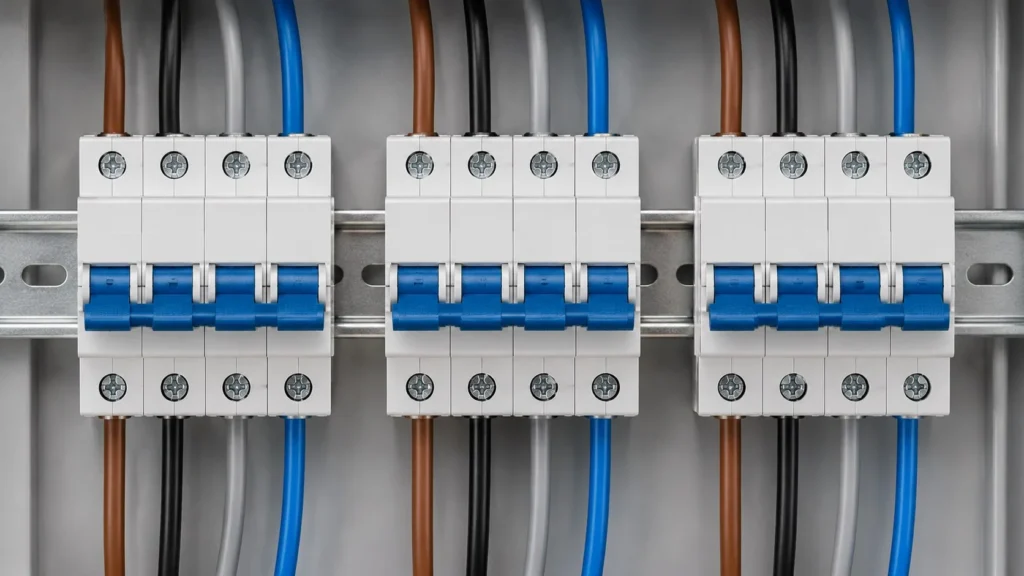
One extra module per device, on every three-phase way in the board. On a 12-way three-phase board that is 12 extra modules — most of an 18-module row — which usually comes out of either the spare capacity or the physical size of the enclosure.
The cost is not only rail space. Four-pole devices are longer to wire, need the neutral brought to the device and taken away again, and add a terminal pair that has to be torqued and checked. Boards that were sized for 3P devices and then changed to 4P late in the project frequently run out of wiring space before they run out of modules.
Each four-pole device takes four modules, so a twelve-way three-phase board gives up twelve modules of rail to the fourth pole.
Neutral current is not automatically zero
A balanced three-phase load has no neutral current, which is why the neutral is often omitted. But balance is an assumption, not a guarantee. Single-phase loads distributed across the three phases are never perfectly balanced, and the neutral carries the difference. Add harmonic content and the neutral current can be higher than any single phase.
If you are specifying a 4P device for a mixed board, the neutral rating matters as much as the phase rating. A device with a reduced neutral rating, sometimes marked as a 3P+N device with a lower N current, is not suitable for a harmonic-rich load.
Mistakes that show up in inspections
A 3P main switch with a separate neutral bar, leaving every single-phase circuit connected to a live neutral when the switch is open.
Buying “4P” without checking the protected pole count, then relying on it for neutral overload protection.
Breaking a PEN conductor with a four-pole device in a TN-C installation.
Assuming a balanced load means no neutral current and omitting the neutral from the protection scheme entirely.
Sizing the enclosure before the device count is fixed, then discovering that the fourth pole has consumed the spare ways.
How to choose
Does the circuit have a neutral connection to the load? No — 3P is enough. Yes — continue.
Must the neutral be isolated? Yes — 4-pole or 3P+N.
Can the neutral carry harmonic or unbalanced current that needs protection? Yes — a device with four protected poles.
Is the supply TN-C at this point? Yes — the PEN must not be switched; check where the split occurs.
No. A motor has no neutral connection, so the fourth pole has nothing to switch. A 3P device with the correct utilisation category and setting is the normal choice.
Is a 4P breaker the same as a 3P+N breaker?
Not necessarily. Both take four modules and both switch the neutral. A true 4P device has a protective element in every pole; a 3P+N device has three protected poles and one switched neutral. The datasheet is the only reliable way to tell them apart.
Can I use a 3P breaker on a circuit with a neutral?
Only if the neutral is solid and does not need to be isolated at that point, for example where a downstream board breaks it. Otherwise the circuit is not fully isolated when the breaker is open.
Why does the neutral current sometimes exceed the phase current?
Triplen harmonics — the third, ninth, fifteenth and so on — add in the neutral rather than cancelling. With a high proportion of switch-mode loads this can push neutral current above the phase current, which is why some installations specify a full-size or oversized neutral.
Do I need a 4P RCD as well?
If the circuit includes a neutral and the RCD is protecting it, the device has to sense and switch that neutral. A four-pole RCCB or a 3P+N device is the usual answer, and mixing a 3P RCD with a separately routed neutral defeats the protection.
When you are ready to specify, the AC MCB range lists single-pole to four-pole versions with module widths, and the circuit breaker category covers MCCB and RCCB options for larger frames.
Choosing between a 1P and a 2P MCB for a single-phase circuit looks like a simple decision, and in many boards it is. The two devices are not interchangeable in every installation: the right choice depends on the earthing system, on whether the neutral has to be isolated for maintenance, and on what your local […]
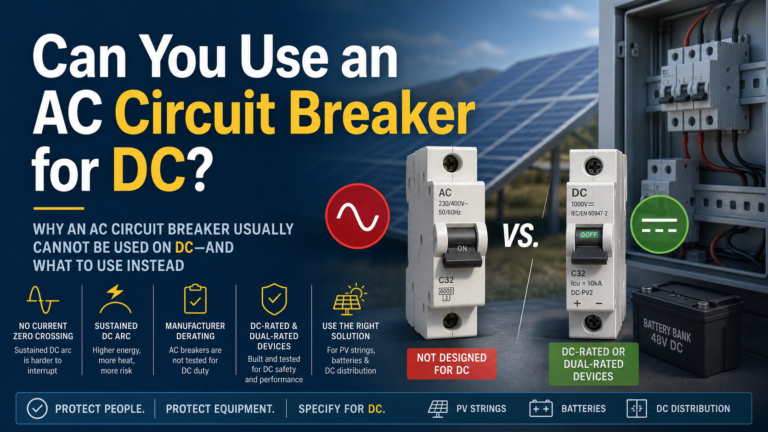
Can an AC circuit breaker be used for DC? Usually no. Unless that specific device carries a declared DC rating — or a dual rating — at your system voltage, an AC-only breaker can fail to open, weld its contacts or destroy itself, because DC has no natural current zero to extinguish the arc. That […]
Comparación específica de la corriente continua (CC) entre fusibles y disyuntores en sistemas fotovoltaicos solares: extinción del arco sin paso por cero de la corriente, velocidad de actuación, energía transmitida, selectividad, reinicio y mantenimiento, con una matriz de decisión para las posiciones de cadena, caja combinadora, entrada de CC del inversor, batería/BESS y línea principal de CC.