An AC contactor and a relay do the same thing in the simplest sense: a coil pulls in a set of contacts. That similarity is why they get substituted for each other, and why those substitutions fail. The contactor is built to break a motor current and extinguish the arc that comes with it; the relay is built to switch a control signal cleanly and repeatedly. Putting one in the other’s place usually works for a while, which is the worst kind of working.
The short answer: use a contactor for load switching — motors, heaters, capacitor banks, anything drawing more than a few amps with an inductive component. Use a relay for control switching — signals, interlocking, small loads, and circuits where several isolated contacts are needed.
The two standards that separate them
They are specified under different parts of IEC 60947, and the difference is not administrative.
Contactors: IEC 60947-4-1. Rated by utilisation category, which describes the load and the duty. AC-1 is non-inductive or slightly inductive load; AC-3 is squirrel-cage motor starting and stopping during running; AC-4 is motor starting, plugging and inching. The same contactor has a different current rating in each category.
Relays: IEC 60947-5-1. Rated as control circuit devices, with categories such as AC-15 and DC-13 that describe the control load being switched.
This is why a “32 A” contactor can be rated 32 A in AC-1 and 18.5 kW at 400 V in AC-3. The number on the front is one number from one column of a table.
Property
AC contactor
Control relay
Typical current
9 A to several hundred amps
5 A to 10 A, often less
Contact material
Silver alloy designed to survive arcing
Silver-nickel or gold-plated for low-level signals
Arc control
Arc chutes and magnetic blowout
Minimal; not intended for heavy arcing
العمر التشغيلي
Hundreds of thousands to a million operations at AC-3
Hundreds of thousands at rated control load
الأعمدة
3 or 4 main poles plus auxiliary
2 to 8 changeover contacts, often mixed
Coil
AC or DC, higher VA, hold-in current matters
AC or DC, low consumption
التركيب
DIN rail or panel, often with overload relay
DIN rail or plug-in socket
Why a relay cannot simply replace a contactor
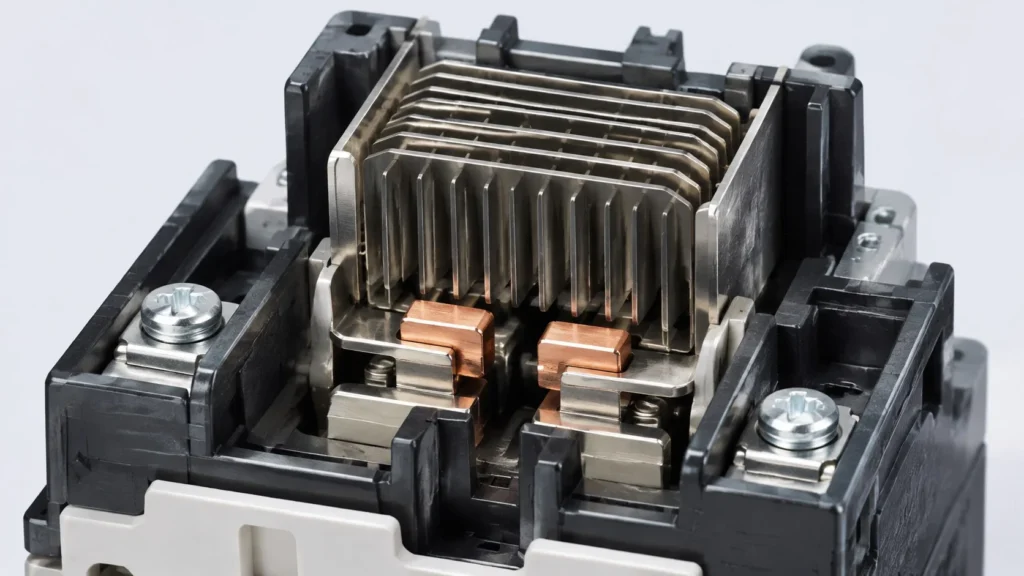
A relay rated 10 A will carry 10 A. It will not happily break a motor circuit at 10 A, because the arc drawn when the contacts part has nowhere to go. The contactor’s arc chute stretches and cools the arc so it extinguishes within a few milliseconds; a relay relies on the contact gap alone. The result is contact erosion, welded contacts, and eventually a short circuit across the supply.
There is a second reason: motor starting current. A motor draws several times its full-load current during run-up. A contactor rated AC-3 is tested for making that current and breaking the running current. A relay’s rating does not include that duty, and the contacts will not survive many starts.
Splitter plates in the arc chute stretch and cool the arc so it extinguishes within a few milliseconds. A control relay has no equivalent.
Why a contactor is a poor relay
Going the other way is less dangerous but still wrong. Contactor contacts are designed to carry and break real current; they rely on a certain wetting current to keep the contact surfaces clean. Switching a 24 V, 10 mA signal through a contactor contact for years can lead to a build-up of oxide and intermittent operation. If the signal is a safety interlock or a PLC input, that intermittency shows up as a spurious stop that nobody can reproduce.
Contactors also consume more coil power, which matters when a control circuit is fed from a small transformer or a UPS, and they rarely offer the changeover contact configurations that interlocking needs.
Choosing a contactor: start with the utilisation category
What is the load? Motor, resistive heater, capacitor bank, or transformer. Each has a different category and a different inrush.
What is the duty? AC-3 for normal motor starting and stopping. AC-4 if the contactor will plug or inch the motor, which reduces the permissible current sharply.
What is the full-load current? Select from the AC-3 rating at the actual operating voltage, not from the AC-1 figure.
What is the ambient temperature inside the enclosure? Contactor ratings assume a reference ambient, often 40 °C. Inside a sealed panel the temperature is higher, and the device has to be derated or a larger frame selected.
How often will it operate? Operations per hour affects both the electrical and the mechanical life.
Add an overload relay matched to the motor’s full-load current, and check that the combination’s short-circuit coordination is valid — the contactor and the upstream breaker or fuse are tested as a pair, not independently.
Coil voltage and the chattering problem
Most contactor failures that are blamed on the contactor are actually coil circuit problems. A contactor that chatters — pulling in and dropping out repeatedly — will destroy its own contacts and the motor it controls within a short time.
Common causes:
Coil voltage outside the tolerance band. An AC coil has a pick-up voltage and a drop-out voltage; if the control supply sags below the hold-in level during a motor start, the contactor drops out and re-closes.
DC coil on an AC supply, or the reverse. An AC coil on DC will overheat; a DC coil on AC will chatter or fail to pull in.
A control transformer that is too small. Contactor coils draw a high inrush VA. If several close at once, the supply dips enough to drop the ones already closed.
Long control cables. Voltage drop on the coil circuit reduces the voltage at the coil, which is the same problem as a sagging supply.
Loose coil terminals or a worn auxiliary contact in the self-holding circuit, which interrupts the hold-in path.
Mechanical binding from a distorted DIN rail, dirt, or a wrong-size overload relay mounted underneath.
Diagnose by measuring the voltage at the coil terminals while the contactor is energised, not at the control transformer. If it is within the coil’s specified range and the device still chatters, the problem is mechanical or in the holding circuit.
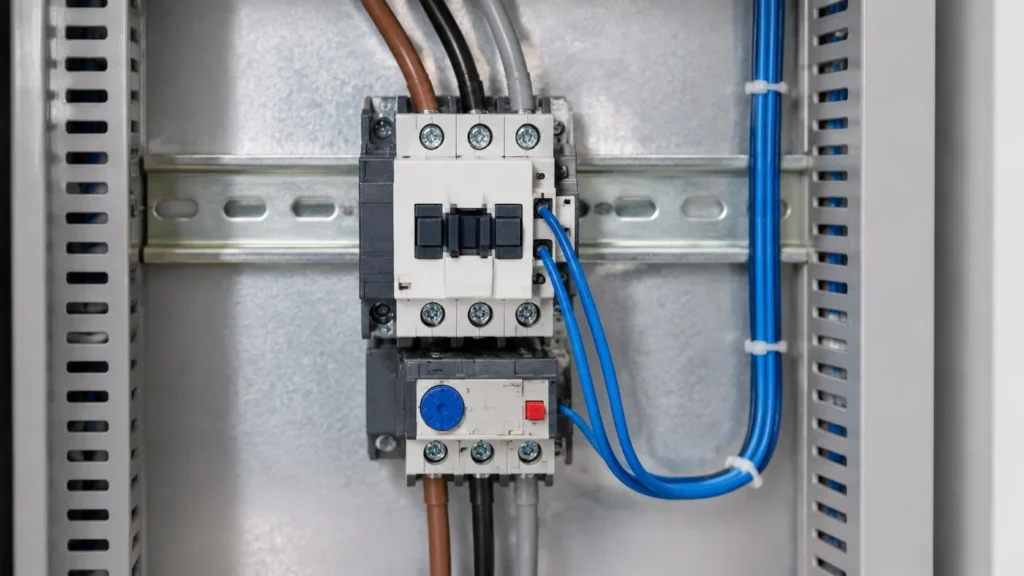
Contactor with the matching thermal overload relay underneath, and the coil wires brought to the front terminals.
Where the household contactor fits
Small AC contactors sold for domestic use — often 25 A to 63 A with a 220 V coil — are used to switch water heaters, air conditioners and whole sub-boards from a timer or a smart switch. They follow the same rules: check the load type, derate for the enclosure, and do not use them to switch a load above their AC-1 rating just because the coil is convenient.
الأسئلة الشائعة
Can I use a relay instead of a contactor for a small motor?
Only if the relay is specifically rated for motor switching at that current. A general-purpose control relay is not, and the contacts will erode quickly. For anything above a fractional-kilowatt motor, use a contactor.
What does AC-3 mean on a contactor?
AC-3 is the utilisation category for squirrel-cage motors: making the starting current and breaking the running current. The current rating in AC-3 is lower than the AC-1 rating for the same device.
Why is my contactor humming?
An AC coil hums because the shading ring or the mating face of the magnet is damaged or dirty. A worn face lets the magnet vibrate at twice the supply frequency. Clean the face; if the shading ring is cracked, replace the contactor.
Do I need an overload relay with a contactor?
Yes for a motor. The contactor switches, the overload relay protects the motor against sustained overload. The contactor alone provides no overload protection.
Can a contactor switch a DC load?
Only if it is rated for DC. DC arcs do not self-extinguish at a zero crossing, so a contactor rated for AC will not break a DC load of the same voltage and current safely.
Our AC contactor range lists AC-1 and AC-3 ratings, coil voltages and frame sizes; the household contactor range covers the smaller frames used for water heaters and air conditioners. If the contactor is being fitted into a distribution board, the module space it consumes is part of the same calculation as the breakers — see distribution box layout and spare module space.
RS485 and 24 V PLC I/O are the two interfaces that fail most often in industrial installations, and they fail for a reason that has nothing to do with the data rate. Both run on long cables between cabinets that sit on different earth references. When lightning or a switching event raises the potential of […]
A 4-20 mA loop or a 0-10 V signal line carries almost no energy, which is exactly why a surge matters there. The transmitter, the PLC analogue card or the drive input is built around a few milliamps and a handful of volts, and a surge that would be a minor event on a power […]
An outdoor distribution box fails for reasons that have very little to do with the IP number printed on the lid. Water gets in through a gland that was never tightened, through a knockout that was punched and left open, or as condensation on the inside of a sealed enclosure that never had a chance […]