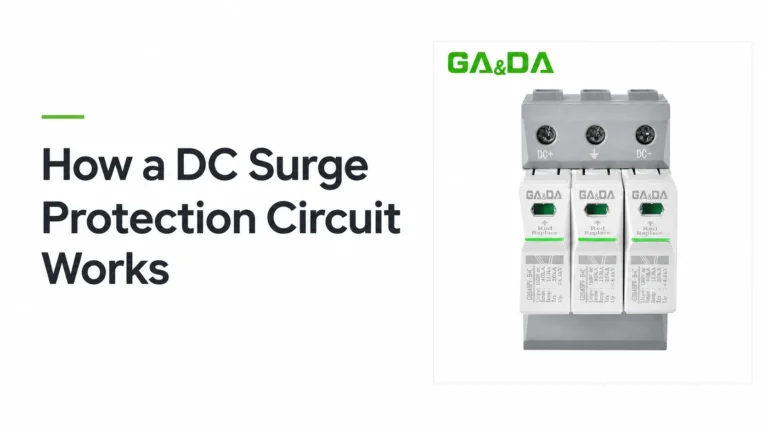





How a DC Surge Protection Circuit Works
Follow a DC surge protection circuit through normal operation, a surge and recovery, and see why protection modes and DC fault disconnection need their own design.
Read More English
If you are comparing AC SPD vs DC SPD, the real question is not which one is better. It is which one matches the circuit you are trying to protect.
That distinction matters because the wrong surge protective device can leave equipment exposed, create coordination problems in the panel, or fail under conditions it was not designed to handle. This is especially important in projects that combine AC distribution, solar PV, inverters, battery systems, or mixed OEM assemblies.
This article will help you make a practical selection decision. You will see what actually separates AC and DC surge protection, where each one should be installed, which ratings matter most, and which mistakes cause trouble in real projects.
In most cases, no. An AC SPD should not be treated as a DC SPD just because the voltage number looks close.
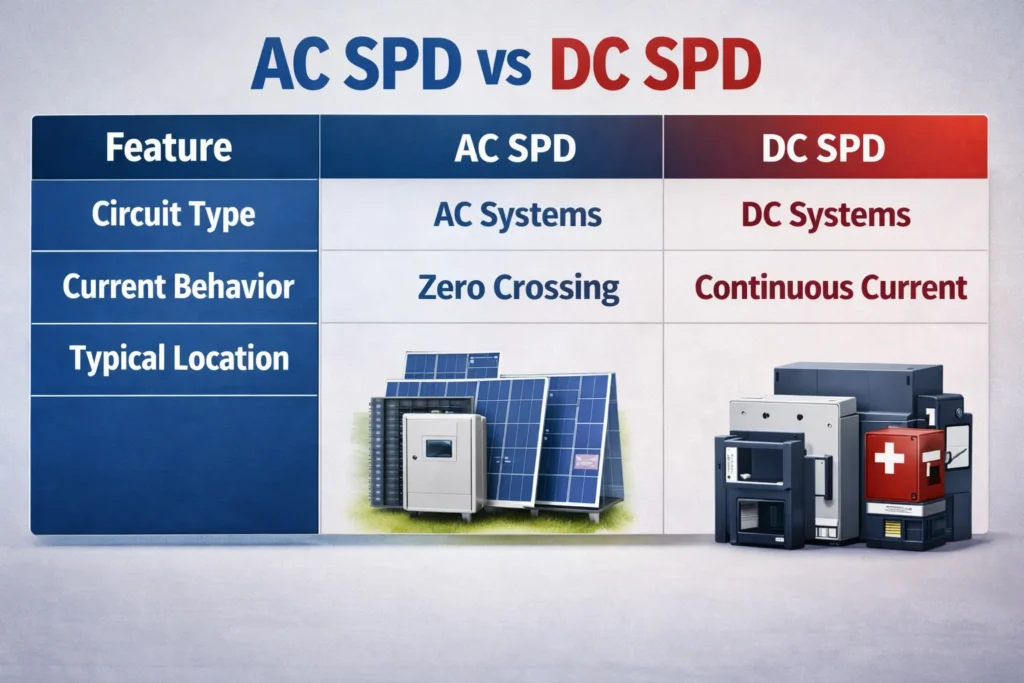
The main reason is that AC and DC circuits behave differently during fault and surge conditions. AC current crosses zero repeatedly, which makes arc interruption easier. DC current does not naturally cross zero in the same way, so the device needs different internal design features to manage follow current, thermal stress, and arc control.
That is why two SPDs that look similar from the outside may still be intended for completely different duties.
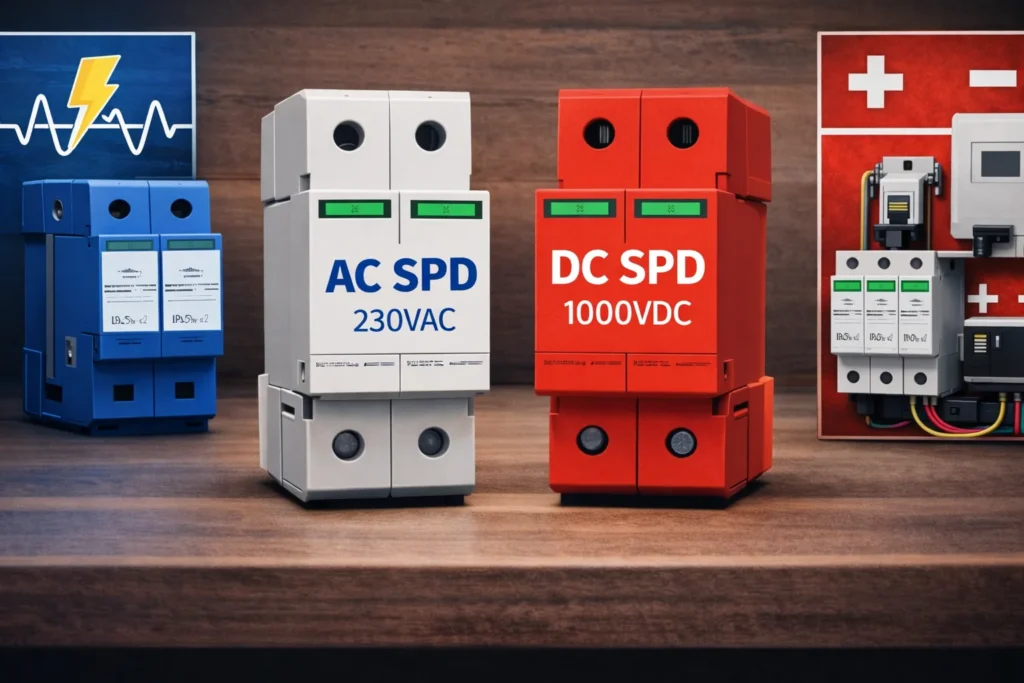
Buyers sometimes compare label voltage, module shape, or pole count and assume the devices are interchangeable. That shortcut causes problems.
An SPD is selected for the electrical behavior of the system, not just for appearance. A device intended for an AC distribution board is designed around AC-side conditions. A device intended for a solar PV string or battery DC circuit is designed around DC-side conditions.
Using the wrong SPD can lead to:
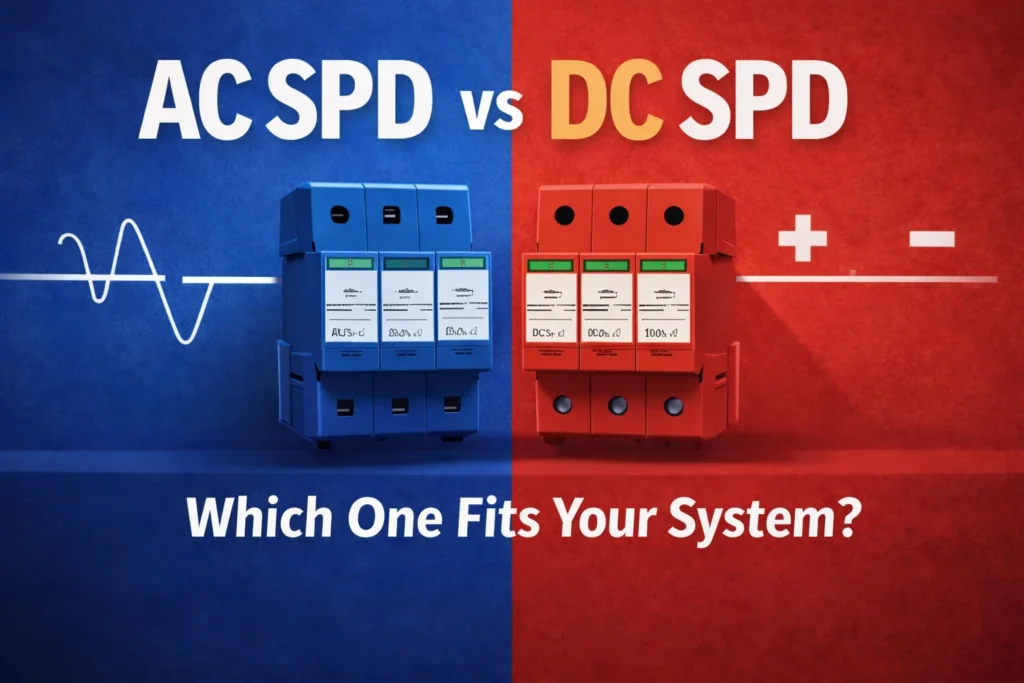
The phrase difference between AC and DC SPD is often answered too simply. It is not just “one is for AC and one is for DC.” The more useful answer is that they are designed for different circuit behavior, different installation sides, and different risk patterns.
| Item | AC SPD | DC SPD | Why it matters |
|---|---|---|---|
| Circuit type | AC distribution and equipment supply | PV strings, battery circuits, DC equipment feeds | The installation side determines the correct device family |
| Current behavior | Alternating current with zero crossing | Continuous current without the same zero-crossing behavior | Arc control and internal design requirements are different |
| Typical location | Main panel, sub-panel, service-side or equipment-side AC boards | PV combiner box, inverter DC input, battery DC section | Correct placement is part of correct selection |
| Common rating focus | AC system voltage, discharge ratings, installation class | DC system voltage, PV-related conditions, discharge ratings | Similar-looking ratings may not mean equivalent application |
| Risk of misapplication | Reduced protection or coordination issues | Higher risk of improper interruption under DC conditions | Misuse is not just a labeling issue |
AC systems alternate direction. That recurring zero-crossing helps extinguish arcs more easily. DC systems maintain current in one direction, so the device cannot rely on the same interruption behavior.
This is one reason AC surge protection vs DC surge protection is a real engineering distinction, not a marketing distinction.
In DC applications, especially in solar PV strings and higher-voltage DC circuits, the device must deal with conditions that can sustain an arc longer. That is why DC-side protection needs proper DC-specific design and proper voltage matching.
If you are evaluating can AC SPD be used for DC, this is one of the clearest reasons the answer is usually no.
Rated voltage still matters, but it is not enough on its own. Selection should also account for:
Choosing only by the headline voltage is one of the most common selection errors.
Many buyers understand the theory but still ask the practical question: where should each SPD actually be installed?
| System location | AC or DC side | Recommended SPD direction | Typical purpose |
|---|---|---|---|
| Main distribution board | AC | AC SPD | Protect incoming AC distribution and connected equipment |
| Sub-distribution panel | AC | AC SPD | Limit surge energy closer to branch equipment |
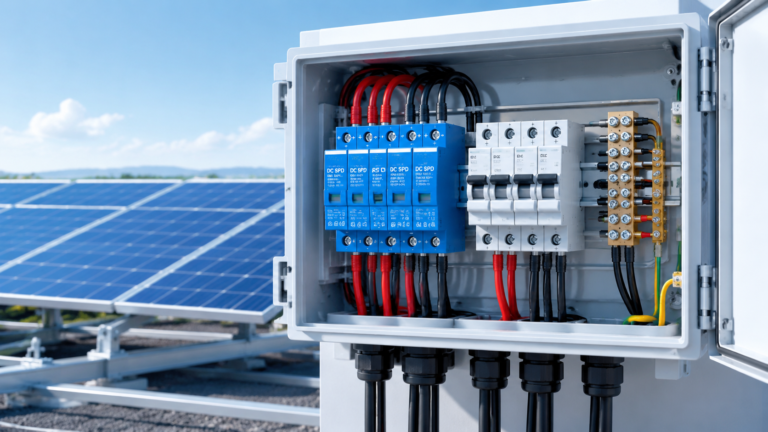
| PV combiner box | DC | DC SPD | Protect PV strings and associated DC wiring |
| Inverter DC input | DC | DC SPD | Protect the inverter from DC-side surge exposure |
| Inverter AC output | AC | AC SPD | Protect the inverter connection to the AC network |
| Battery DC circuit | DC | DC SPD | Protect battery-side power electronics and controls |
An AC SPD is normally used in:
This is the typical context for AC surge protection device for distribution board and Type 2 AC SPD for panel searches.
A DC SPD is normally used in:
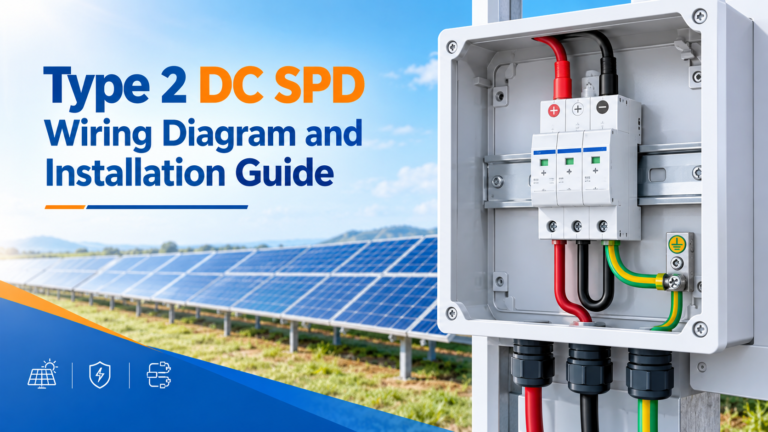
This is the practical context for DC surge protection device for solar PV and Type 2 DC SPD for PV systems.
A solar inverter system is the clearest example. The DC side and the AC side are not the same protection point, even when they connect to the same inverter.
In many projects, the correct answer is not “AC or DC SPD.” It is “AC SPD on the AC side, DC SPD on the DC side, each selected for its own location.” If you are reviewing options for that kind of setup, it is more useful to compare separate SPD categories by application side than to assume one device can cover every position.
Once you know the correct side of the system, the next step is parameter judgment.
| Parameter | What it tells you | Why buyers get it wrong |
|---|---|---|
| Uc | Maximum continuous operating voltage | They compare only nominal system voltage and ignore continuous conditions |
| In | Nominal discharge current | They treat it as a marketing number instead of a duty indicator |
| Imax | Maximum discharge capability | They assume higher is always better without considering application fit |
| Up | Voltage protection level | They ignore how it affects downstream equipment stress |
| Type 1 / Type 2 / Type 1+2 | Installation class and surge environment | They select by price or habit, not by installation point |
These ratings should support a selection decision, not replace it.
A good selection balances these values against the actual circuit, not just against a competitor’s catalog.
Type matters because the surge environment matters.
This is why how to choose AC or DC surge protection device often becomes a second question after the AC/DC distinction: what type is appropriate at that position?
Even the right SPD family can perform poorly if the installation logic is wrong. The actual position in the system, conductor routing, bonding quality, and coordination with nearby equipment all affect the result.
A technically correct part number does not fix a poor protection layout.
This is where comparison becomes selection.
Choose the AC side first if your project is centered on:
Ask:
For solar PV DC SPD vs AC SPD, the most common mistake is treating the inverter as a single protection point.
A better approach is:
That is the logic behind SPD for inverter AC and DC side searches.
OEM assemblies often combine AC input, DC control, inverter stages, and communication electronics. In that case, selection should follow the internal power architecture, not the external label on the machine.
For export projects, this matters even more because panel builders and distributors are often expected to justify why a device was selected for that exact section of the system.
| Common mistake | What goes wrong | Better approach |
|---|---|---|
| Choosing by appearance | Similar module shape is mistaken for application equivalence | Select by circuit side and duty |
| Looking only at voltage | Continuous operating conditions and type are ignored | Check Uc, type, and location together |
| Using one SPD for the whole system | Separate surge paths are left uncovered | Protect each relevant section appropriately |
| Treating the inverter as one side only | DC input and AC output risks are mixed together | Evaluate both sides independently |
| Chasing the highest kA value | The device may be oversized or mismatched | Choose ratings that fit the installation case |
This is common in catalog-driven buying. The device may fit the rail and still be wrong for the circuit.
Voltage is necessary, but not sufficient. It does not tell you how the device will behave at the installation point or whether it matches the surge environment.
Protection zones matter. A single SPD at one location does not automatically protect every DC string, panel section, or inverter interface in the project.
When comparing AC SPD vs DC SPD, the safest conclusion is simple: select by circuit side, installation point, and system behavior, not by appearance or voltage label alone.
AC SPDs belong to AC distribution and AC-side equipment protection. DC SPDs belong to PV, battery, and other DC-side circuits where the protection requirements differ in meaningful ways. In mixed systems, the right answer is often not one or the other, but both in the correct positions.
Before you finalize a purchase or panel design, confirm three things: which side of the system you are protecting, what ratings fit that location, and whether separate AC and DC protection points are required. If you are still comparing options for a live project, a quick technical review before requesting a quote usually saves more time than replacing the wrong SPD later.
Usually no. An AC SPD is designed for AC-side behavior, while a DC SPD is designed for DC-side conditions, especially where arc control and continuous current behavior are different. The correct device should match the actual side of the circuit.
It should not be assumed interchangeable. Even if the numbers appear close, the selection still needs to follow the intended application side, voltage conditions, and installation requirements.
Many of them do. The DC side protects the PV side and inverter input, while the AC side protects the inverter output and connected AC distribution, so the correct answer often depends on protecting both sections separately.
No. A higher rating is not automatically a better fit if the device class, voltage, and installation position do not match the application. Selection should be based on the actual surge environment and system layout.
Start with the installation point and surge exposure. Type 1 is considered where lightning current handling at the entrance or exposed interface is part of the design case, while Type 2 is widely used for downstream distribution and equipment protection.
It should be installed according to the system side being protected. In inverter systems, that often means evaluating the DC input side and the AC output side separately rather than assuming one location covers both.