Type 2 DC Surge Suppressor Selection for Solar, BESS and DC Panels
Published: Author: info@cngdfl.com
If you’re looking at DC Surge Protection Devices, you’re probably responsible for gear that absolutely cannot go down: solar PV fields, battery energy storage systems, telecom racks, industrial DC panels, or even EV fast chargers. In all those places, a Type 2 DC surge suppressor is the small DIN‑rail box standing between your investment and an expensive “pop” you hear during a storm or switching event.
In this article I’ll walk you through how to choose, where to use, and how to connect the right device, using concrete examples like Type 2 DC surge suppressor 40 kA In, Type 2 DC surge protection device 1500 V DC, and Type 2 DC surge suppressor 1000 V DC Uc. We’ll also touch on standards such as IEC 61643‑31 Type 2 DC SPD and practical variants like DIN‑rail Type 2 DC SPD with remote alarm. And yes, I’ll keep it as down‑to‑earth as possible—because you’ve got projects to deliver, not standards to memorize.
Let’s start with the basics, but quickly. A Type 2 DC surge suppressor (or Type 2 DC SPD) is a surge protective device specifically designed for DC circuits, tested with an 8/20 µs surge waveform and intended to handle indirect lightning strikes and switching surges in the distribution level of your system.
It is not there to take a direct hit from lightning; instead, it clips and diverts the residual surge energy that reaches your DC side after upstream protection and the installation’s earthing system have done their job. That’s why you see it everywhere in the middle of the system: in the PV combiner box, in the BESS container, inside the telecom 48 V DC rack, or in an industrial DC control panel.
Put in one sentence: the Type 2 DC surge suppressor limits overvoltage to a level your inverter, battery management system, telecom rectifier, PLC, or EV charger electronics can tolerate.
Main application scenarios
Solar PV: inside the combiner box
In a solar plant, the classic device is a Type 2 DC SPD for solar PV combiner box. Here it’s mounted on a DIN rail right after the string inputs and DC fuses, clamping surges before they reach the DC bus and the inverter’s DC input.
For most medium and large PV systems, engineers often specify a Type 2 DC surge suppressor 40 kA In as a good balance between protection level and cost, especially on 1000 V or 1500 V DC strings. When the plant is built with long DC cable runs in open fields, going for a Type 2 DC surge protection device 1500 V DC is standard practice to match modern high‑voltage strings.
BESS: protecting high‑value batteries
In battery storage, you typically see a Type 2 DC surge suppressor for BESS 1500 V DC at the interface between the battery rack and the DC bus or converter. The surge suppressor protects battery racks and power conversion systems against transients caused by switching operations, nearby lightning, or grid‑side disturbances coupling into the DC side.
Because BESS containers are often packed with electronics, fire‑safety and monitoring matter. So a spec line here often reads something like: “DIN‑rail Type 2 DC SPD with remote alarm, 1500 V DC Uc, 40 kA In, with thermal disconnector,” giving you both robust surge capacity and remote status monitoring.
Telecom DC power systems (48 V DC)
In telecom applications, power systems often run at 48 V DC, which is low voltage but mission‑critical. A Type 2 DC SPD for telecom 48 V DC is usually placed near the rectifier outputs or distribution panels that feed BTS equipment, radio units, and network switches.
Here the priorities are compact size, low residual voltage, and high reliability. You still want a DIN‑rail device, but sized for lower system voltage: something like a 48–75 V DC Uc rating, with decent surge handling, and ideally remote signalling so the NOC can see when a surge module has failed.
Industrial DC control panels
In factories, water plants, and process lines, you’ll often find PLCs, sensors, actuators, and drives powered from a DC bus at 24 V, 48 V or higher. To keep these control systems stable during switching operations, motors starting, or nearby lightning, you use a Type 2 DC surge suppressor for industrial DC control panel.
This device typically sits on the same DIN rail as DC power supplies, DC‑DC converters, and I/O modules, clamping surges before they can jump into delicate PLC inputs or fieldbus modules. Here again, a DIN‑rail Type 2 DC SPD with remote alarm is popular because maintenance teams can see the SPD state directly from the SCADA or DCS.
EV charging DC side
Finally, high‑power DC fast chargers are another growing application. On the DC output side feeding the vehicle, a Type 2 DC surge suppressor for EV charging DC side is used to protect the DC link, control electronics, and sometimes the communication circuits between charger and EV.
This environment can be rough: repetitive high currents, outdoor installation, and a mix of AC and DC disturbances. That’s why many EV charging designs specify a robust, high‑voltage Type 2 DC surge protection device 1500 V DC or whatever maximum DC output the charger needs, ensuring enough headroom during load changes and surges.
Learn how to pick, wire, and spec the right AC Surge Protective Device for industrial and commercial projects.
Now let’s match your keywords to the most important parameters you should look at when selecting a SPD.
Uc – maximum continuous operating voltage
Uc must always be equal to or higher than your system’s maximum DC voltage.
For modern PV strings up to 1000 V, you will commonly use a Type 2 DC surge suppressor 1000 V DC Uc, which is designed to stay stable at that continuous voltage level.
For newer, higher‑voltage arrays and BESS systems, a Type 2 DC surge protection device 1500 V DC is used so that even at temperature‑related voltage rises and no‑load conditions, the SPD will not enter conduction prematurely.
So when you’re choosing between 1000 V and 1500 V models, you’re really just matching the Uc value to your system, then checking the rest of the SPD ratings.
In – nominal discharge current (and why 40 kA matters)
The In rating tells you how much surge current (with the standard 8/20 µs waveform) the SPD is designed to handle repeatedly.
In many PV, BESS, and industrial applications, a Type 2 DC surge suppressor 40 kA In is a sweet spot: high enough to survive serious surges over its life, but not so over‑engineered that it kills your budget. For lighter duty or more protected environments, 20 kA In may be enough, but 40 kA In is a very common reference level for professional B2B projects.
Installation format and monitoring
You specified DIN‑rail Type 2 DC SPD with remote alarm, which is exactly what most engineers end up asking for when they realize the maintenance advantages.
DIN‑rail mounting lets you drop the SPD into a combiner box, BESS cabinet, telecom rack, or industrial control panel with standard tooling. The remote alarm (often a change‑over contact) allows the system controller or SCADA to receive a signal when the SPD module has reached end‑of‑life or tripped, so you’re not relying only on someone checking a little red window on site.
Standards and compliance
To make sure the device does what the label claims, it should be tested and certified under the right standards. For DC SPDs, the reference is IEC 61643‑31 Type 2 DC SPD, which defines test procedures, surge waveforms, performance levels, and marking for surge protective devices in DC applications.
When you see “Type 2 DC surge suppressor” on a datasheet, you want that to be backed by compliance to IEC 61643‑31 (or the corresponding EN adoption). This is especially important for EPC contractors working on utility‑scale solar farms, BESS installations, and critical infrastructure like telecom and EV charging, where insurance and grid‑code requirements depend on recognized standards.
Practical selection examples
To make this even more concrete, let’s walk through three short examples.
Example 1: 1000 V solar rooftop with combiner box
You’re designing a 500 kW rooftop PV system with 1000 V DC strings and several roof‑mounted combiner boxes. Here you’d choose:
Uc: 1000 V DC → Type 2 DC surge suppressor 1000 V DC Uc
Application: Type 2 DC SPD for solar PV combiner box
In: to be safe, Type 2 DC surge suppressor 40 kA In per pole
Mounting: DIN‑rail Type 2 DC SPD with remote alarm so that faults are visible from the main monitoring system
Result: robust, standardized protection across all combiner boxes.
Example 2: 1500 V BESS container
You’re specifying protection for a containerized battery system with a 1500 V DC bus. Your shortlist will probably say:
Use a Type 2 DC surge suppressor for BESS 1500 V DC at each connection point between racks and bus
Choose Type 2 DC surge protection device 1500 V DC compliant with IEC 61643‑31 Type 2 DC SPD
Request remote alarm capability for integration into the energy‑management system
Now you’ve aligned device voltage, type, and standard in one shot.
Example 3: Mixed site with telecom, industrial DC, and EV chargers
On a campus or smart‑city project, you may have:
Small telecom shelters needing a Type 2 DC SPD for telecom 48 V DC
Process control panels needing a Type 2 DC surge suppressor for industrial DC control panel
DC fast chargers requiring a Type 2 DC surge suppressor for EV charging DC side
You can standardize the vendor and platform by selecting a product family that covers all these variants, each with appropriate Uc and In ratings, but with the same DIN‑rail footprint and remote alarm interface. That makes life easier for both purchasing and maintenance.
No. You choose between Type 2 DC surge suppressor 1000 V DC Uc and Type 2 DC surge protection device 1500 V DC based on your actual system voltage. Oversizing Uc too far can compromise protection level, so match the SPD to your design voltage with reasonable headroom.
When is 40 kA In worth paying for?
If you’re protecting large PV fields, BESS, or outdoor EV charging and industrial DC panels, a Type 2 DC surge suppressor 40 kA In gives you a strong safety margin against repeated surges. For very small or well‑shielded systems, 20 kA might be enough, but 40 kA is a common “no‑regrets” choice.
Is the remote alarm really necessary?
For single small systems, you might skip it. But for anything spread out—solar farms, telecom networks, BESS sites—a DIN‑rail Type 2 DC SPD with remote alarm saves a lot of manual inspection time. Your control room can see when a module fails instead of waiting for a field visit.
Why is IEC 61643‑31 important?
Because IEC 61643‑31 Type 2 DC SPD certification tells you the device has been tested for DC surge duty using standardized procedures. That makes it easier to justify your design to consultants, insurers, and clients, and reduces the risk of “mystery” failures.
An SPD that has failed is not automatically a bad device. Most surge protection devices are sacrificial by design: they absorb surge energy, give up a little of their capacity each time, and eventually reach a condition in which they can no longer clamp anything useful and must come out of service. Ask why does […]
Ask when should an SPD be replaced and most answers stop at the status window. That is one input, and on its own a weak one: it shows that a device has reached end of life, never that a device is still fit for service. An SPD can be electrically exhausted while the window still […]
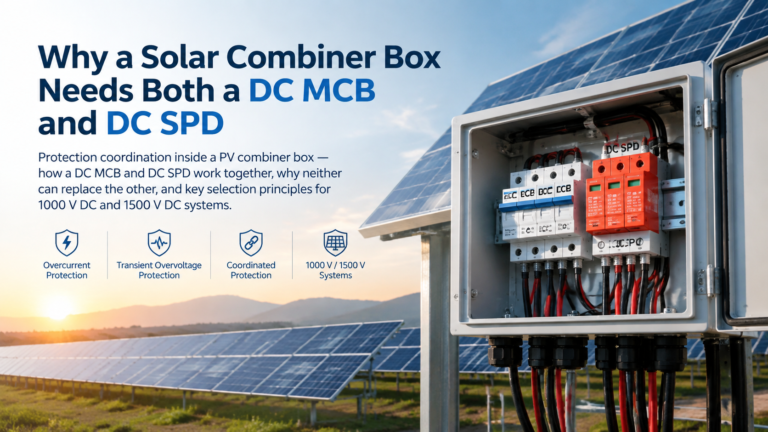
Why a solar combiner box needs both a DC MCB and a DC SPD: the division of labour between overcurrent and transient overvoltage protection, why neither device can substitute for the other, how they coordinate on the DC bus including the SPD backup protection requirement, and how the pairing changes between 1000 V DC and 1500 V DC systems.