How Are Fuses Rated Explained by Amperage Voltage and Breaking Capacity
Published: Author: info@cngdfl.com
Table of Contents
If you’re working with electrical circuits, you already know that choosing the right fuse rating is critical—but do you really understand how fuses are rated? It’s more than just the ampere rating on the label. To protect your circuits safely and effectively, you need to grasp the importance of voltage rating, interrupting capacity, and response time—and how each factor impacts performance and safety. In this guide, you’ll get a clear, no-nonsense breakdown of what these ratings mean and why they matter, so you can make informed decisions and avoid costly or dangerous mistakes. Let’s dive into the technical details behind how fuses are rated, with the precision you expect from GA&DA.
The Current Rating (Amperage)
The current rating, often called the ampere rating, is a fundamental fuse specification. It defines the maximum continuous current a fuse can carry without blowing. In simple terms, this rating ensures the fuse operates safely under normal electrical load conditions.
Operating Limits and Opening Threshold
A fuse’s current rating sets its opening threshold—the point at which it interrupts current flow to protect equipment from damage. Typically, fuses trip when the current exceeds the rated value by a certain percentage, often around 135–200%. This margin prevents nuisance blows due to minor transient surges while providing reliable overcurrent protection.
Temperature Sensitivity and Derating
Ambient temperature significantly influences fuse performance. Higher temperatures increase fuse element resistance and reduce current capacity. That’s why derating, or lowering the current rating according to temperature, is critical to maintain safety. For example, a fuse rated for 10A at 25°C might need to be rated lower if used at 40°C.
Selection Guidelines
When selecting a fuse based on amperage:
Choose a fuse with a current rating slightly above the normal operating current to avoid false trips.
Ensure the rating matches the application’s continuous current and anticipated transient surges.
Consider temperature derating for the installation environment to maintain accurate protection.
Confirm that the fuse’s amperage rating aligns with system design and safety standards.
By correctly rating a fuse’s amperage, you ensure effective protection against overcurrent conditions while avoiding unnecessary downtime. Always prioritize the current rating within the broader electrical context for optimal fuse performance.
The Voltage Rating
The voltage rating of a fuse is the maximum voltage it can safely interrupt without arcing or damage. It’s crucial to pick a fuse with a voltage rating equal to or higher than your circuit’s voltage.
Why Voltage Rating Matters
Maximum voltage threshold: The fuse must handle the highest voltage in your system when breaking the circuit.
Risks of a lower voltage rating:
Fuse might not fully open.
Risk of dangerous arcing or fire.
Potential damage to equipment or safety hazards.
AC vs. DC Voltage Ratings
Feature
AC Voltage
DC Voltage
Interruption ease
Easier to open gap
Harder due to steady current
Typical rating
Usually higher
Usually lower for same fuse size
Application examples
Residential, industrial AC circuits
Solar systems, battery banks, DC motor controls
Because DC current does not pass through zero like AC, fuses rated for DC often require a lower voltage rating to guarantee safe interruption.
Applications and Considerations
Always confirm the fuse’s voltage rating suits your system type: AC or DC.
In high-voltage circuits, using a fuse with the proper rating is critical for reliable overcurrent protection.
For detailed fuse bases compatible with AC systems, check industrial-grade options like these alternating current fuse bases.
Choosing the right voltage rating ensures your fuse provides efficient and safe short circuit protection, avoiding hazardous failure or downtime.
Interrupting Rating (Breaking Capacity)
The interrupting rating, also called breaking capacity, is the maximum current a fuse can safely interrupt without causing damage or becoming a hazard. This rating is crucial because it defines the fuse’s ability to handle extreme overcurrent situations like short circuits.
Fuses come with either low or high breaking capacity ratings:
Low breaking capacity fuses are designed for circuits with minimal short-circuit current. Using these fuses where high fault currents are possible can lead to fuse failure or dangerous explosions.
High breaking capacity fuses handle large fault currents safely, making them suitable for industrial and heavy-duty applications.
Choosing the right interrupting rating is vital for safety. If a fuse’s breaking capacity is too low for a circuit’s potential fault current, it may not interrupt the fault effectively, posing a serious risk of fire or equipment damage. For proper overcurrent protection, always match the fuse’s interrupting rating to or above the maximum expected fault current.
For integrating fuses in surge protection setups, you can check options compatible with rated interrupting capacities like the G20POE-X Series Gigabit Power Network Surge Protector. Proper fuse selection alongside surge protection can greatly enhance system safety and reliability.
Time-Current Characteristics (Fuse Speed)
When choosing a fuse, understanding its time-current characteristics is crucial. This rating shows how quickly a fuse responds to different levels of overcurrent.
Fast-Acting Fuses
Fast-acting fuses react almost immediately to overcurrent. They’re best for protecting sensitive electronics and circuits where even short overloads can cause damage. These fuses prevent heat buildup and component failure by opening the circuit quickly.
Slow-Blow (Time-Delay) Fuses
Slow-blow or time-delay fuses tolerate short surges without blowing, making them ideal for devices with high inrush currents like motors and transformers. They avoid nuisance trips in applications where brief current spikes are normal.
How to Read Time-Current Curves
Time-current curves graph the fuse’s blow time against the current flowing through it. The vertical axis shows the time (seconds), and the horizontal axis indicates the current relative to the fuse’s ampere rating. These curves help you see how fast a fuse will react under different overload conditions, assisting in selecting the right fuse speed for your protection needs.
For applications requiring precise short circuit protection and overcurrent protection, consider reviewing product specs carefully. Proper fuse selection, including speed and rating, ensures safety and equipment reliability—some detailed options and installation tips can be found in our surge protective device installation mistakes to avoid page.
Advanced Ratings (For Engineers)
When selecting fuses for more precise applications, engineers often look beyond simple ampere and voltage ratings, focusing on advanced parameters like I²t (Melting Integral) and the effects of voltage drop and internal resistance.
I²t rating measures the thermal energy a fuse can tolerate before it melts. It’s crucial for understanding how the fuse will handle short bursts of overcurrent without blowing prematurely. This rating helps in coordinating protection with sensitive electronics or inrush currents, ensuring the fuse reacts appropriately to fault conditions.
Voltage drop across a fuse and its internal resistance also matter, especially in high-current or DC circuits. A fuse with high internal resistance can cause a significant voltage drop, which affects overall circuit performance and efficiency. Knowing these values helps engineers optimize circuit design for reliability and energy efficiency.
For more precise applications, such as DC circuits, exploring products like DC fuse bases can also provide insights into handling these advanced ratings effectively.
Incorporating these advanced ratings ensures better safety, longer equipment life, and proper short circuit protection tailored to your specific engineering needs.
Regulatory Standards and Approvals
When choosing fuses, understanding regulatory standards like UL/CSA and IEC is crucial for ensuring safety and reliability. UL (Underwriters Laboratories) and CSA (Canadian Standards Association) standards are widely recognized in North America, focusing on product safety and performance under specific testing conditions. On the other hand, IEC (International Electrotechnical Commission) standards are more common globally and often used for products designed for international markets.
The main difference lies in testing methods and performance criteria. For example, UL/CSA standards may emphasize certain interrupting ratings and temperature deratings suited for North American electrical systems, while IEC standards provide a broader, more universal framework, including fuse speed categories and time-current characteristics.
Certifications from these bodies guarantee that a fuse meets stringent requirements, especially for overcurrent protection and short circuit protection. Using certified fuses reduces the risk of failure and enhances operational safety in residential, commercial, or industrial applications.
Always look for UL, CSA, or IEC marks on fuse packaging or datasheets to ensure compliance. This helps confirm the fuse’s ampere rating, voltage rating AC/DC, interrupting rating, and overall quality meet recognized benchmarks.
For detailed insights on fuse breaking capacity and voltage ratings relevant to these standards, you can check a comprehensive guide on fuse breaking capacity and voltage ratings. This resource supports better understanding and selection of certified fuses tailored to your application needs.
How to Select the Right GA&DA Fuse
Choosing the right GA&DA fuse is essential for reliable overcurrent protection and safety. Here’s a simple step-by-step guide to help you pick the correct fuse:
Determine the Ampere Rating: Check the normal operating current of your device or circuit. Your chosen fuse’s ampere rating should match this current to avoid nuisance blowing or insufficient protection.
Verify the Voltage Rating: Ensure the fuse voltage rating suits your application’s voltage—whether AC or DC—as this affects how the fuse will perform under fault conditions.
Consider the Interrupting Rating (Breaking Capacity): Select a fuse with an interrupting rating higher than the maximum short-circuit current expected. This prevents catastrophic failure during faults.
Choose Fuse Speed According to Application: Fast-acting fuses are best for sensitive electronics, while slow-blow (time-delay) fuses work well for devices with temporary surge currents.
Check Advanced Ratings if Needed: For more demanding designs, compare I²t ratings and thermal characteristics to avoid damage from transient overloads.
Account for Environmental Factors: Remember to derate the fuse’s amp rating for ambient temperature variations to keep protection reliable.
Review Applicable Standards: Make sure the fuse complies with relevant UL or IEC standards for safety and performance.
Important Warnings on Fuse Replacement and Rating Mismatches
Never replace a fuse with one of a different ampere or voltage rating unless explicitly authorized. Using the wrong fuse risks equipment damage or fire.
Avoid lower breaking capacity fuses; they may fail catastrophically under fault currents.
Don’t ignore manufacturer recommendations for GA&DA fuse ratings specific to your equipment.
Always source fuses from trusted suppliers to ensure genuine ratings and certifications.
Choosing the right GA&DA fuse and respecting its ratings keeps your electrical systems safe and efficient. For a detailed explanation of fuse ratings, you can visit this comprehensive guide on fuse ratings including current, voltage, and interrupting capacity.
A blowing solar fuse is either a real fault being cleared or nuisance operation. Learn how to tell the two apart, the causes behind each, the measurements that confirm them, and why replacing the fuse without diagnosing is the wrong response.
A DC-specific comparison of fuses and circuit breakers in solar PV systems: arc extinction without a current zero, operating speed, energy let-through, selectivity, reset and maintenance, with a decision matrix for string, combiner box, inverter DC input, battery/BESS and DC main positions.
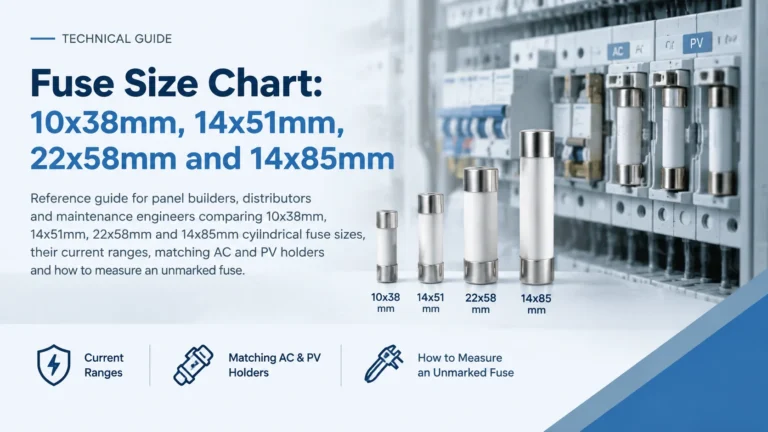
A fuse size chart for 10x38, 14x51, 22x58 and 14x85mm fuses: dimensions, current ranges, matching AC and PV holders, and how to measure an unmarked fuse.