Understanding what is a fuse is fundamental for anyone designing, installing, or maintaining electrical and photovoltaic systems. When engineers ask “what is a fuse,” they are talking about a deliberately weak link in the circuit that sacrifices itself to protect cables, devices, and people from dangerous overcurrent. In low‑voltage panels this often means combining fuse links with a suitable base such as an AC fuse base for low voltage fuse links or high‑current links like the NT00 160A 250A 400A AC fuse link.
This complete guide to what is a fuse walks through basic definitions, construction, working principle, key ratings, and typical fuse types. It then translates the theory into practical selection and application tips so that “what is a fuse” becomes a concrete design tool rather than just a textbook definition.
Overview: Why understanding what is a fuse matters
From a protection point of view, “what is a fuse” can be summed up as a fast‑acting, one‑time overcurrent protection device that interrupts fault currents before they damage conductors or equipment. Unlike resettable devices, the fuse is designed to melt and open the circuit once its current‑time limits are exceeded, providing a clear, visible indication that something has gone wrong. This sacrificial behavior is the core reason fuses are still widely used in distribution boards, control panels, PV combiner boxes, and battery systems.
Knowing what is a fuse also helps engineers coordinate multiple protective devices. Fuses have predictable time‑current curves and let‑through energy (I²t) characteristics, which makes them valuable for limiting short‑circuit energy and achieving selectivity with downstream breakers or semiconductor fuses. When “what is a fuse” is fully understood, it is easier to pick the right fuse type and rating so that the weakest point in the circuit is located where it is safest and most economical to replace.
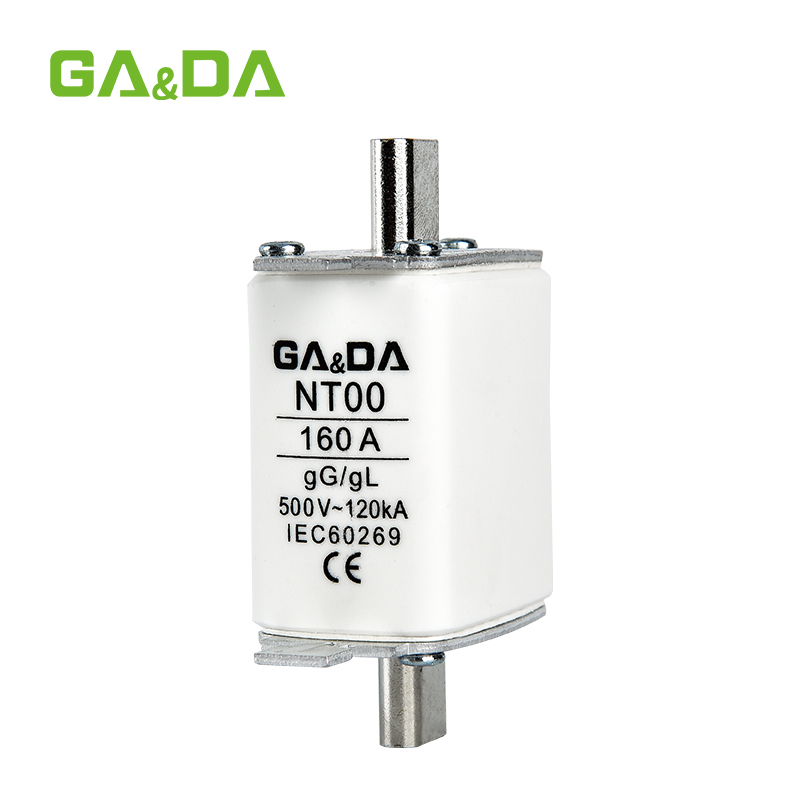
Product illustration – basic low‑voltage fuse components For standard low‑voltage applications, the Alternating Current Fuse Base combined with NT00 160A 250A 400A AC fuse links provides a practical example of how what is a fuse translates into real DIN‑rail or panel‑mounted hardware.
(Insert fuse base + NT00 fuse link image here, each linked to its URL.)
What is a fuse: construction and working principle
To go beyond the simple definition of “what is a fuse,” it is useful to examine how a fuse is built and how it behaves electrically and thermally during faults. Every construction detail—from the fuse element material to the type of filler and enclosure—affects the way the fuse responds to overloads and short circuits.
At its core, what is a fuse if not a calibrated weak link? The fuse element is sized so that it carries rated current indefinitely under normal conditions but melts quickly when current rises above its time‑current characteristic. Understanding this mechanism helps engineers interpret I²t ratings, pre‑arcing times and total clearing times on fuse datasheets, and ensures that “what is a fuse” is tied directly to coordination calculations.
Construction of a fuse in practical applications
In practical terms, the answer to “what is a fuse” always starts with the fuse element and its housing. A typical low‑voltage power fuse consists of:
A metallic fuse element (often copper, silver, or alloy) with a carefully controlled cross‑section and profile.
A body or cartridge made of ceramic or other non‑combustible insulating material that can safely contain the arc.
End caps or blades that provide low‑resistance electrical contact to the circuit conductors or fuse base.
Many cylindrical and NH‑type fuses use quartz sand or other filler materials to help cool and extinguish the arc when the element melts. In automotive or miniature formats, plastic housings replace ceramic, but the basic idea of what is a fuse—a calibrated metal strip inside an insulating body—remains the same.
Fuse working principle step by step
Electrically, the working principle behind “what is a fuse” is based on Joule heating. When current flows through the fuse element, it generates heat proportional to I²R, where R is the resistance of the element. Under normal load, this heat is safely dissipated to the surroundings and the element remains solid. When a fault or severe overload occurs, the current rises and the element temperature increases rapidly.
If the current‑time combination exceeds the fuse’s designed limit, the element reaches its melting point and opens the circuit. During this process, an electric arc forms across the gap, but the fuse’s internal design (element shape, filler, and housing) forces the arc to cool and stretch until it is extinguished. At that point, the circuit is fully interrupted, and the question “what is a fuse” is answered in the most practical way: the device has sacrificed itself to prevent further damage.
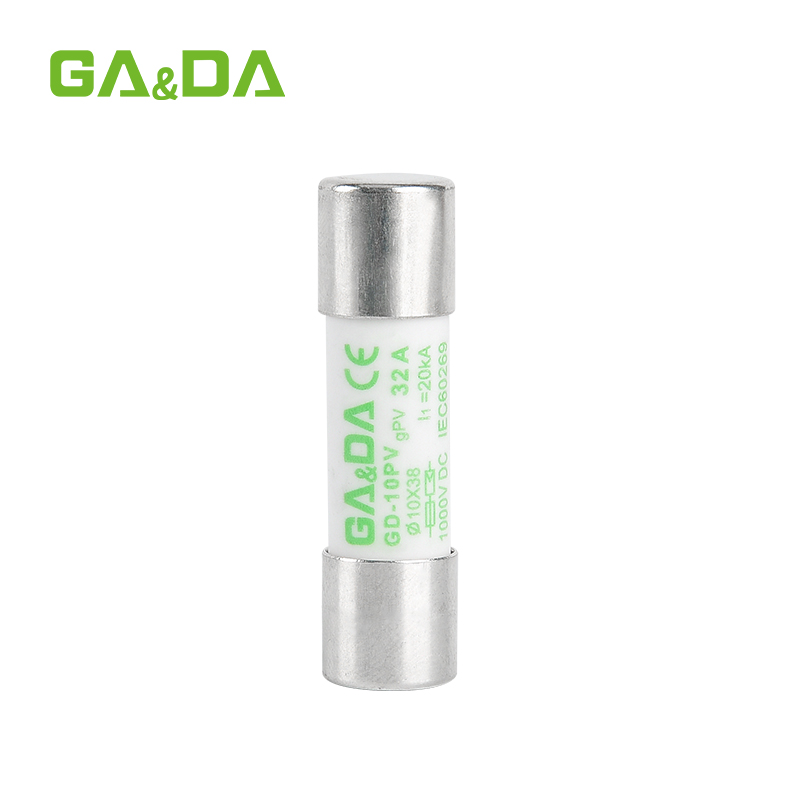
Product illustration – PV string fuse links based on the same principle DC PV applications answer “what is a fuse” with cylindrical 10×38 mm links such as the GD‑10PV Direct Current Fuse Link 32A and GD‑12PV Direct Current Fuse Link 32A, which use the same melting and arc‑extinguishing principles but are optimized for high‑voltage DC strings.
(Insert GD‑10PV / GD‑12PV product image here and link to URLs.)
Key electrical characteristics that define what a fuse can do
When engineers evaluate what is a fuse for a particular application, they quickly move from basic definitions to specific electrical characteristics. Datasheets for power fuses, PV fuses, and semiconductor fuses all use a common set of parameters that define how the device behaves in a circuit. Understanding these parameters is critical to converting the textbook idea of “what is a fuse” into a safe and standards‑compliant design.
The most important characteristics include rated current (In), rated voltage, breaking capacity, utilization category (such as gG, aM, or gPV), time‑current curves, and I²t values. Each parameter gives a different perspective on what is a fuse in terms of how much current it can carry continuously, what system voltage it can safely interrupt, and how much energy it lets through during faults.
Rated current, rated voltage, and breaking capacity
Rated current tells you the continuous current a fuse can carry without melting under specified ambient conditions. When asking “what is a fuse” for a given circuit, the answer must consider load current, inrush, and ambient temperature. Fuses are not intended to run exactly at their rated current under all conditions; derating is typically applied for high ambient temperatures or enclosed installations.
Rated voltage defines the maximum system voltage at which the fuse can safely interrupt a fault. This is one of the reasons why “what is a fuse” in DC systems often involves higher voltage ratings than in AC systems, due to DC arc extinction challenges. Breaking capacity (or interrupting rating) specifies the maximum short‑circuit current the fuse can safely clear without rupturing or failing dangerously. For low‑voltage power fuses, modern standards like IEC 60269 require high breaking capacities so that “what is a fuse” always implies safe interruption of the worst‑case fault.
Time‑current curves, I²t, and utilization categories
Time‑current curves define how long a fuse will take to operate at different levels of overcurrent. These curves provide a graphical answer to “what is a fuse” when coordination is required, since they show whether the fuse will clear before or after another device in the circuit. I²t values (melting I²t and total clearing I²t) quantify the energy the fuse element lets through during operation, which is important for protecting cables, busbars, and semiconductor devices.
Utilization categories such as gG, aM, or gPV describe what is a fuse in terms of its application range. For example, gG fuses are general‑purpose for cable and line protection, aM fuses are intended for motor circuits where overload protection is handled elsewhere, and gPV fuses are dedicated to photovoltaic applications. Selecting the correct utilization category is as much a part of answering “what is a fuse” for your circuit as choosing the current and voltage rating.
Product illustration – high‑current low‑voltage fuse links and holders Low‑voltage distribution boards often use NT00‑format links such as the NT00 160A 250A 400A AC fuse link together with appropriately rated bases to meet the current, voltage, and breaking‑capacity requirements of IEC 60269. (Insert NT00 link + base image here and link to URLs.)
Common fuse types and where what is a fuse really matters
In practice, the question “what is a fuse” leads to multiple answers depending on the format and application. Low‑voltage power systems use cylindrical or NH (knife‑blade) fuses; automotive systems rely on blade fuses; PV and battery systems use gPV or special DC fuses; and sensitive electronics are protected by ultra‑fast semiconductor fuses. Each type answers “what is a fuse” slightly differently in terms of geometry, mounting, and speed of operation.
Engineers should therefore always connect “what is a fuse” to the specific environment: is it a DIN‑rail distribution board, an enclosed combiner box, a vehicle wiring harness, or a semiconductor drive? This context determines not only the mechanical type (cylindrical, NH, blade, etc.) but also the utilization category and necessary environmental ratings.
Low‑voltage power fuses in distribution boards
In building and industrial distribution boards, “what is a fuse” is most often a cylindrical or NH power fuse used for feeder, distribution, or motor protection. Cylindrical types may be 10×38 mm, 14×51 mm, or similar, while NH fuses come in standardized sizes such as NH00, NH1, and so on. They are mounted in dedicated fuse bases or switch‑disconnectors, allowing safe replacement and, in some designs, visible isolation.
These fuses are typically classified as gG or aM, and their I²t and breaking‑capacity values are used in coordination studies with upstream and downstream devices. In this context, what is a fuse becomes part of a broader protection scheme including MCBs, MCCBs, and residual current devices.
PV and DC fuses in renewable and storage systems
In PV and energy storage applications, “what is a fuse” usually means a gPV fuse optimized for high‑voltage DC. These fuses are designed to interrupt string or battery faults in systems that can reach 1000 V or 1500 V DC, where arc extinction is more difficult than in AC circuits. They are installed in combiner boxes, inverter inputs, or battery racks, often in 10×38 mm cylindrical form factors.
Products like the GD‑10PV 10×38 mm DC fuse link 32A and compatible DC fuse bases such as GDPV‑32 DC fuse base 1P 2P are direct answers to “what is a fuse” in PV string protection. They are tested to gPV requirements in IEC 60269‑6 and sized based on open‑circuit voltage, short‑circuit current, and string configuration.
Practical engineering tips based on what is a fuse in real projects
Once the theoretical side of “what is a fuse” is clear, engineers still need practical rules to apply fuses effectively in real‑world projects. Good practice begins with a simple hierarchy: protect conductors first, then equipment, and finally consider selectivity and serviceability. Fuses should always be placed where the cost and difficulty of replacement are acceptable compared with the value of what they protect.
When implementing “what is a fuse” in panel layouts, keep fuses accessible for maintenance but physically separated from sensitive electronics to manage heat and arc by‑products. Always follow torque specifications for fuse bases and switch‑disconnectors, and respect polarity markings on DC fuse bases and links to avoid reverse‑connection issues in PV or battery systems.
Correctly sizing a fuse starts with load current and expected overloads, then checks coordination with cable ampacity and protective device curves. The answer to “what is a fuse” in selection terms is a device that:
Carries normal and allowable overload currents without nuisance operation.
Operates fast enough to protect cables and equipment for foreseeable faults.
Has voltage and breaking‑capacity ratings suitable for the maximum system voltage and prospective fault current.
For advanced designs, engineers should also use I²t to coordinate fuses with semiconductor devices or downstream protective devices. The more precisely “what is a fuse” is connected to datasheet curves and standards, the more reliable and optimized the protection scheme becomes.
FAQ – what is a fuse and how it works
Q1. In simple terms, what is a fuse? A fuse is a sacrificial overcurrent protection device that melts when too much current flows, breaking the circuit and preventing cables or equipment from overheating or catching fire. It is designed to be the weakest, most easily replaceable link in the system.
Q2. How does the working principle of a fuse differ from a circuit breaker? Both provide overcurrent protection, but a fuse uses a melting metal element that must be replaced after operation, while a circuit breaker uses a mechanical switching mechanism that can usually be reset. Fuses typically offer very fast and predictable response, especially for high fault currents.
Q3. Why do some fuses have sand or filler inside them? The sand or other filler material helps cool and stretch the arc when the fuse element melts, allowing the fuse to interrupt higher fault currents safely and within the limits defined by standards such as IEC 60269. Without filler, the arc could persist and damage the fuse body or nearby equipment.
Q4. When should I choose a gPV fuse instead of a general‑purpose gG fuse? Use gPV fuses for photovoltaic DC circuits, especially high‑voltage PV strings and combiner boxes. These fuses are designed and tested specifically to handle the continuous DC voltage, fault current profiles, and environmental conditions found in PV systems, which differ from standard AC distribution circuits.
A blowing solar fuse is either a real fault being cleared or nuisance operation. Learn how to tell the two apart, the causes behind each, the measurements that confirm them, and why replacing the fuse without diagnosing is the wrong response.
A DC-specific comparison of fuses and circuit breakers in solar PV systems: arc extinction without a current zero, operating speed, energy let-through, selectivity, reset and maintenance, with a decision matrix for string, combiner box, inverter DC input, battery/BESS and DC main positions.
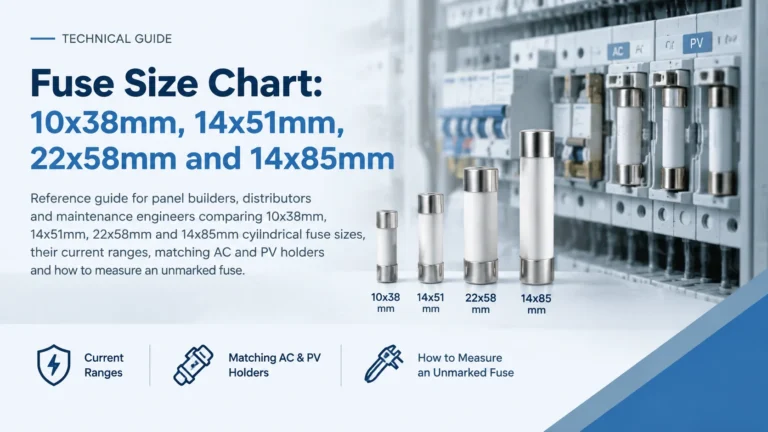
A fuse size chart for 10x38, 14x51, 22x58 and 14x85mm fuses: dimensions, current ranges, matching AC and PV holders, and how to measure an unmarked fuse.