Why Does a Solar Fuse Keep Blowing? Causes and Solutions
Publicado: Autor: Rachel
If your solar fuse keeps blowing, the first thing to establish is whether the fuse is doing its job or whether it is operating when it should not. Those are two different problems with two different investigation routes, and treating them as one is how an array ends up with a box full of spent fuses and a fault that is still there.
A string fuse that opens because a real fault exists has performed as designed, and the answer is to find and repair the fault. A fuse that opens because it was the wrong rating, the wrong class, or running hotter than anyone allowed for is nuisance operation, and the fix lies in the device’s selection and installation. This guide separates the two and shows how to confirm each cause in the field.
Sizing is deliberately out of scope: string current, the applicable margin and temperature correction are covered in solar PV fuse selection for gPV 1000 V and 1500 V. This article assumes the fuse is already in place and asks why it keeps opening.
Two different events behind the same blown fuse
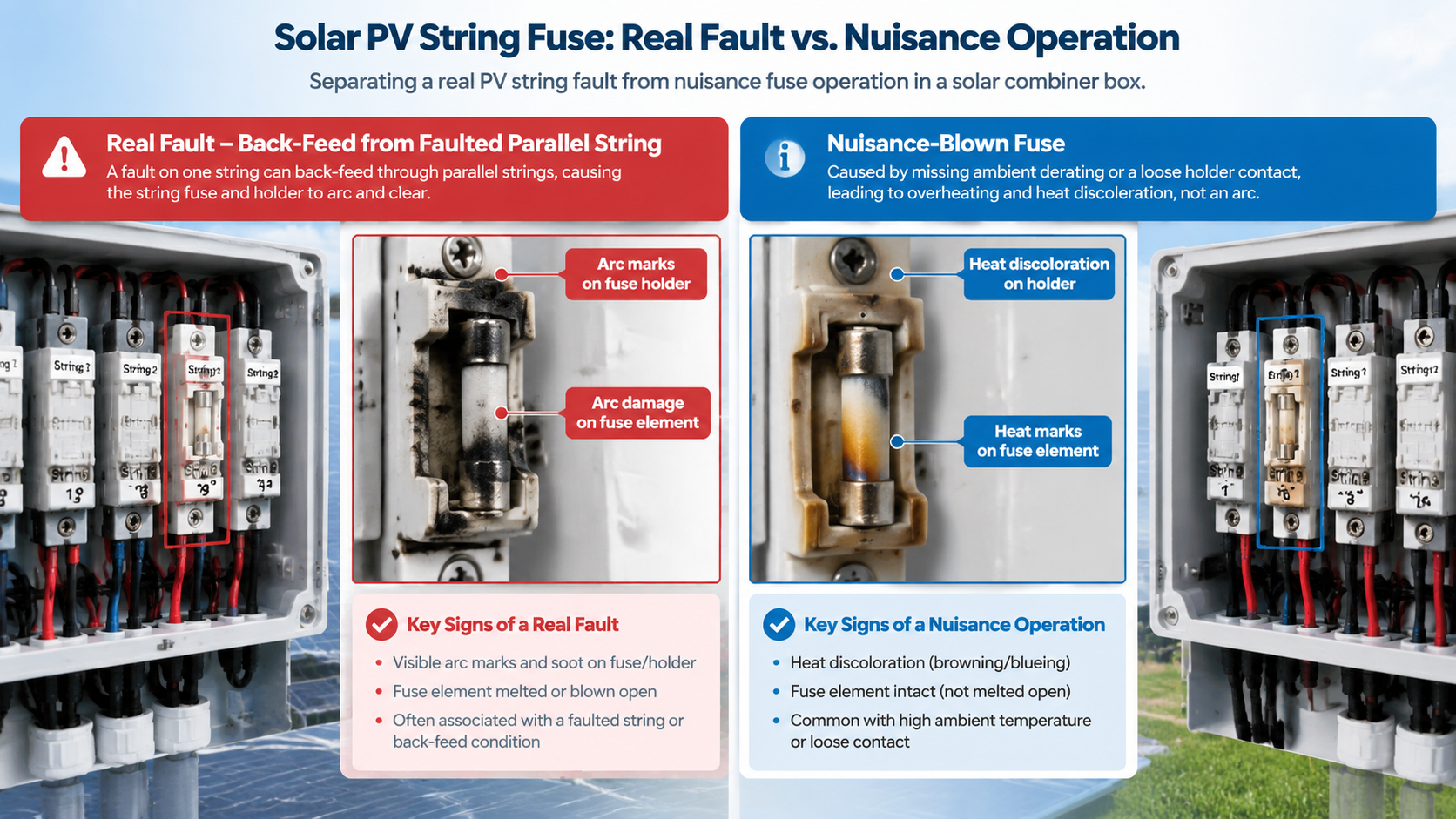
Read the evidence rather than the symptom. Both cases leave you with an open fuse, but the site gives different clues.
What you observe
Fuse cleared a real fault
Nuisance operation
How often
Once, or after a specific event — a storm, impact damage, work on the array
Repeatedly, often after hot weather or re-termination, or after a string was added
Which fuse
One string, and the same one each time
Different strings on different occasions, or several at once
Fuse and holder
Soot, arc marks, a blackened body or holder, sometimes a cracked body
Element parted with a heat-discoloured barrel; a warm or lightly discoloured holder
Array beforehand
The affected string measured worse than its neighbours, or a defect was obvious nearby
All strings normal right up to the moment of failure
Marked rating
Consistent with the string current and the datasheet
At or barely above the string’s short-circuit current, or a class that is not PV-specific
Neither column is a diagnosis by itself, but the pattern tells you where to spend your time. A real fault can also be intermittent: a connector that only fails when wet, or a cable that only faults when the array flexes in wind, will open fuses at intervals that look random.
Safety first: a PV array has no off switch
Everything below assumes a competent person working to the site’s own procedures. Modules produce voltage as soon as light falls on them, and opening a fuse or isolator removes the path to the rest of the system rather than de-energising the cable between the modules and the open device.
Isolate, then verify dead at the point of work. Open the string at the combiner box and at the inverter where applicable, then prove the conductors you will touch are de-energised with an instrument rated for the system’s DC voltage, applied where you will actually work. Re-verify after any interruption, and follow lockout/tagout.
Never pull a fuse on a loaded string. A DC arc does not extinguish at a natural current zero the way an AC arc does. PV fuse holders and fuse-disconnectors are generally meant to be opened off-load — check the supplied instructions.
Use DC-rated instruments and suitable PPE. Leads, probes and meters need a DC rating at least equal to the maximum system voltage; insulated gloves and arc-rated clothing are the normal minimum.
Reduce irradiance where your procedures allow, but treat it as hazard reduction, not permission. Covering modules is rarely complete, so it never makes a string safe to handle like a dead circuit.
Read the failed fuse before you throw it away
Keep it. Bag and label the fuse with the date, string number and location. A pattern across failures is only visible if the parts survive.
Inspect the body and the holder. Soot and arc marks point to a high-energy interruption at fault current; a heat-discoloured barrel with a parted element points to long-term overheating near rated current. Blackened contacts, a deformed holder body or a brown heat mark on the rail show the holder was part of the problem.
Read the markings. Compare with the fuses on the other strings and with the spares box. One string carrying a different fuse is an assembly or procurement error that will keep repeating.
Ask what changed. A new string, a re-termination, a different fuse supplier, a repaired connector — the answer often explains the timing of the first failure.
A real fault leaves arc damage; nuisance operation leaves heat discolouration. The two point to different fixes.
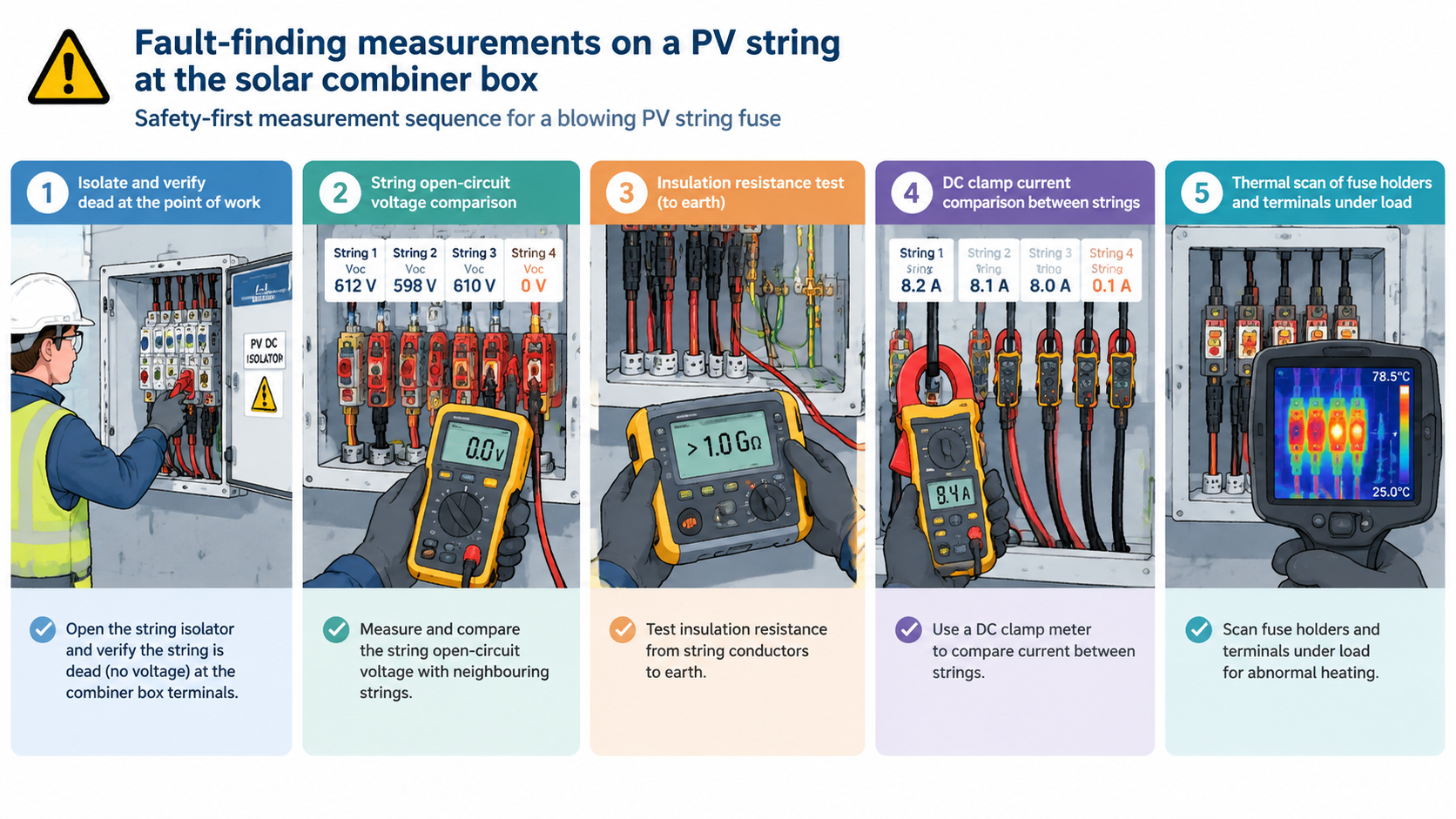
A safety-first measurement sequence
Work through the sequence in order and record every result; the value is in the comparison between strings, not in any single number.
Record the system state first. Date, time, irradiance, string number, inverter alarms and monitoring history. A string that only fails at high irradiance is telling you something specific.
Isolate the affected string at the combiner box and at the inverter where applicable, then verify dead at the point of work.
Check the fuse and holder as above, and measure fuse continuity with the fuse out of circuit.
Measure string open-circuit voltage and compare it with neighbouring strings and with the value expected from the module datasheet. A low or absent voltage localises the fault inside the string; a normal value moves suspicion to the fuse, the holder and the selection.
Check polarity at the box. A reversed string is a genuine fault and invites reverse current from the others.
Test insulation resistance from the string conductors to earth with an instrument suited to PV circuits — not every tester is safe or accurate on an array, so check its instructions. Compare the reading with the commissioning baseline.
Inspect every connector and module junction box in the string: discoloured housings, partial mating, water or corrosion inside, a boot that no longer seals.
Compare string currents under similar load with a DC clamp. Ratios between strings matter more than absolute values.
Thermal-scan the combiner box under load — fuse holders, terminals, busbars. One holder warmer than the others is a contact-resistance defect, not a selection problem.
Only then replace and re-energise, watching current and temperature as the string returns to service.
The sequence matters: isolate and verify dead, then work from array voltage through insulation resistance to current and temperature.
Real faults: when the fuse was right to open
Reverse or back-feed current from parallel strings
Strings in a combiner box are in parallel. If one develops an internal fault — a shorted bypass diode, a shorted module section, a failed connector — it stops behaving as a source and starts behaving as a load, and the remaining strings push their combined current into it. The fuse in the faulted string carries the sum of the others’ currents and is expected to open. This is exactly what a string fuse exists for.
So the question is not why the fuse failed but what is wrong in the string it protected. It only works if every string has its own fuse of the correct class and rating — a box that fuses groups of strings, or leaves some unfused, cannot limit back-feed at all.
Insulation or earth fault within a string
Damaged insulation, chafing on a roof edge, rodent damage, a cable crushed under a mounting foot or water tracking inside a junction box creates a path from the string to earth. Depending on where the fault is and how the system is earthed, the result is a sustained leakage current the fuse sees as an overload, or an intermittent fault triggered by moisture. Insulation resistance testing confirms it; a healthy reading on a dry day and a clear failure after rain is a common signature.
Module or connector failure
Connectors are among the most frequent failure points in fielded arrays: a partly mated pair, mismatched types, a crimp never properly made, or corrosion in a housing that has taken water. A high-resistance joint heats under load, accelerating its own deterioration, and can end as an open circuit, an earth fault or a fire. Bypass-diode failure inside a module junction box produces the back-feed condition above. Confirm with thermal imaging under load, a physical check of every connector, and voltage comparison between modules.
Water ingress in a junction box or connector
Water in a module junction box, an inline connector or a combiner-box gland rarely announces itself. It corrodes contacts, provides a leakage path, and creates faults that appear after rain or condensation and disappear later. Look for staining, verdigris on copper, tide marks and swollen or cracked gaskets. Replace the affected connector or gland rather than drying it out and closing it up — the corrosion is already in the contact.
Nuisance operation: when the fuse was the wrong answer
Here the array is healthy and the fuse still opens. Every cause below sits in the selection or installation of the fuse and its holder — and one of them, the wrong fuse class, is a safety problem rather than an inconvenience.
Undersized rating for the string current
A PV string fuse is normally specified with margin above the string’s short-circuit current, because a module can deliver more than its nameplate value at high irradiance and low cell temperature, and the margin also absorbs manufacturing tolerance and the fuse’s behaviour over life. Without it, the fuse lives at or above its rating, ages quickly and eventually opens on a healthy string.
The method belongs to the dedicated guide — see how to select a gPV solar fuse for 1000 V and 1500 V systems. If the installed fuse was chosen by eye, copied from a similar project or inherited from a supplier’s default, verify it against that method before looking any further.
Missing derating, and high ambient inside the enclosure
A fuse’s current rating applies at the reference ambient stated in its standard and on its datasheet. Above that temperature the element runs hotter for the same current, ages faster and carries less. The temperature that matters is not the weather forecast but the air inside the enclosure, which on a sunny day can sit well above the outside air and higher still once the devices inside are loaded. The correction factor is standard- and manufacturer-specific and must come from the datasheet — it is not a universal number.
If a design used the rating at the reference ambient and never corrected for a box that runs hot, the result is exactly the symptom in the title: a fuse opening a healthy string on the hottest days of the year while every measurement looks normal. Find out whether the enclosure has ever been temperature-surveyed at peak load.
Wrong fuse class: a gG fuse where a gPV fuse belongs
A gG fuse is a general-purpose industrial fuse. It is not a PV fuse class. gPV fuses designed and tested to IEC 60269-6 — and to UL 248-19 for the North American market — are built for what a string imposes: sustained DC operation, a time–current characteristic matched to the slow thermal behaviour of a PV string, and the ability to interrupt the reverse current a parallel array can drive through a faulted string. A gG fuse may have no DC rating at all, or a DC voltage rating below the string’s open-circuit voltage; fitting one in a string holder is both unreliable and dangerous. The general principles are in AC vs DC fuses.
Thermal cycling and poor terminal contact
A fuse holder is part of the current path. A terminal never torqued to the manufacturer’s value, a ferrule not fully seated, or contacts that have lost tension adds resistance, and every amp through it produces heat that cycles with the day. The fuse body sits next to that heat source, so its element ages faster than the datasheet implies. The signature is a warm holder and a discoloured fuse in an otherwise healthy string. Fix it by re-terminating to the specified torque and replacing a heat-affected holder matched to the fuse body — see matching a DIN rail fuse holder to the fuse. Never by fitting a larger fuse.
Transient events and switching
Lightning and switching events can damage a fuse element without destroying it, leaving it to open later under normal load. A fuse that fails alongside a nearby strike is one symptom of a surge event, and the surge protection should be inspected at the same time — a surge that reached the fuse also reached the SPDs, whose indicators and condition are part of the evidence.
Cause, how to confirm, and what to do
Cause
How to confirm
Correct action
Reverse or back-feed current from parallel strings
One string’s fuse open; that string shows low or zero open-circuit voltage or a shorted section; neighbours normal; arc damage in the fuse
Keep the string isolated, find the faulted module, diode or connector, repair or replace, then fit the correct gPV fuse
Insulation or earth fault in a string
Insulation resistance to earth below specification, or changing between dry and wet conditions; visible cable damage
Repair or replace the damaged cable section, re-test, record the result against the baseline
Module or connector failure
Hot connector or junction box on thermal image under load; discoloured or partly mated connector; abnormal module voltage
Remake or replace the connector with a matched pair and correct crimp tool; replace the module if the fault is internal
Water ingress in a junction box, connector or gland
Water, tide marks, verdigris or corrosion inside a housing; faults appearing after rain or condensation
Replace the affected connector or gland; correct gland sizing and entry direction; re-verify enclosure integrity
Undersized rating for the string current
Marked rating barely above the string short-circuit current on the module datasheet
Re-select using the proper method, fit the correct gPV fuse, record the calculation
Missing ambient or enclosure derating
Measured internal temperature well above the fuse’s reference ambient; failures concentrated in hot weather or at peak load
Apply the datasheet derating for the real internal temperature, re-select the rating, reduce enclosure temperature where possible
Wrong fuse class — gG or AC-rated fuse in a string
Class marking on the fuse; datasheet with no DC rating, or a DC voltage rating below string open-circuit voltage
Replace with a gPV fuse of the correct voltage and current rating, in a holder rated for the same
Loose terminal or high holder contact resistance
Holder or terminal warmer than its neighbours on thermal image; terminal not at the manufacturer’s torque value
Re-terminate to the specified torque with the correct ferrule or lug; replace a heat-affected holder
High ambient inside the enclosure
Temperature survey of the enclosure interior at peak load
Shade the box, ventilate consistently with the IP requirement, or re-select devices for the real temperature
Transient or surge event
Fuse failed around a storm or utility switching event; SPD indicators at end of life or SPD damaged
Fit the correct replacement fuse, inspect and replace SPDs as required, verify earthing
Fuse not seated, or holder mismatched to the fuse body
Fuse loose in the holder or not gripped at the caps; holder voltage rating below the system voltage
Use the holder matched to the fuse body size and voltage; confirm the assembly before re-energising
Something about the string changed
New string, new module type, re-termination or a different fuse batch immediately before the failures began
Re-verify the affected string’s design, including fuse and holder, as a change rather than a repair
Why “just fit another fuse” is the wrong response
You destroy the only evidence. Arc damage, heat discolouration and the fuse markings are what separate a real fault from a selection problem. Once the fuse is in the bin, the diagnosis starts from nothing.
You re-apply the damage. If a string really is faulted, every re-energisation pushes reverse current through it again, asking modules, junction boxes and connectors to survive an event they were not designed for.
The fuse may not be able to clear what it is being asked to clear. Where a gG or AC-rated fuse is the underlying problem, the device is being asked to interrupt a DC fault current it was never tested for. A DC arc it cannot extinguish does not fail quietly; it can sustain and damage the holder or worse.
An underlying defect progresses. A high-resistance joint that opened a fuse once does not improve on its own. Next time it may fail as an open circuit during generation, or heat until something ignites.
You lose the maintenance history that reveals patterns and supports any later warranty discussion — and repeat failures are a design signal, not a reason to order more fuses.
One related temptation is worth naming: raising the fuse rating to stop it opening. That is not a repair. It removes overcurrent protection from the string and leaves the array outside its design basis, while the actual cause — a fault, a hot enclosure, a bad holder — carries on unchanged.
Preventing the next failure
Verify the device, not just the symptom. Confirm the fuse is a gPV type, its DC voltage rating covers the array’s maximum system voltage, body size and holder match, and the rating came from a documented calculation. The fuse size chart for 10×38, 14×51, 22×58 and 14×85 bodies is a useful cross-check when a fuse has evidently been replaced with whatever was on the van.
Measure enclosure temperature at peak load and keep the number in the project file — it is the missing input in most nuisance-fuse investigations.
Record commissioning baselines — insulation resistance, per-string current and a thermal image — so a later comparison means something.
Torque and inspect at every visit, and treat a warm fuse holder as a defect to fix rather than an observation to note.
Keep the right spares, correct in class, voltage, rating and body size, so nobody reaches for a general-purpose fuse in an emergency. The fuse product range shows the device families involved.
Log every failure with string number, date, measured values and action taken — patterns are what turn a nuisance problem into a solved one.
Perguntas frequentes
Can I just replace a blown solar fuse and restart the system?
No. A blown string fuse is a symptom. Replace it only after the measurement sequence has been worked through and the cause is known — a repaired fault or a corrected selection. If it opens again immediately, stop and diagnose rather than repeating the cycle.
Why does my solar fuse blow on hot days?
Usually because ambient and enclosure derating was never applied, the rating has no margin above the string’s short-circuit current, or a loose terminal is heating the holder. Hot-weather-only failures point at temperature effects rather than a fault in the array; the enclosure’s internal temperature at peak load is the number to measure first.
Can I use a normal industrial fuse instead of a solar fuse?
Not on a PV string. General-purpose classes such as gG are not built or tested for sustained DC operation, and may have no DC rating at all or a DC voltage rating below the string’s open-circuit voltage. Use a gPV fuse, with a holder rated for the same voltage and current.
How do I know whether a solar fuse is actually blown?
Isolate the string, verify dead, remove the fuse and test continuity out of circuit. A visual check alone is not reliable, because an element can part inside an intact-looking barrel. Then compare the fuse with its neighbours to confirm it was the right class and rating in the first place.
Will fitting a bigger fuse stop it blowing?
It may stop the fuse opening, but it also removes the protection the string was designed around and leaves any underlying fault in place. Oversizing is not a solution to nuisance operation; correcting the selection, the enclosure temperature or the holder is.
Next step
Work through the sequence, keep the failed fuse and the measurements, and decide from the evidence whether you are repairing an array or correcting a specification. In most nuisance cases the answer is the fuse class, the derating or the holder rather than anything in the modules.
If you are specifying string fuses and holders, or replacing a fuse that keeps opening, send us the string datasheet values, the system voltage and the enclosure details — contact us and we will help match the device to the job.
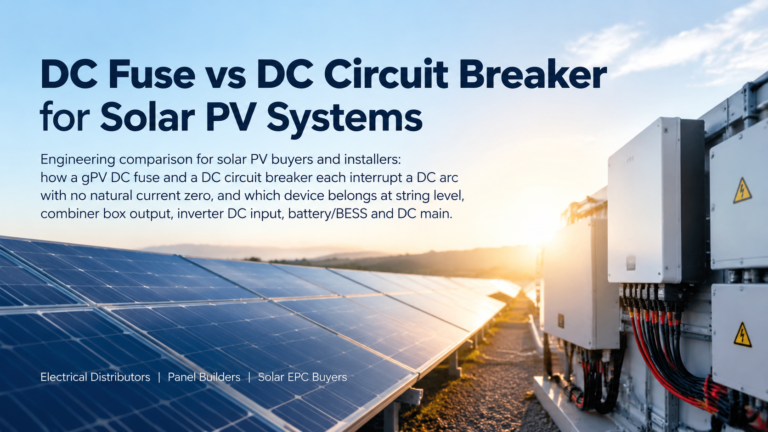
A DC-specific comparison of fuses and circuit breakers in solar PV systems: arc extinction without a current zero, operating speed, energy let-through, selectivity, reset and maintenance, with a decision matrix for string, combiner box, inverter DC input, battery/BESS and DC main positions.
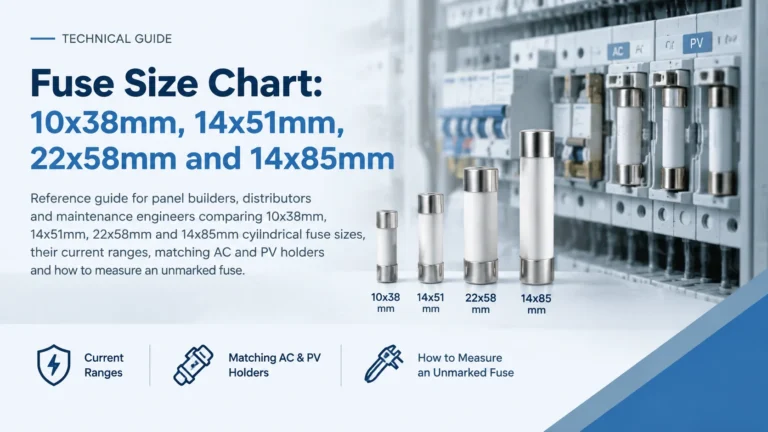
A fuse size chart for 10x38, 14x51, 22x58 and 14x85mm fuses: dimensions, current ranges, matching AC and PV holders, and how to measure an unmarked fuse.
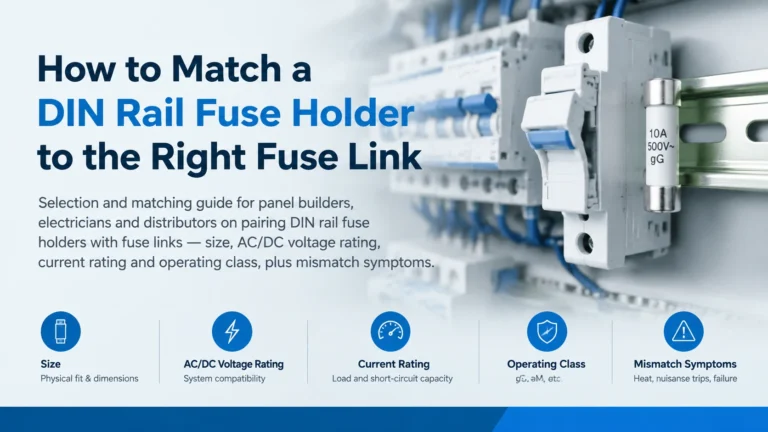
How to choose a DIN rail fuse holder and match it to a fuse link: size, AC or DC voltage, current rating and class, plus the symptoms of a mismatched pair.