FUSE BASICS
How Are Fuses Rated Explained by Amperage Voltage and Breaking Capacity
Learn how fuses are rated by amperage voltage interrupting capacity and speed for safe circuit protection with GA&DA expert guidance.
Read More
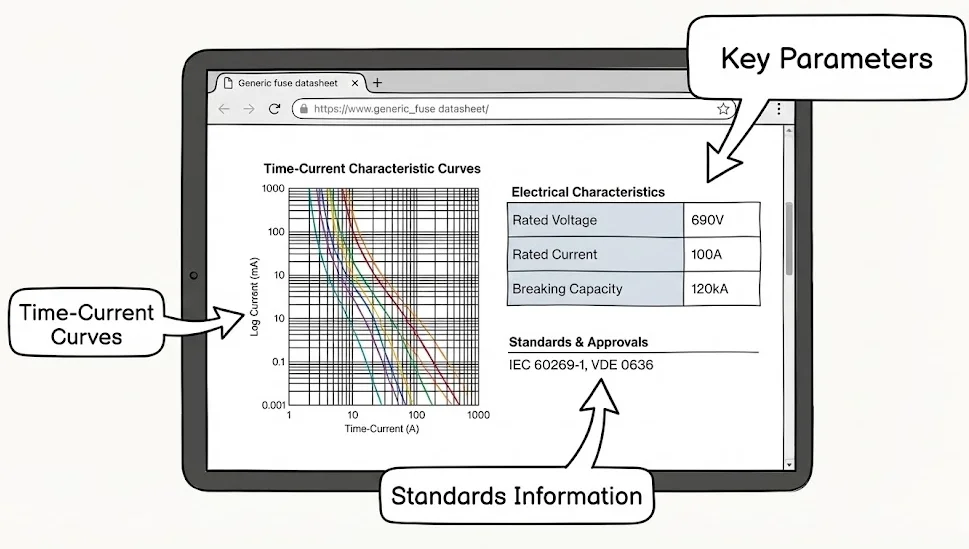
How to read fuse datasheet information correctly is essential if you want to choose protection devices that are truly matched to your system. When you understand how to read fuse datasheet fields such as rated current, voltage, breaking capacity, i²t and time‑current curves, the risk of under‑ or over‑sizing protection drops dramatically. In practical panel work this might mean reading the datasheet for a feeder device like the GDHR18‑160 fuse switch disconnector 1P 2P 3P and confirming that its fuse links and switch body both meet your fault‑level and isolation requirements.
This article provides a structured way to learn how to read fuse datasheet documents for low‑voltage and PV applications. It explains which parameters matter most, how to interpret graphs and tables, and how to apply this information when you specify fuses for cables, motors, PV strings, battery racks and distribution boards.
The main reason to master how to read fuse datasheet information is that fuses are safety devices with very specific operating limits. Choosing a device on current rating alone, without checking voltage, breaking capacity or time‑current behavior, can leave hidden weaknesses that only show up during faults. Once you know how to read fuse datasheet pages completely, you can see whether a candidate device really fits your system voltage, fault level and load characteristics.
A second benefit of learning how to read fuse datasheet parameters is better coordination with other protection devices. Circuit breakers, contactors and relays all have their own curves and limits; integrating them without understanding fuse data is little more than guesswork. By reading the full specification you can align fuse operation with upstream and downstream protection so that faults are cleared quickly and selectively without unnecessary outages.
Product illustration – datasheet-driven feeder protection example
In a typical main or sub‑distribution board, you might use the GDHR18‑160 fuse switch disconnector 1P 2P 3P as a feeder device. Knowing how to read fuse datasheet sections for this product lets you confirm its current rating, fault‑clearing ability, and isolation performance all match the application.
(Insert GDHR18‑160 product image here and link it to the URL above.)
When you begin to learn how to read fuse datasheet information, it helps to group the parameters into a few main families: basic electrical ratings, short‑circuit performance, time‑current and i²t data, and application categories. Together, these sections describe exactly what the fuse can do and under what conditions.
Many engineers first focus on current and voltage, but how to read fuse datasheet content properly also means studying the short‑circuit and energy‑let‑through sections. These are the data that reveal whether the device can interrupt worst‑case faults safely, and whether it protects cables, busbars and semiconductors from excessive thermal and mechanical stress.
The first step in how to read fuse datasheet electrical sections is understanding rated current. This is the continuous current the device can carry under the reference ambient temperature without melting. Datasheets often note a reference temperature and may provide derating curves; in hot panels the actual allowable current will be lower than the nameplate value. Good practice is to compare load profiles and ambient conditions with these details instead of relying on the rated current alone.
Rated voltage defines the maximum system voltage at which the fuse has been tested to clear its full interrupting rating. When you learn how to read fuse datasheet data, pay attention to separate AC and DC ratings: a device listed as 500 V AC may have a different or lower DC rating, or none at all. Always make sure the rated voltage is equal to or greater than the highest voltage that can appear at the installation point, including tolerances and temporary overvoltages permitted by system standards.
Another key part of how to read fuse datasheet information is the time‑current curve section. These log‑log graphs show how quickly the fuse operates at different multiples of rated current, from mild overloads to severe short circuits. Curves are often presented as bands showing minimum and maximum operating times, reflecting manufacturing tolerances and test conditions. By overlaying cable or equipment withstand curves, you can verify that the fuse clears dangerous faults before damage occurs.
I²t values (melting and total clearing) quantify the energy that passes through the fuse during operation. When you learn how to read fuse datasheet tables, look for these values at specific test currents and compare them with the I²t withstand of cables, busbars or semiconductors. Utilization categories such as gG, aM or gPV tell you whether the device is intended for general‑purpose cables, motor circuits or PV strings; they shape the time‑current behavior, especially in the overload region.
Product illustration – PV fuse links with distinctive curves and ratings
For DC PV applications, devices like the G2010RXX‑2/3/4 control signal line surge protector are often installed alongside string fuses and other protection components. Reading their datasheets in the same way you learn how to read fuse datasheet parameters helps ensure coordination between power and signal protection in the same enclosure.
(Insert G2010RXX‑2/3/4 product image here and link it to the URL above.)
A practical way to master how to read fuse datasheet documents is to follow the same sequence every time: confirm the application, check the main electrical ratings, review short‑circuit and energy data, then verify mechanical details and standards. This step‑by‑step approach reduces the risk of overlooking a critical figure or misreading a table.
When you consistently apply this method, how to read fuse datasheet information becomes a routine part of the design process rather than an afterthought. It also makes it easier to compare products from different manufacturers, because you are always looking for the same key values in each document.
The mechanical section is easy to skip, but it is an important part of how to read fuse datasheet information fully. Here you will find body size, terminal type, mounting orientation, torque values and, in many cases, recommended bases or fuse switch disconnectors. These details determine whether the device will physically fit your enclosure and whether connections will remain reliable under thermal and mechanical stress.
For PV combiner boxes and similar equipment, the datasheets of compatible bases are as important as the links themselves. When you learn how to read fuse datasheet information for DC circuits, check that products such as the GDS‑PV1‑1 DC500V 1000V PV plastic combiner box 1 in 1 out or GDT‑PV8‑1 DC1000V PV metal combiner box 8 in 1 out specify the correct fuse size, pole count and environmental rating (IP code, temperature range, UV resistance).
Another essential part of how to read fuse datasheet documentation is the section on standards and approvals. References to IEC 60269 or other regional standards indicate which test methods and utilization categories apply. Certification marks from third‑party labs show that rated current, voltage, breaking capacity and temperature‑rise limits have been independently verified.
You should always check that the application category in the datasheet matches your use case. For example, if you are protecting PV strings or battery racks, the device should clearly state a DC rating and, ideally, a gPV or equivalent classification. Learning how to read fuse datasheet references to standards and categories ensures that you are not unknowingly using a device outside its intended scope.
Product illustration – enclosure and accessory datasheets used with fuses
Combining devices such as the GDA 8‑way plastic distribution box or GDT 12‑way plastic distribution box with the right fuse and base depends on reading all relevant datasheets together, not just the fuse link data in isolation.
(Insert GDA or GDT distribution box image here and link it to the URL above.)
Once you are comfortable with how to read fuse datasheet information, you can turn that knowledge into practical design rules. In low‑voltage distribution boards, you will compare fuse curves with cable ampacity and motor starting currents, then verify that voltage and breaking capacity ratings exceed system requirements. This helps you avoid nuisance tripping and ensures that short circuits are cleared fast enough to protect insulation and switchgear.
In PV and energy‑storage systems, the same skills guide your choice of DC fuses, combiner boxes and isolation devices. For example, after you learn how to read fuse datasheet tables for a PV string fuse, you will check open‑circuit voltage, short‑circuit current, maximum number of parallel strings, and the I²t values at likely fault currents. You will then confirm that the combiner box, surge protection and downstream breakers share compatible ratings and clear faults without overstressing the DC bus.
Q1. What is the quickest way to start learning how to read fuse datasheet information?
Begin by focusing on four core items: rated current, rated voltage, breaking capacity and utilization category. Once you can find and interpret these on any document, add time‑current curves and I²t values to your checklist.
Q2. When I learn how to read fuse datasheet curves, do I always need to compare them with cable data?
Yes, comparing time‑current curves and I²t values with cable or busbar withstand data is the best way to confirm that the fuse will clear faults before thermal damage occurs. This is a key benefit of understanding how to read fuse datasheet graphs properly.
Q3. How do I know whether a fuse is suitable for DC use when I read fuse datasheet tables?
Look for explicit DC ratings (voltage, current and breaking capacity) and check that the application category or notes mention PV, battery or general DC usage. If only AC ratings are given, you should not assume the device is suitable for DC circuits.
Q4. Does learning how to read fuse datasheet information also help with breaker coordination?
Yes. Once you are comfortable reading fuse curves and I²t data, you can overlay them with circuit breaker trip curves to check selectivity, making it easier to design coordinated protection schemes.
Learn how fuses are rated by amperage voltage interrupting capacity and speed for safe circuit protection with GA&DA expert guidance.
Read More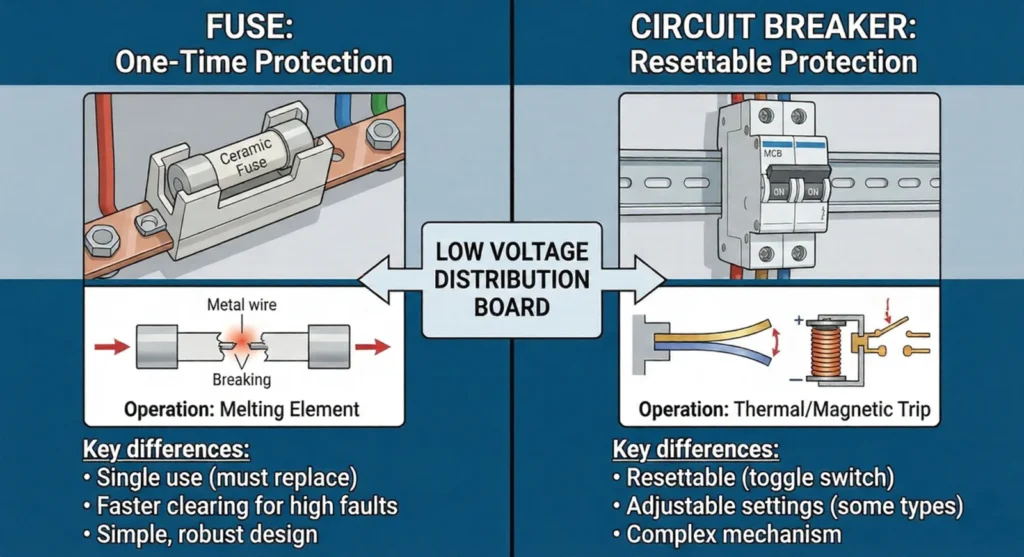
TABLE OF CONTENTS Fuse vs circuit breaker choices are at the heart of every low‑voltage protection design, from small consumer units to industrial switchboards and PV systems. Making the right fuse vs circuit breaker decision means understanding how each device behaves under overload and short‑circuit conditions, how it interacts with cables and loads, and what […]
Read More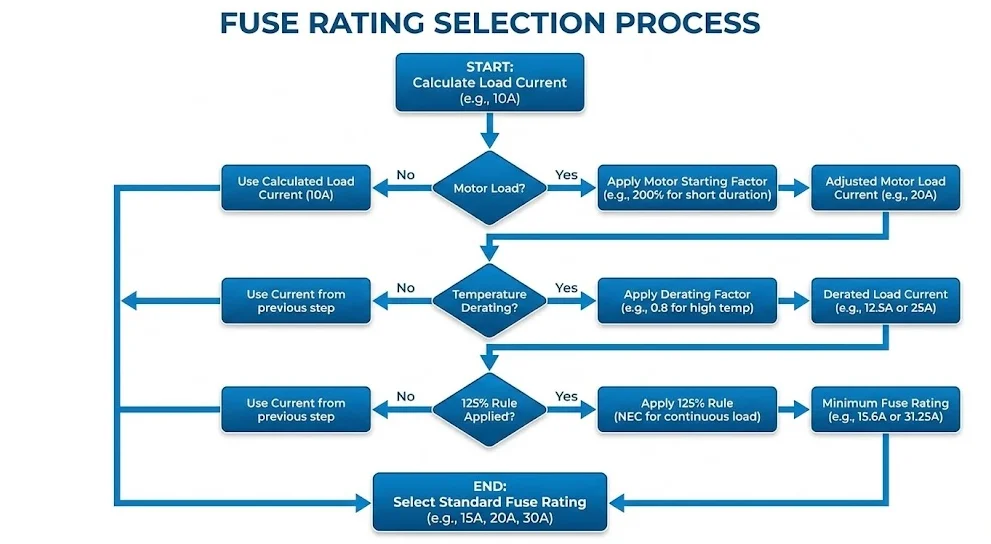
TABLE OF CONTENTS Introduction to Fuse Rating Selection Selecting the right fuse rating for electrical circuits is one of the most critical decisions in electrical system design and installation. The fuse rating determines how much current can flow safely through a circuit before the fuse operates to protect against overcurrent conditions. Choosing the correct fuse […]
Read More