TABLE OF CONTENTS
Fuse vs circuit breaker choices are at the heart of every low‑voltage protection design, from small consumer units to industrial switchboards and PV systems. Making the right fuse vs circuit breaker decision means understanding how each device behaves under overload and short‑circuit conditions, how it interacts with cables and loads, and what the trade‑offs are in terms of speed, cost and maintenance. In practical panel work this might involve comparing a fuse‑based feeder like the GDHR18‑160 fuse switch disconnector 1P 2P 3P with a breaker‑based feeder using an GDC5‑63 AC miniature circuit breaker and deciding which better fits the installation.
This article explains fuse vs circuit breaker fundamentals, highlights the key technical differences, and offers clear guidance on where each technology is usually preferred. By the end, selecting between fuse vs circuit breaker options for feeders, motor circuits, PV strings and distribution boards will feel like a structured engineering decision rather than a rule‑of‑thumb guess.
Why fuse vs circuit breaker decisions matter
In any electrical system, the way you resolve the fuse vs circuit breaker question affects safety, uptime and lifecycle cost. Both devices provide overcurrent protection, but their construction, response characteristics and failure modes are very different. A fuse is sacrificial and must be replaced after it operates, while a circuit breaker can usually be reset, but this convenience comes with different performance and coordination considerations.
Fuse vs circuit breaker choices also influence how easily the system can be expanded or modified in the future. Breakers are adjustable in some ranges and offer integrated switching and status indication, which can simplify panel layouts. Fuses, on the other hand, offer very fast, predictable limiting of short‑circuit energy and can provide excellent selectivity when properly coordinated. Understanding these trade‑offs is essential for reliable, standards‑compliant design.
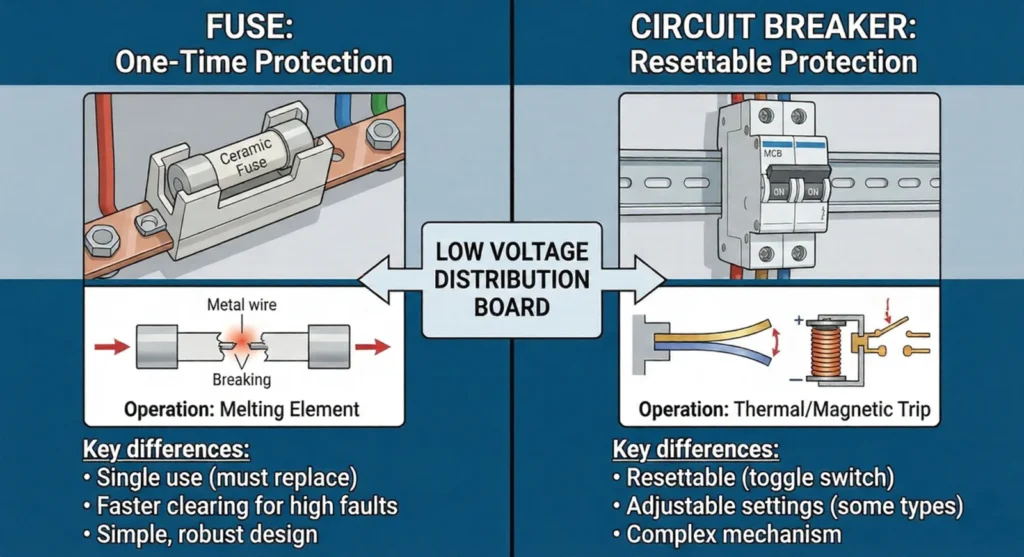
Product illustration – basic fuse vs circuit breaker devices in a board
A typical distribution board might combine fuse‑based feeders using the GDHR18‑160 fuse switch disconnector 1P 2P 3P with branch circuits protected by the GDC5‑63 AC miniature circuit breaker, illustrating a mixed fuse vs circuit breaker approach.
(Insert GDHR18‑160 and GDC5‑63 product images here and link them to the URLs above.)
Fuse vs circuit breaker: how each device works
To compare fuse vs circuit breaker options fairly, it helps to start with the basic operating principles. Both are designed to sense excessive current and interrupt the circuit before cables or equipment are damaged, but the mechanisms they use and the way they respond over time are quite different.
A fuse relies on a calibrated metal element that melts when overheating occurs, while a circuit breaker uses an electromechanical or electronic trip unit to unlatch contacts. These operating differences in fuse vs circuit breaker design translate directly into differences in speed, energy let‑through and reset behavior.
How a fuse works in overcurrent protection
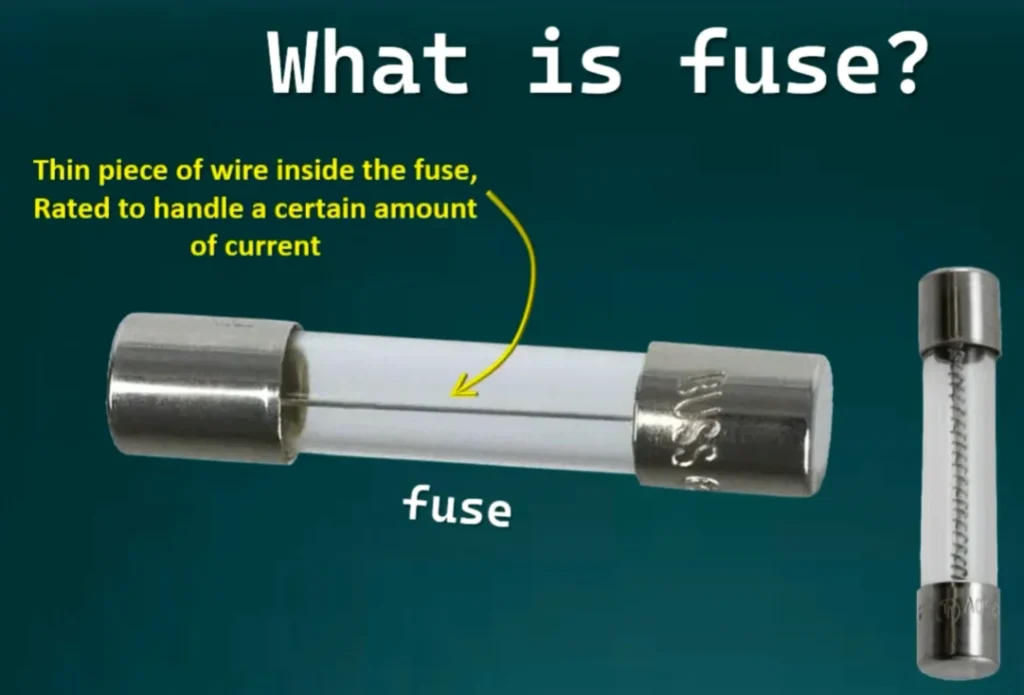
In the fuse vs circuit breaker comparison, the fuse is the simpler device. It consists of a metallic element, often surrounded by filler inside an insulating body, connected between two terminals. Under normal conditions, the element carries the rated current with acceptable temperature rise. When an overload or short circuit occurs, the I²R heating in the element causes its temperature to rise until it melts and opens the circuit.
During high fault currents, the fuse operates very quickly and can limit both peak current and let‑through energy. This current‑limiting behavior is a major advantage for fuse vs circuit breaker decisions in circuits that must withstand very high fault levels, such as transformer feeders or semiconductor drives. Once the element has melted, the fuse must be replaced, which also provides a clear visual indication that a serious fault has occurred.
How a circuit breaker works in overcurrent protection
On the circuit breaker side of the fuse vs circuit breaker comparison, the device combines switching contacts with a trip mechanism. In thermal‑magnetic breakers, a bimetal strip responds to long‑term overloads while an electromagnetic element responds quickly to short‑circuit currents. In more advanced MCCBs or electronic breakers, the trip function is handled by adjustable electronic sensors and solenoids.
When the breaker senses a current above its threshold for a defined time, it unlatches the mechanism and opens the contacts. Unlike a fuse, the breaker can usually be reset once the fault is cleared, either manually or remotely. This reset capability is a key factor when weighing fuse vs circuit breaker options in installations where fast restoration of service is important and spare fuses may not always be on hand.
Product illustration – typical MCB used in fuse vs circuit breaker designs
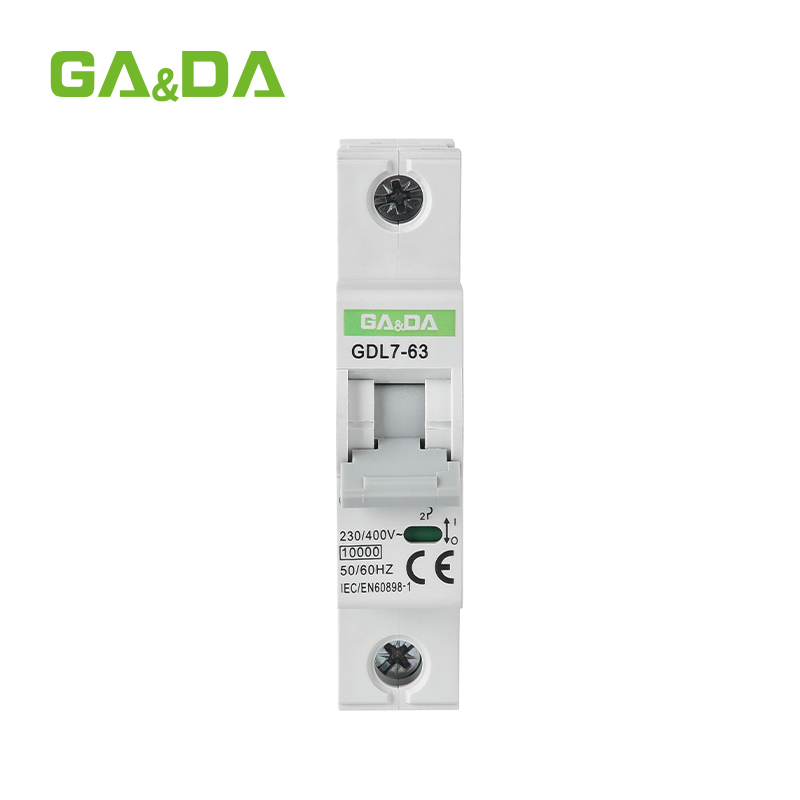
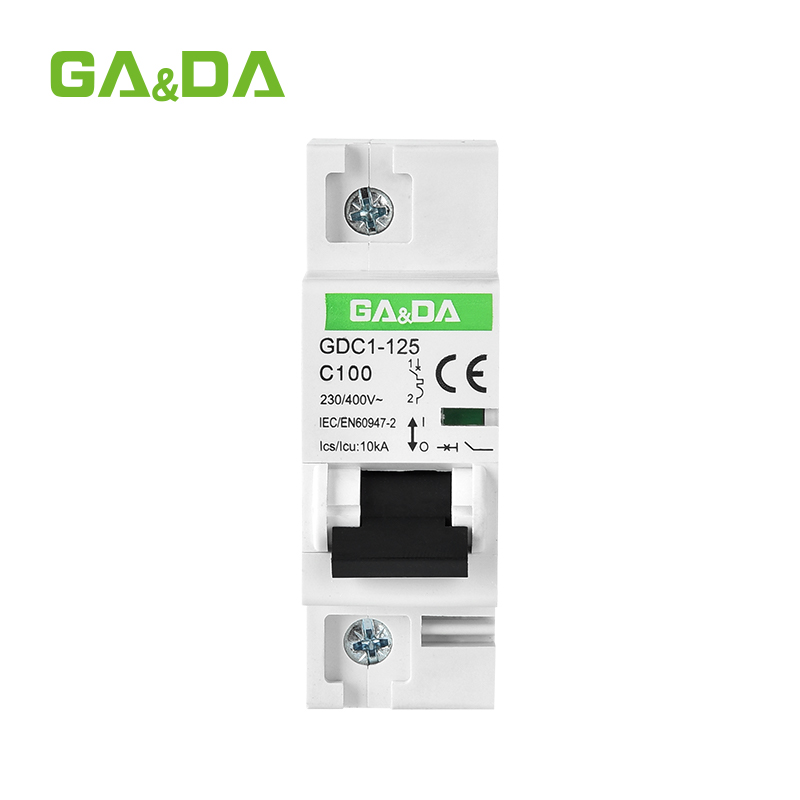
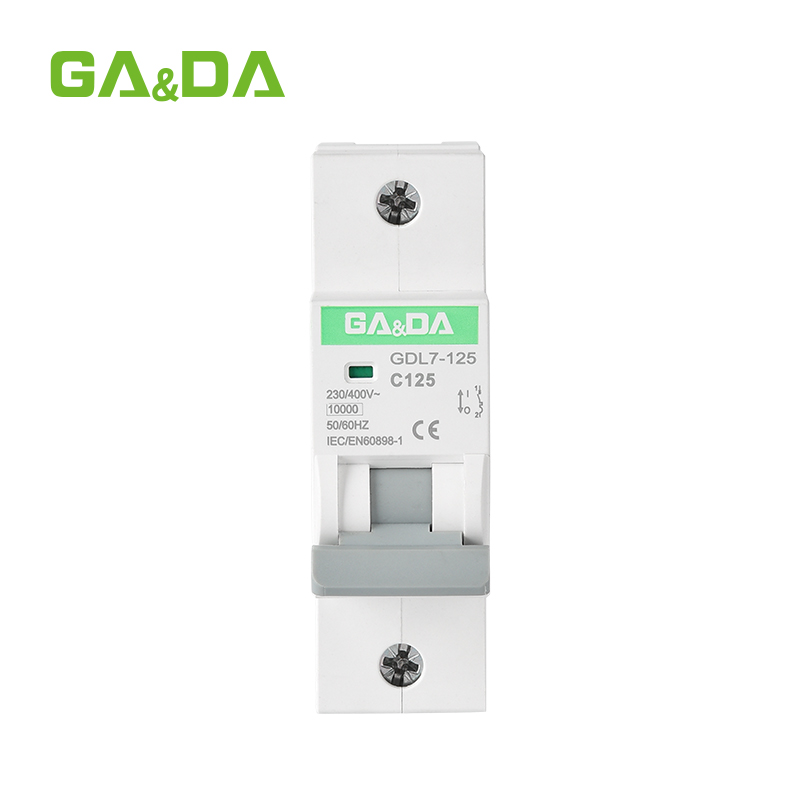
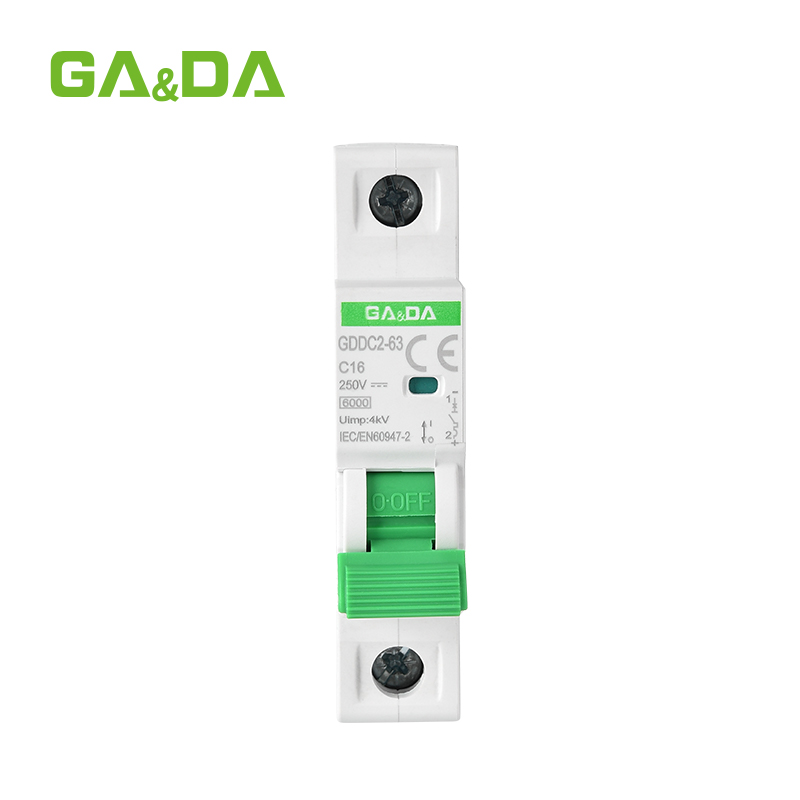
In small distribution boards, devices like the GDC5‑63 AC miniature circuit breaker represent the circuit breaker side of the fuse vs circuit breaker decision, providing both protection and manual switching on DIN rail.
(Insert GDC5‑63 product image here and link it to the URL above.)
Technical differences in fuse vs circuit breaker selection
From an engineering standpoint, the fuse vs circuit breaker question often comes down to technical details: operating speed, current‑limiting performance, breaking capacity, adjustability and long‑term maintenance. Each technology has strengths and weaknesses that become more or less important depending on the application.
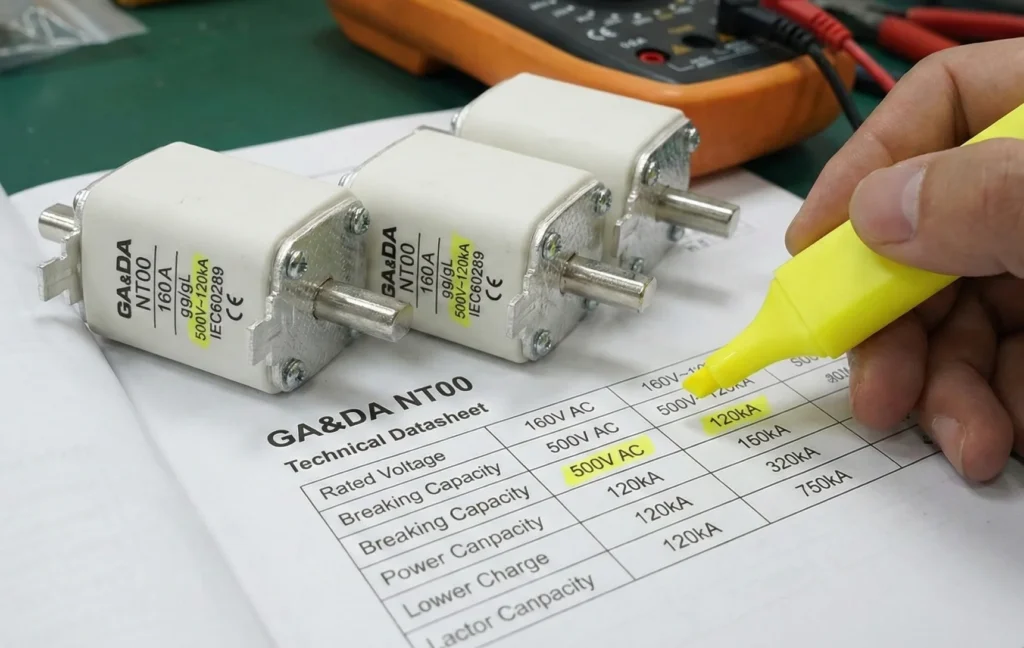
Modern standards define performance metrics for both fuses and circuit breakers, including rated current, voltage, breaking capacity, time‑current characteristics and energy let‑through. When comparing fuse vs circuit breaker products in a catalog, focusing on these metrics helps you move past generalizations and base decisions on measurable behavior.
Speed, energy let-through and selectivity
One of the clearest technical differences in fuse vs circuit breaker selection is operating speed and energy let‑through. High‑performance fuses are extremely fast in the short‑circuit region and can limit both peak current and I²t, which reduces thermal and mechanical stress on cables and downstream equipment. This makes them attractive for protecting sensitive semiconductors or for installations with very high prospective fault currents.
Circuit breakers, especially thermal‑magnetic types, may respond more slowly to high faults than equivalent fuses, but they offer the possibility of adjustable settings and coordinated tripping curves. In a complex system, careful coordination of time‑current curves can still achieve selectivity between upstream and downstream devices. However, when the top priority is minimizing fault energy, fuses often have an advantage in the fuse vs circuit breaker comparison.
Breaking capacity, reset capability and maintenance
Breaking capacity is another important dimension in fuse vs circuit breaker selection. Fuses can offer very high interrupting ratings in relatively compact sizes, making them suitable close to sources such as transformers where fault currents are large. Circuit breakers also have specified breaking capacities, but very high ratings often mean larger frame sizes and higher cost.
On the other hand, reset capability and maintenance favor the breaker side of the fuse vs circuit breaker balance. After a fault that does not damage the device, a breaker can be reset, restoring service without replacing components. Fuses must always be replaced after operation, requiring spare stock and access to the installation. In critical systems where downtime must be minimized and maintenance access is difficult, resettable breakers may be preferred even if they deliver slightly less current‑limiting performance than equivalent fuses.
Product illustration – enclosures that can host both fuses and breakers
Distribution boxes such as the GDA 8‑way plastic distribution box and GDT 12‑way plastic distribution box are often designed to accept both fuse‑based devices and miniature circuit breakers, giving designers flexibility in how fuse vs circuit breaker choices are implemented physically.
(Insert GDA or GDT product image here and link it to the URLs above.)
When to use a fuse vs circuit breaker in real applications
In everyday design work, the fuse vs circuit breaker question is usually answered at the application level rather than in the abstract. Different parts of a system have different priorities: some require maximum current limitation, others need easy reset, and some must coordinate with existing protection. Understanding typical use cases helps you apply the right mix of fuses and breakers.
In many building installations, miniature circuit breakers are widely used for final circuits because they are easy to reset and provide clear on/off indication. Fuses may still appear at higher levels, such as main incomers, large feeders or specialized protection for semiconductors and PV strings, where their current‑limiting performance and high breaking capacity offer clear benefits. This layered approach combines both sides of the fuse vs circuit breaker comparison in a complementary way.
For PV arrays and DC combiner boxes, DC‑rated fuses remain common for string protection, often integrated into dedicated enclosures. On the AC output side of inverters, breakers and RCDs are more typical. In industrial motor circuits, the fuse vs circuit breaker choice depends on starting currents, coordination with contactors and overload relays, and the need for selectivity with upstream devices. In some designs, fuses protect the motor starter while breakers protect control circuits and auxiliary loads.
Practical tips for choosing between fuse vs circuit breaker
When facing a fuse vs circuit breaker decision in a new design, start by clarifying priorities: safety margin, current limitation, ease of reset, space constraints, and total cost of ownership. If the installation is close to a source with very high fault levels, current limitation and breaking capacity may point toward fuses at least at the top level. If frequent configuration changes and quick restoration of service are expected, breakers may be more appropriate for many circuits.
Compatibility with enclosures and accessories also influences the fuse vs circuit breaker decision. Combiner boxes such as the GDS‑PV1‑1 DC500V 1000V PV plastic combiner box 1 in 1 out, GDS‑PV2‑1 DC500V 1000V PV plastic combiner box 2 in 1 out, GDT‑PV8‑1 DC1000V PV metal combiner box 8 in 1 out and GDT‑PV16‑1 DC1000V PV metal combiner box 16 in 1 out are designed around specific device types and dimensions. Ensuring that chosen fuses or breakers fit the mechanical layout and environmental ratings is just as important as the electrical parameters.
Finally, consider long‑term maintenance and operator skills. In some facilities, maintenance staff are very comfortable replacing fuses and appreciate their clear visual indication of serious faults. In others, the ability to reset a breaker after investigating a trip simplifies operations. Balancing these human factors with the technical aspects of fuse vs circuit breaker performance leads to more robust and user‑friendly systems.
FAQ – fuse vs circuit breaker
Q1. In simple terms, when should I choose a fuse vs circuit breaker?
Use fuses where maximum current limitation, very high breaking capacity or protection of sensitive semiconductors is the top priority, especially near transformers, large feeders or DC strings. Choose circuit breakers where easy reset, integrated switching and frequent reconfiguration or maintenance access are more important.
Q2. Can I replace a fuse with a circuit breaker directly in an existing panel?
Not always. The fuse vs circuit breaker substitution must respect breaking capacity, time‑current behavior, physical clearances and standards requirements. A breaker with inadequate interrupting rating or different tripping characteristics can reduce safety or upset selectivity with other devices.
Q3. Are fuses always faster than circuit breakers?
Fuses are generally faster and more current‑limiting in the high short‑circuit region, but in the overload region the difference may be less pronounced. Modern electronic breakers can also be configured with fast tripping characteristics for specific applications, so the fuse vs circuit breaker speed comparison should be based on actual curves, not assumptions.
Q4. Does cost favor fuse vs circuit breaker over the life of an installation?
Initial purchase cost per pole is often lower for fuses, especially at high currents, but replacement and stocking costs must be considered. Breakers may have higher upfront cost but can be reset many times. The most economical choice depends on fault frequency, maintenance practices and how critical downtime is for the installation.
Outbound authority links