Surge Protection Device Specification Guide for Buyers
تاريخ النشر: المؤلف: راشيل
A datasheet tells you what a device can do. An SPD specification sheet tells a supplier what you need — and it decides whether the quotes you receive can be compared at all. Enquire with a part number or two lines of description and you will get prices built on different assumptions: different protection levels, different pole configurations, different backup protection requirements, different documentation. The cheapest reply is often the one that quietly answered a different question.
This is a procurement template, not a parameter tutorial: what to write into an RFQ and a purchase specification, in the order a supplier needs it, ending with a fill-in checklist you can paste into your own document. What the parameters mean is covered separately in Iimp, In and Imax explained; where a field below asks you for one of those values, that article is where to find out what you are choosing.
The specification must also state that the device will be inspected and replaced only after isolation and proof of dead, with correct PPE, never while energised. For PV work, add that the array is live whenever daylight falls on it.
Why a written specification beats a part number
Reordering by part number works until it does not. A written specification gives you four things a part number cannot: comparable quotes, because every supplier prices the same requirement; responsibility, because a supplier who deviates is departing from your tender rather than exercising judgement; repeatability across staff changes and re-tenders; and a basis for acceptance when the cartons arrive.
Part 1 — System definition
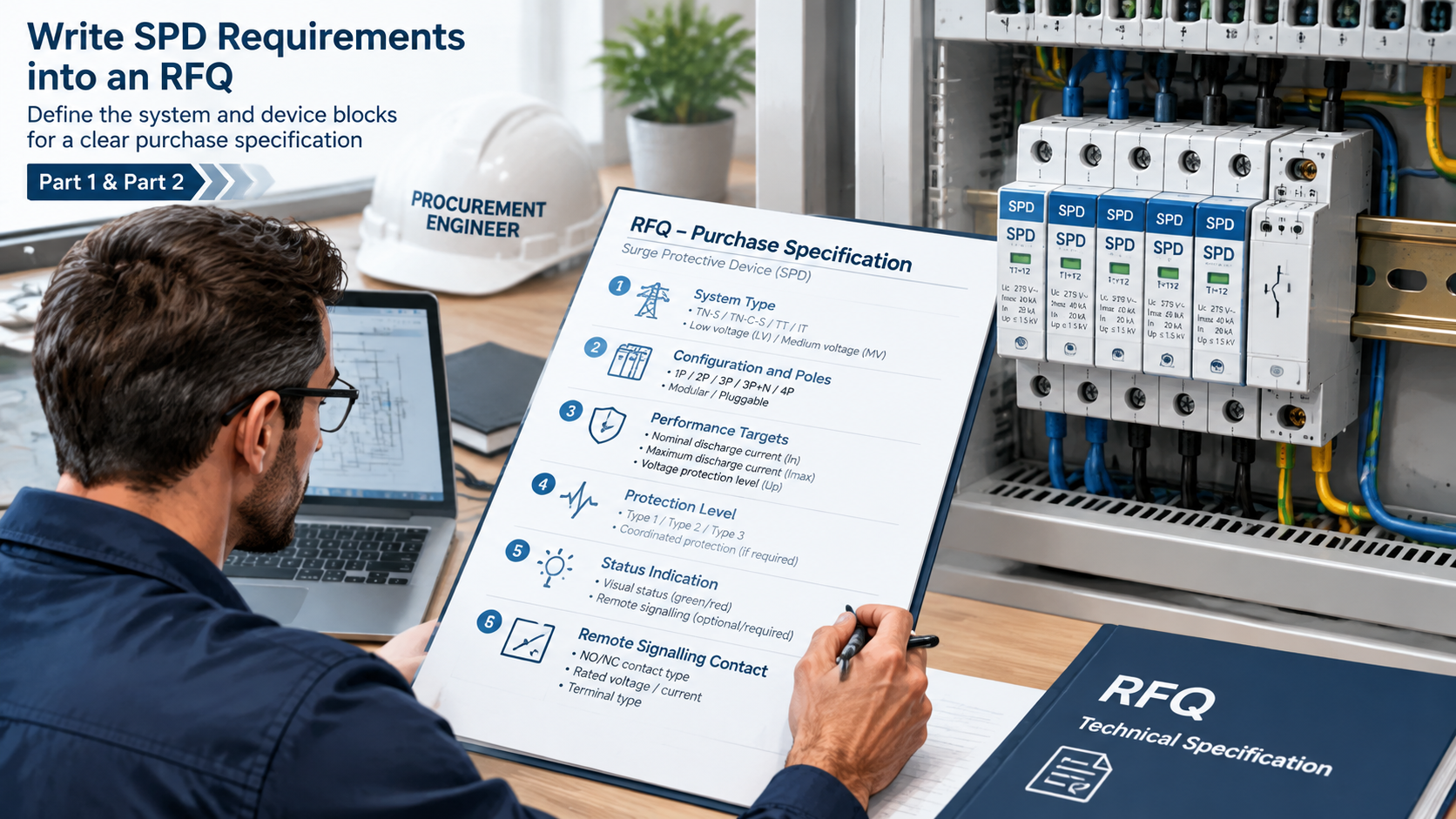
Everything downstream depends on this block, so it is the part you should not delegate. Describe the system, not the device:
Supply type — AC or DC; if AC, single-phase or three-phase.
Nominal system voltage , and the maximum sustained voltage that can appear at the point of protection. That second figure drives the Uc requirement; if you do not know it, require the supplier to confirm it in writing rather than leaving the field blank.
DC system class where relevant. A 1000 V and a 1500 V DC string system are different device families, not two settings on one — see 1000 V vs 1500 V DC SPD .
Earthing system — TN-S, TN-C-S, TT or IT for AC; for DC, whether the system is grounded or ungrounded.
Point of protection — main incomer, sub-distribution board, machine control panel, string combiner box, inverter DC input, battery or BESS DC bus.
Position in the scheme — whether the device is the primary Type 1 defence, a Type 2 distribution device, or a Type 3 device close to sensitive equipment. State the position and let the supplier justify the type against it.
Part 2 — Device definition
This is the block most buyers write too thinly. List the requirement field by field and require a written answer against each:
Type or class required by the position stated in Part 1.
Configuration and poles — 1P, 2P, 3P or 4P for AC, or the positive, negative and earth arrangement for a DC device; say whether an earth-referenced device is needed separately.
Performance targets — the minimum impulse, nominal or maximum discharge current you will accept, and the maximum Up you will accept for the equipment being protected.
مؤشر الحالة — the type of end-of-life indication required and where it must be visible; state whether it has to be readable with the panel door closed.
Remote signalling — whether a volt-free changeover contact is required, its contact rating and terminal arrangement, and whether indication is per-pole or common.
Construction — pluggable cartridge or one-piece. This is a maintenance decision: a pluggable unit reduces the wiring work and the risk at every replacement.
Where you do not know which value suits a position, state the position and the equipment being protected, and require the supplier to propose and justify a value. An entirely open field is what makes quotes incomparable.
The system and device blocks carry the technical risk. Fill both before the enquiry goes out, or every quotation that comes back answers a slightly different question.
Part 3 — Mechanical and mounting requirements
التركيب — 35 mm DIN rail, panel mount, or a dedicated holder inside an existing enclosure.
Module width — the maximum number of module widths (TE) the position can accept. Give a hard limit rather than describing the space, because device widths step in fixed increments.
Terminal capacity — the minimum and maximum conductor cross-section the terminals must accept, and whether conductors are solid, stranded, or fine-stranded with ferrules.
Terminal type and access — cage clamp, screw or push-in, and whether terminals are reachable with the device in place.
Torque — require the manufacturer’s terminal torque value on the instruction sheet and state that it will be applied and recorded. Do not put a number in the specification yourself.
Part 4 — Protection coordination
An SPD is not installed alone, and this block separates a competent RFQ from a shopping list. Require the supplier to state, for each device offered:
The maximum rating and type of backup protection permitted upstream — fuse or breaker, its characteristic where relevant, and whether the device is safe without separate backup protection. This is a manufacturer-declared value, so it must come with the device; the reasoning is covered in SPD backup fuse or circuit breaker .
The maximum connecting-lead length between the SPD and the point of protection, and the conductor cross-section assumed. Ask for the limit in metres and hold the installer to it.
Any change required to devices already in the board , stated in the offer with the proposed replacement rating.
Part 5 — Environmental requirements
Ingress protection — the IP rating the location needs, and whether it is indoor, outdoor, coastal, dusty or washed down.
Impact resistance — the IK rating required where the device may be struck.
Operating temperature range — the site’s maximum ambient, not a nominal figure. The maximum is the value that constrains the device.
Altitude — state it, and require the supplier to confirm whether any current derating applies above it.
Humidity and condensation — require a suitability statement, or a recommendation for ventilation or desiccant.
Flammability class of the housing material, as declared by the manufacturer, plus UV resistance where the device or enclosure sits in direct sun.
Part 6 — Compliance and documentation to demand
Do not accept the word “certified” on its own. List these as deliverables in the RFQ, not as questions:
The standards claimed , by number and part. For surge protective devices the applicable family is the IEC/EN 61643 series, and the part that applies depends on the application — require the supplier to name it and say what it covers.
Type test reports for the offered product, or a clear statement that the offer rests on a product family declaration, and which model it covers.
A declaration of conformity naming the exact model or range offered, not a generic company document.
Current RoHS and REACH statements covering the offered material composition.
Batch or date traceability back to the tested configuration.
Revision confirmation — that documentation reflects the revision actually supplied, and that superseded documents are not acceptable at delivery.
Ask for the paperwork with the quotation: a supplier who cannot produce it at tender stage rarely produces it at delivery.
Part 7 — Marking, packaging and labelling
Device marking — manufacturer’s mark, type designation, electrical ratings, standards referenced and terminal identification, permanently marked and legible after installation.
Instructions — the language required, and whether a printed sheet must be in every box.
Packaging — the pack quantity you will receive and stock, and whether individual boxes are required.
Carton labelling — part number, quantity, batch or date code, barcode symbology and gross weight.
Part 8 — OEM and private-label requirements
If the device will carry your brand, put it in the specification rather than raising it after the price is agreed. State the brand to be applied, whether the manufacturer’s mark must be removed or may remain, the part-number scheme and how it maps to the supplier’s own, who approves artwork proofs, and the minimum order quantity for a branded run. Add that branding changes nothing technical, and require written confirmation that the branded unit is the same tested configuration.
Part 9 — Quantity, delivery and commercial terms
State the project or annual quantity and the call-off pattern, since both affect price and lead time; the pack quantity and minimum order you can accept; the lead time and delivery point; the Incoterms; whether a pre-production sample is required; and the warranty period. A sample requirement written here gives you something to inspect against in the next section.
Part 10 — Acceptance criteria on receipt
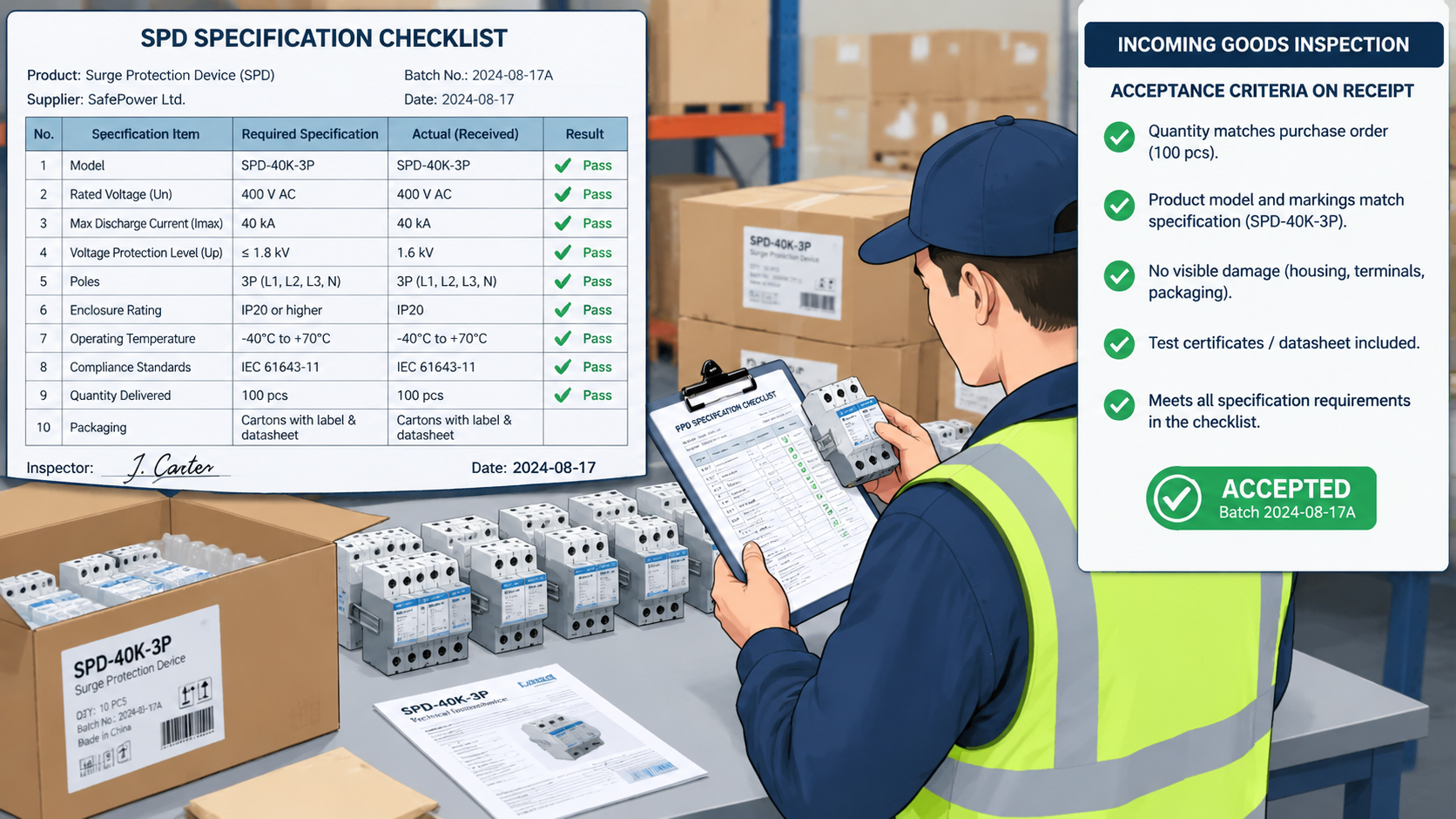
The specification is only complete if it tells your goods-in team what to reject. Set out the checks, and the action taken when one fails:
Identity — part number, ratings and configuration match the purchase order line by line.
Quantity and packaging — correct pack quantity, undamaged boxes, no sign of moisture or impact.
Marking — present, legible, and consistent with the documentation supplied.
Documentation — declaration of conformity, test documentation and instruction sheet present for the batch delivered.
Physical condition — no cracks, discolouration, corrosion, damaged terminals or loose modules.
Sampling — where agreed, a sample checked against the declared values, with the sample size and method written in so a result is not disputed later.
Non-conformance — the hold, quarantine and notification route, and confirmation that non-conforming goods do not return to stock.
The fill-in SPD specification checklist
Use this as the structure of your RFQ. Fill the fourth column with your requirement, and use the fifth to record what the supplier must provide or what you will verify. A blank entry is a question you have not asked.
#
Section
Field to specify
Your requirement
Evidence or verification
1
System
Supply type and phases
Single-line diagram reference
2
System
Nominal system voltage
Network data or design drawing
3
System
Maximum sustained voltage at the point of protection
Supplier to confirm the Uc requirement in writing
4
System
Earthing arrangement (AC) or DC grounding
Design drawing
5
System
Point of protection and position in the scheme
Panel schedule and drawing reference
6
Device
Type or class required
Supplier to justify against row 5
7
Device
Configuration and poles
Dimensioned drawing
8
Device
Minimum impulse or discharge current target
Datasheet value and the standard it is declared to
9
Device
Maximum protection level accepted
Datasheet value against equipment withstand
10
Device
Status indication and visibility
Product photo or sample
11
Device
Remote signalling contact, rating and terminals
Datasheet and wiring diagram
12
Device
Pluggable module or one-piece
Spare module part number and price
13
Mechanical
Mounting method
Dimensioned drawing
14
Mechanical
Maximum module width in TE
Dimensioned drawing
15
Mechanical
Terminal capacity and conductor type
Datasheet against site cable
16
Mechanical
Terminal torque value
Manufacturer’s instruction sheet
17
Coordination
Maximum backup protection rating and type
Manufacturer declaration per offered model
18
Coordination
Maximum connecting-lead length and cross-section
Manufacturer declaration, verified at installation
19
Coordination
Changes required to existing upstream devices
Stated in the offer with proposed ratings
20
البيئة
IP rating required
Declared rating and test reference
21
البيئة
IK rating required
Declared rating
22
البيئة
Operating temperature range
Datasheet against site maximum
23
البيئة
Altitude and any derating
Supplier statement
24
البيئة
Housing flammability class
Declared class
25
Compliance
Standards claimed, by number and part
Declaration of conformity naming the model
26
Compliance
Type test reports
Reports or family declaration statement
27
Compliance
RoHS and REACH, batch traceability
Date-stamped statements; batch or date code on unit
The checklist only pays for itself if goods-in uses it. Agree the sample size, the method and the quarantine route before the first delivery arrives.
Three omissions that cause disputes after the order
No maximum protection level. Buyers specify surge capacity and leave the protection level to the supplier, so the device ends up protecting itself rather than the equipment downstream. State the maximum Up you will accept for what is protected.
No backup protection requirement. Without a required declaration of the maximum upstream device rating, the installation may end up with protection the SPD was never coordinated with, and nobody can verify it.
No documentation list. Without it, “compliant” is unverifiable at goods-in, and the acceptance criteria have nothing to check against.
Once the requirement is fixed, compare it against a range built for it rather than against a catalogue page: our surge protection devices range is organised by application and configuration, and the technical files are collected under downloads. Send the specification to our team through contact us and we will confirm which fields need a value rather than a range.
الأسئلة الشائعة
What should an SPD purchase specification contain that a datasheet does not?
The system it is being bought for, and the acceptance conditions. A datasheet describes one product; a specification states the supply type, system voltage, earthing arrangement, point of protection, the performance and protection-level targets you will accept, the position’s mechanical limits, the documentation required at delivery, and the checks applied on receipt.
Can I write an SPD specification sheet by naming a competitor’s model?
It is a common shortcut and a poor one. If the named model is wrong for the application, superseded, or unavailable in the quantity you need, you have written a constraint rather than a requirement, and left yourself no basis for accepting an equivalent. Specify the function, ratings and documentation, and use the reference model as a benchmark, not a mandatory substitution.
Should the RFQ ask the supplier to state the backup protection rating?
Always, as a required declaration for each model offered. The maximum permitted upstream fuse or breaker is a manufacturer-declared value for a specific device, so it cannot be inferred from the SPD’s own ratings. Without it, coordination with the existing board cannot be checked at installation.
How much detail should the environmental block carry?
Enough to rule out an unsuitable product: the IP rating the location needs, impact resistance where relevant, the site’s maximum ambient temperature, the altitude, and the humidity or condensation conditions. State the site maximum, not a nominal figure, and require the supplier to confirm suitability, including any derating above the stated altitude.
What acceptance checks justify rejecting a delivered batch?
Failures against the criteria you wrote in: wrong part number, ratings or configuration; incorrect quantity or damaged packaging; missing or unreadable marking; absent documentation for the batch; physical damage or corrosion; or a sampled unit that does not meet the declared values. Agree the sample size, method and quarantine route in the specification so a rejection becomes a process step rather than a negotiation.
Ask when should an SPD be replaced and most answers stop at the status window. That is one input, and on its own a weak one: it shows that a device has reached end of life, never that a device is still fit for service. An SPD can be electrically exhausted while the window still […]
Why a solar combiner box needs both a DC MCB and a DC SPD: the division of labour between overcurrent and transient overvoltage protection, why neither device can substitute for the other, how they coordinate on the DC bus including the SPD backup protection requirement, and how the pairing changes between 1000 V DC and 1500 V DC systems.
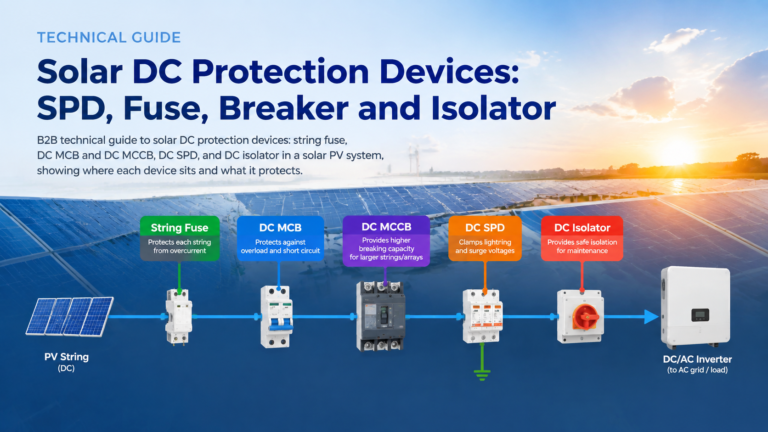
Solar DC protection is a chain, not a purchase. In one array you can have a reverse current from nine healthy strings into one faulted string, a lightning-induced impulse arriving on the same conductors, and a maintenance team that needs to work on the inverter DC input — three problems that share a cable and […]