IP65 vs IP66 Solar Combiner Box: Which Rating Do You Need?
تاريخ النشر: المؤلف: راشيل
When two combiner boxes are quoted side by side and the only visible difference is IP65 vs IP66, it is tempting to assume the higher number is simply the safer purchase. On a solar combiner box that assumption is often wrong, and it can cost you in both directions: paying for protection the site does not need, or accepting a rating that does nothing about the failure that actually floods the enclosure.
This is a selection guide for the IP65 vs IP66 solar combiner box decision. It covers how to read an IP code, what the change from 5 to 6 genuinely buys in the water test, why a sealed rated enclosure still fills with condensation, how installation and maintenance undo a rating in the field, how the environment should drive the choice, the related ratings buyers forget, and a decision table for quotation review. For the basics of what the box contains and does, start with what a solar combiner box is.
Safety Before Anything Else
PV arrays are live in daylight. Isolating the inverter does not de-energise the strings, so a combiner box on a working array is not dead.
Isolate, verify dead, then work. Prove your tester on a known live source before and after the test, and treat an unexpected reading as real.
Opening an enclosure breaks its rating. Do not open a rated box in wind-driven rain to “have a quick look”.
Wear appropriate PPE ; never work on energised PV strings. An enclosure sealed in the sun can also release hot, pressurised air when opened — let it equalise first.
How to Read an IP Code
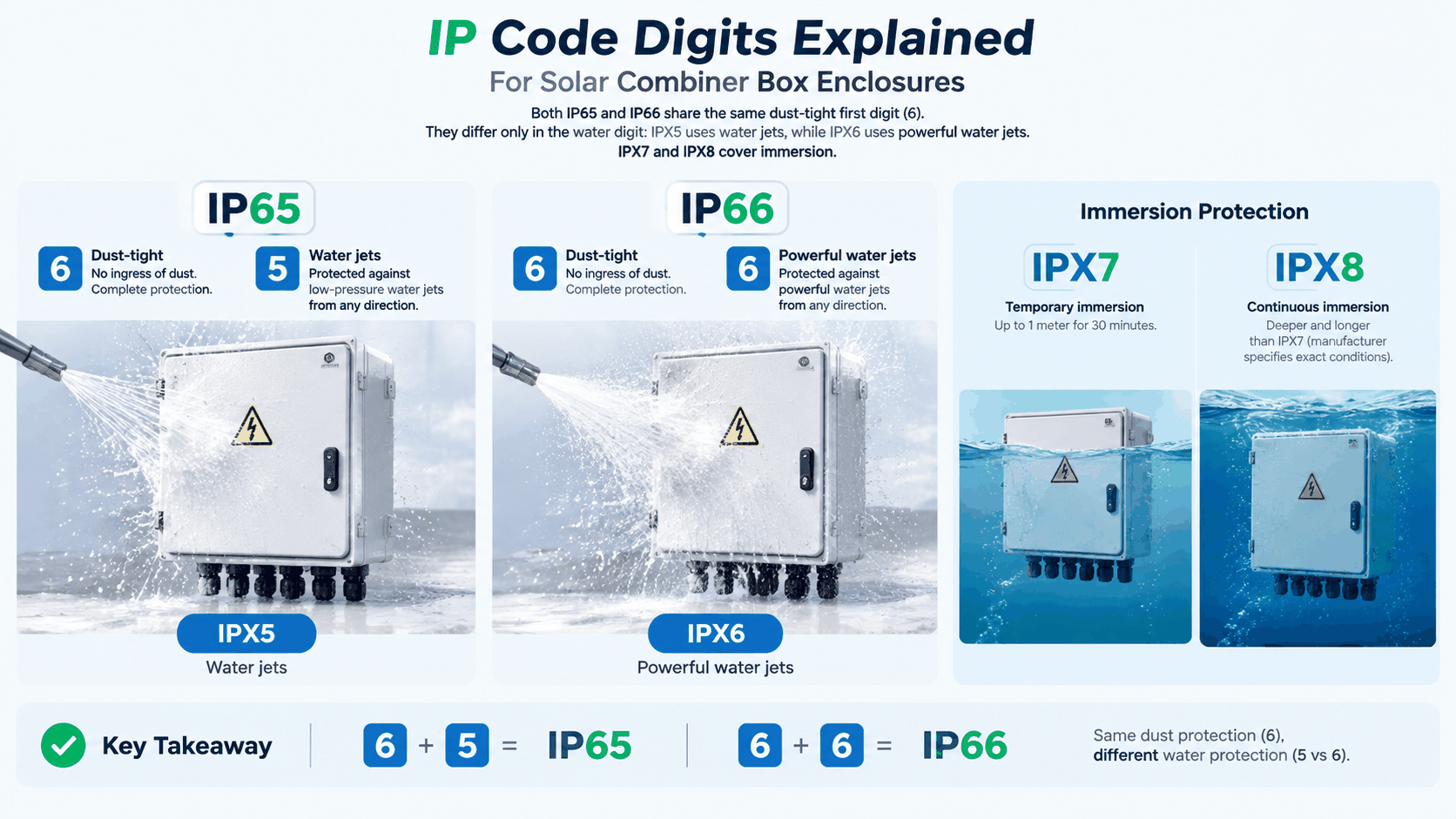
IP stands for Ingress Protection, defined by IEC 60529. The familiar form is IPXY: the first digit (X) rates protection against solid objects and dust from 0 to 6, and the second digit (Y) rates protection against water from 0 to 9.
Two things cause most of the confusion in PV procurement. The two digits are independent tests, not one severity ladder — a higher second digit proves nothing about the first. And the rating applies to the complete enclosure as tested: shell, door, gasket, hinges and cable entries in the configuration the manufacturer specified. An enclosure certified IP66 with the maker’s glands and blanking plugs is not automatically IP66 with a hole you drilled yourself.
What the First Digit Says — and Why It Does Not Separate IP65 from IP66
This is the most useful fact in the article. IP65 and IP66 share the same first digit. Both are 6. The difference between them is entirely in the water digit.
First digit
Meaning against solids and dust
Applies to
5
Dust protected — dust ingress is not entirely prevented, but not enough enters to interfere with satisfactory operation or impair safety
IP5X enclosures
6
Dust tight — no ingress of dust, verified by test
IP65 and IP66
So for a dusty site you are not choosing between two levels of dust protection; both are dust tight, and buying “the bigger number” for dust gains nothing. Both are, however, a real step up from IP54, whose first digit of 5 only limits dust rather than excluding it.
What the Second Digit Buys: Jet Versus Powerful Jet
The water digit is where the two ratings part company. At a high level, the two tests are:
IPX5 — water jets. Water is projected from a nozzle against the enclosure from any direction, and must not have harmful effects.
IPX6 — powerful water jets. The same idea with a more energetic jet, representing heavier conditions such as heavy seas or strong, high-volume spray, with the criterion that water must not enter in a harmful quantity.
Neither is an immersion test. IPX7 covers temporary immersion under defined conditions and IPX8 continuous immersion under conditions agreed between manufacturer and user. Because the digits are verified as separate tests, do not assume a product verified at one water level has been verified at another — read what the datasheet states, and treat a dual marking such as “IP65/IP66” as a claim that both tests were performed.
The practical reading is simple. IP66 is a higher-energy water claim, worth paying for where the enclosure genuinely sees driven water: unsheltered rooftop edges, coastal and offshore locations, and anywhere wind-driven rain reaches the box at an angle. Where the box sits under an overhang and only ever sees falling rain, the extra jet severity rarely earns its premium, because installation quality will decide the outcome long before the jet test does.
Test methods and acceptance criteria are detailed, so confirm the exact conditions against IEC 60529 or the test report supplied with the product rather than relying on any summary. The standard, not this article, is the reference.
IP65 and IP66 share the same dust digit. The difference is only in how energetic the water test is.
What an IP Rating Does Not Cover
An IP rating answers one question: how well does this enclosure keep solids and water out under defined test conditions? It says nothing about several things that destroy combiner boxes in service.
Condensation inside the enclosure — moisture already inside, or arriving as vapour, is not addressed by an ingress test.
Corrosion, UV and material ageing — a watertight box corrodes from the inside out, and a gasket hardened by the sun fails a box that still carries its original rating.
Impact — mechanical damage is covered by a separate IK rating.
Corrosive gases and vapours — IP testing uses dust and water, not gas.
Installation quality — the most common cause of water in a rated box.
Condensation: The Failure IP Cannot Prevent
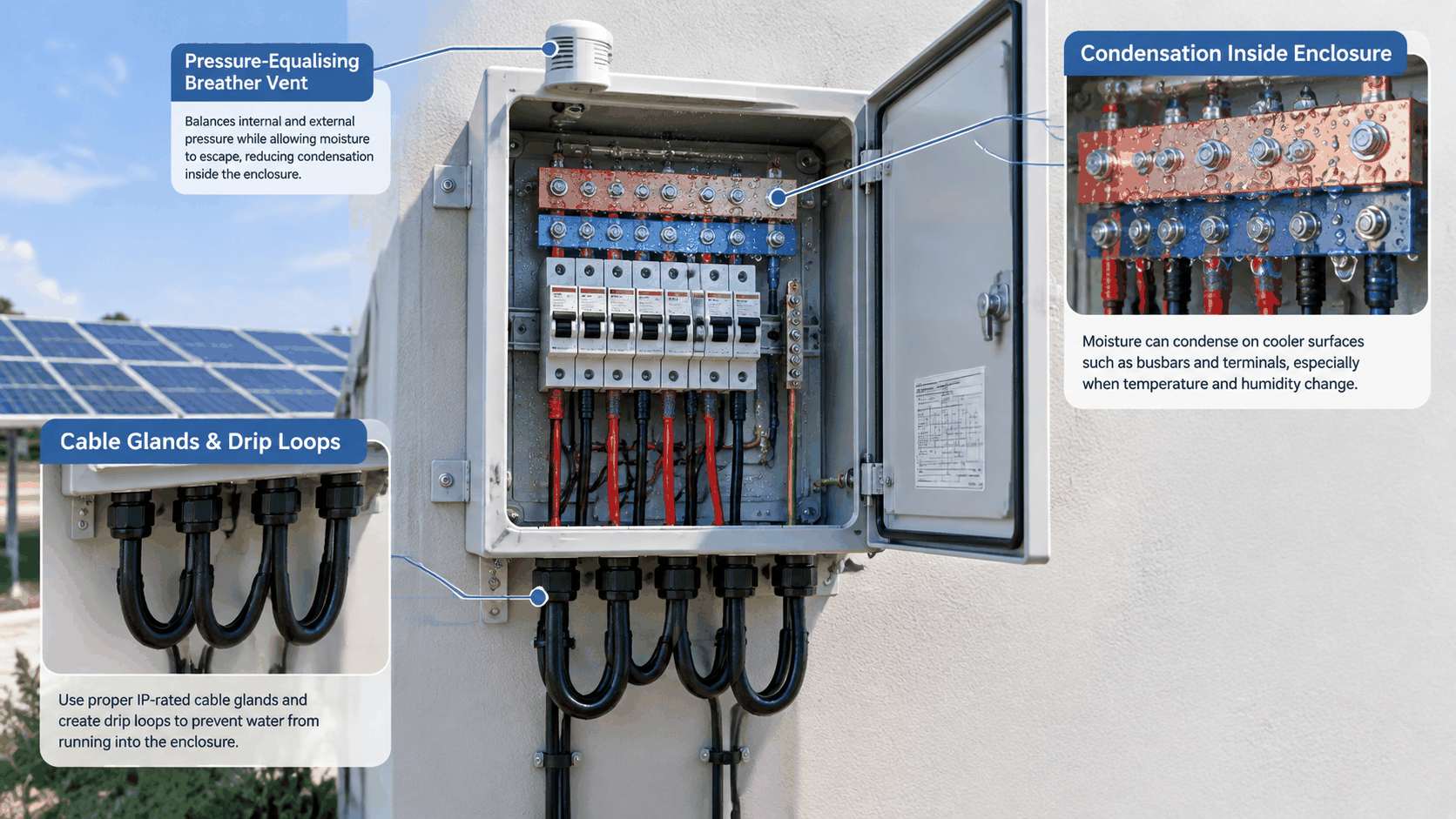
A combiner box spends its life breathing. In daylight the enclosure and the air inside warm up and expand; overnight they cool and contract. That pressure cycle drives air in and out through the only available paths — glands, gasket interfaces and any imperfect seal. Warm daytime air carries moisture, and as the enclosure cools, that moisture condenses on the coldest surfaces inside: the metal back plate, the busbar, terminal screws and any monitoring electronics.
This is why a higher IP rating does not deliver a dry box, and why a perfectly sealed one can be worse. A fully sealed enclosure traps whatever humidity was present at assembly, then pumps it through the same thermal cycle with no way out. The result is corrosion, tracking across insulation, and the terminal hotspots that appear on a thermal scan years later.
What actually manages condensation is a combination of measures that the IP number does not capture:
A pressure-equalising (breathing) vent — a rated breather element lets air pass to relieve the pressure differential while resisting liquid water, cutting both the pumping action and trapped humidity.
Ventilation where appropriate — filtered vents reduce internal temperature rise and therefore the thermal cycle, but the openings must be designed and filtered so they do not defeat the rating.
Desiccant — effective, but a consumable with finite capacity; it must be replaced on a schedule, not installed once and forgotten.
An anti-condensation heater with a thermostat — holding internal air above the dew point is common practice in humid climates.
Correct gland use — the right gland size for the cable’s outer diameter, correctly tightened, entries facing down, unused entries blanked with rated plugs. A gland one size too large is an open path for water and vapour alike.
Assembling in the right conditions — sealing a box in high humidity seals that humidity in.
Two cautions. Do not drill drain holes into an enclosure you intend to keep at IP65 or IP66 — a deliberate opening is a permanent leak path unless the design accounts for it. And do not expect a move from IP65 to IP66 to fix a moisture problem: the problem is inside.
Installation and Maintenance: Where Ratings Are Really Lost
An IP rating is a type test on a sample in controlled conditions. The enclosure on your pole has to survive a ropey cable entry, a gasket pinched at the factory, a door left ajar after servicing and a UV-aged seal. In practice, more water gets into rated combiner boxes through installation and maintenance than through the rating being too low.
Cable entries. Enter from below, with a drip loop so water runs off away from the gland. Multiple cables through one oversized gland is a common and avoidable defect. For the internal connection sequence, follow the combiner box wiring diagram rather than reinventing it on site.
Gasket condition. Store enclosures flat and never close a door on a trapped cable or a hardened, dust-coated gasket. Silicone and EPDM gaskets age; a compressed, cracked gasket fails long before the enclosure does.
Hardware and hinges. Loose hinges mean an uneven door seal, and stainless fixings in coastal or agricultural environments are not a luxury.
Service damage. Screwdrivers gauging a sealing face, missing gland washers, blanking plugs left out “for now”. Each one is a hole.
Cleaning. A pressure washer aimed at a rated box can defeat an aged gasket.
The conclusion is uncomfortable but useful: on most sites a properly installed IP65 enclosure will outperform a badly installed IP66 one. Install the lower rating properly before buying the higher one badly.
Choosing by Environment
Sheltered or low-exposure rooftop. Arrays set back from roof edges, with the box under module level or an overhang, see mostly falling rain. A correctly installed IP65 enclosure with good glands and downward entries is normally adequate — and cable management and thermal performance matter more than the digit. See the guide to PV combiner boxes for commercial solar for the commercial-scale view.
Exposed rooftop and edge locations. Where the enclosure faces wind-driven rain, spray or snow driven at an angle, the powerful-jet claim of IP66 maps onto the real loading. This is the case that justifies the upgrade.
Ground mount. Ground-mount boxes take vegetation, insects, rodents and splash. IP66 with all entries underneath is sensible, but mounting the box above the likely flood or splash level matters more than buying a rating high enough to survive immersion.
Coastal and offshore. Salt-laden air and wind-driven spray make IP66 a reasonable minimum, but IP does nothing about corrosion: material selection, stainless hardware, coating quality and condensation drainage matter more here. An IP66 box with mild-steel hinges will fail at the hinges.
Desert and dusty sites. Fine dust, intense UV and a large day/night swing. Both IP65 and IP66 are dust tight, so dust does not favour either; what matters is dust-tight gaskets and glands and filtered rather than open ventilation. Large thermal swings also make condensation management a priority.
Agricultural and livestock sites. Ammonia and hydrogen sulphide are corrosive gases that no IP rating stops. The response is material and finish selection, sealed or conformally coated electronics, and a maintenance regime.
Related Ratings Worth Checking
IK impact rating (IEC 62262). Mechanical impact in joules; as defined in the standard, IK08 corresponds to 5 J and IK10 to 20 J. Where a ladder, mower or vehicle door could hit the box, the IK number can matter as much as IP.
NEMA and UL enclosure types. In North America, enclosures are more often specified under NEMA 250 / UL 50E — for example Type 3R (outdoor, rain-tight), Type 4 (watertight, hose-directed water) and Type 4X (Type 4 plus corrosion resistance). These and IP codes come from different standards with different tests, so verify the exact type rather than assuming Type 4 equals IP66.
UV resistance and material. Outdoor non-metallic enclosures must be evaluated for weathering; a weathering listing on the material (for example a UL 746C weathering rating) is a more meaningful indicator than the colour of the plastic. Metallics bring coating thickness, cut edges and dissimilar-metal contact into play.
IP69K. A high-pressure, high-temperature washdown rating used mainly in food and process industries; occasionally quoted on PV products but not the requirement a solar site is meeting.
Decision Table
Situation
Sensible rating
What matters more than the rating
Sheltered rooftop, overhang, falling rain only
IP65
Gland sizing, downward entries, gasket condition
Exposed rooftop, wind-driven rain, array edge
IP66
Entry orientation, drip loops, door seal compression
Ground mount, splash and vegetation
IP66
Mounting height above splash and flood level; rodent protection
Coastal or offshore, salt spray
IP66
Corrosion-resistant material and stainless hardware
Desert or dusty, large thermal swing
IP65 or IP66 (both dust tight)
Filtered ventilation if any, gasket integrity, condensation control
Agricultural, ammonia present
IP65 or IP66
Material and finish; no IP rating blocks corrosive gas
Do not rely on immersion ratings; raise the enclosure instead
The rating is a type test; the installed enclosure is decided by gland sizing, entry direction and gasket condition.
الأسئلة الشائعة
Is IP66 better than IP65 for a solar combiner box?
Only in the water digit. Both are dust tight, because both have a first digit of 6. IP66 withstands a more energetic jet, making it the stronger choice where wind-driven water actually reaches the enclosure. On a sheltered site, a properly installed IP65 box beats a badly installed IP66 one.
Is an IP65 combiner box waterproof?
No. IP65 resists water jets; it is not an immersion rating. Temporary immersion is IPX7 and continuous immersion IPX8. If your site can flood the enclosure, mount it higher rather than specifying a higher digit.
Can an IP65 enclosure have a vent?
Yes, if the vent is a designed, rated pressure-equalising element such as a membrane breather that allows air exchange while resisting liquid water. An open drilled hole is not a vent and removes the rating. Filtered ventilation follows the same rule: part of the enclosure design, not an afterthought.
Does a higher IP rating stop condensation inside the box?
No, and it can make it worse. A fully sealed enclosure traps the humidity present at assembly while still cycling through day/night temperature changes. Manage condensation with a breather, appropriate ventilation, scheduled desiccant replacement or a thermostatically controlled heater.
What IP rating does an outdoor solar combiner box need?
It depends on exposure rather than on the box being outdoors. IP65 with correct glanding suits many sheltered installations; IP66 is more defensible for exposed, coastal or wind-driven-rain locations. Also check the IK impact rating, the NEMA or UL type if you buy to a North American specification, and the material’s UV behaviour — those cover risks IP does not.
Next Step
Work out what the site actually does to the enclosure — driven water, dust, salt, ammonia, thermal cycling, impact — then buy a box that answers those and have it installed by someone who understands glands and gaskets. Specify the combiner box itself around your string count, voltage and protection scheme rather than around a single digit.
You can review the solar combiner box range for enclosure options, and if you want help matching a rating to a specific site and mounting method, talk to us with your environment and mounting details.
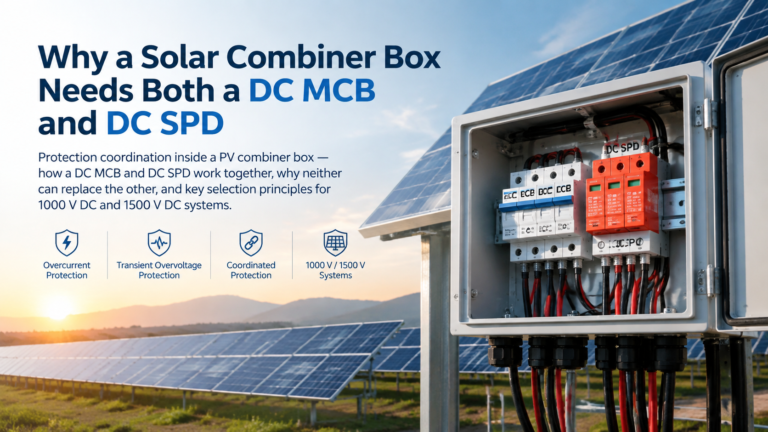
Why a solar combiner box needs both a DC MCB and a DC SPD: the division of labour between overcurrent and transient overvoltage protection, why neither device can substitute for the other, how they coordinate on the DC bus including the SPD backup protection requirement, and how the pairing changes between 1000 V DC and 1500 V DC systems.
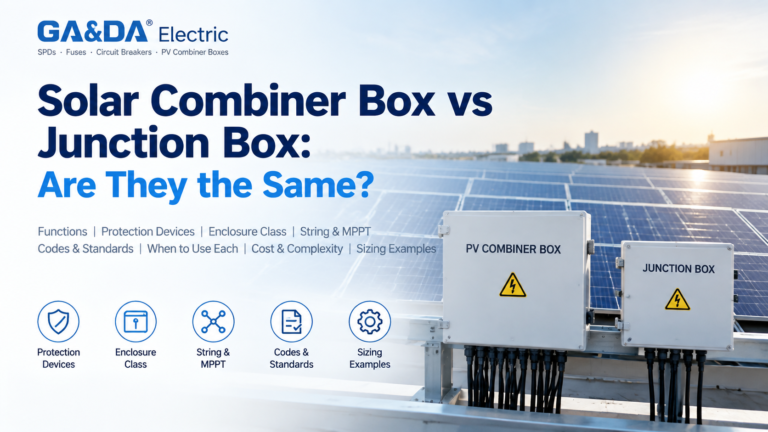
“Combiner box vs junction box” is one of the most common points of confusion in PV design, and it is not a cosmetic one. The two enclosures look similar on a wall, are both described loosely as “the box where the strings are terminated”, and are not interchangeable. A junction box is a passive termination […]
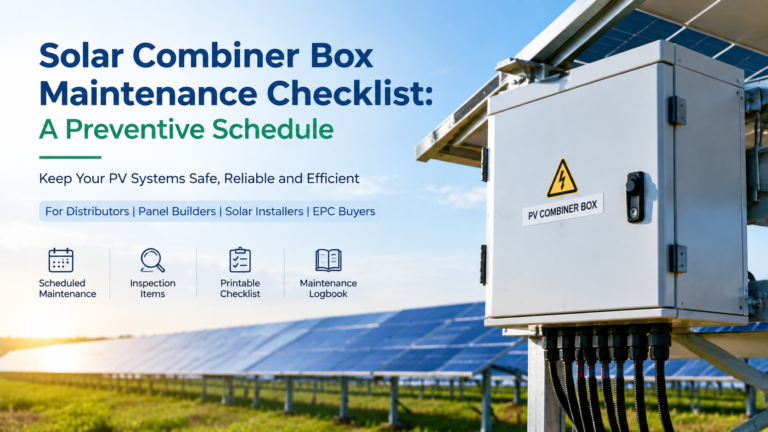
Solar combiner box maintenance is the cheapest protection a PV asset can buy. A short scheduled inspection finds a hardening door gasket, a slack terminal or a saturated desiccant while they are still minor defects; the same three found two years later are an earth fault, a discoloured busbar and a lost production week. This […]