AC Surge Protective Device for Industrial & Commercial Systems
Published: Author: info@cngdfl.com
When you’re sitting in front of yet another RFQ about AC surge protective device for industrial applications, the real question is: “Which SPD will survive a real factory floor, keep PLCs alive, and not blow my budget?”
After years working with AC surge protection device for 3‑phase systems, Type 2 AC surge protective device for distribution boards, and lightning surge protection for AC distribution panels, the pattern is clear: the right device, placed correctly, pays for itself in skipped downtime and fewer warranty claims.
This article is written for B2B buyers, project engineers, and procurement teams who need to specify, compare, and order AC surge protective devices that actually fit real projects—not just tick a box on a tender document.
Why AC surge protective devices matter in projects
In industrial and commercial installations, a single transient surge can knock out a drive, fry a control cabinet, or disable an entire HVAC system. When that happens, the cost of repair is small compared with the cost of downtime and lost production.
An AC surge protective device (SPD) sits quietly at the main panel, sub‑panel, or control cabinet, monitoring the AC voltage. When a surge appears—whether from lightning, grid switching, or nearby equipment—it clamps the spike and diverts excess energy to earth, keeping downstream loads safe.
For you as a purchaser, using the right AC surge protective device for industrial applications means:
Reduced risk of unplanned maintenance and replacement.
Fewer complaints from end‑users about “random” equipment failures.
Easier compliance with standards like IEC 61643‑11 compliant AC SPD requirements.
In commercial buildings, many buyers are now looking for wholesale AC surge protector for commercial buildings, which offers cost‑effective protection for multiple tenants, offices, and shared infrastructure.
How to choose the right AC surge protective device
1. Match device to system and application
Different applications need different types of AC surge protective device. You’ll see many of these phrases in real RFQs and technical specs:
AC surge protective device for industrial applications
AC surge protection device for 3‑phase systems
Wholesale AC surge protector for commercial buildings
Type 2 AC surge protective device for distribution boards
AC surge protection device for HVAC systems
IEC 61643‑11 compliant AC SPD
Lightning surge protection for AC distribution panels
These aren’t just buzzwords—they describe where the device lives and what it protects.
A steel plant often needs lightning surge protection for AC distribution panels at the main service entrance and sub‑panels.
A data center will typically specify an IEC 61643‑11 compliant AC SPD for 3‑phase and single‑phase distribution boards.
An office tower might buy a wholesale AC surge protector for commercial buildings to cover multiple floors and tenants.
2. Pick the right type (Type 1 / 2 / 3)
For AC surge protective device for industrial applications, the choice between Type 1, Type 2, and Type 3 is usually clear once you map them to location.
Type
Location
Typical use case
Type 1
Main service entrance, meter cabinet, main distribution panel
Lightning surge protection for AC distribution panels, high‑risk sites, open‑field factories
Type 2
Sub‑panels, distribution boards
Type 2 AC surge protective device for distribution boards, commercial buildings, HVAC control cabinets
Type 3
Close to loads (PLCs, servers, inverters)
Point‑of‑use protection for sensitive equipment
Many industrial projects combine Type 1 + Type 2 AC SPDs:
Type 1 at the main panel to handle big lightning‑related surges.
Type 2 at secondary distribution boards to protect motors, drives, and control systems.
In commercial buildings, you might see only Type 2 SPDs at sub‑panels, but still insist they are IEC 61643‑11 compliant AC SPD models.
Learn how to pick, wire, and spec the right AC Surge Protective Device for industrial and commercial projects.
For AC surge protection device for 3‑phase systems, the kA rating is a simple way to gauge robustness.
High‑risk main inlet (Type 1):
Often 60 kA or 100 kA Imax for lightning surge protection for AC distribution panels.
Medium‑risk distribution (Type 2):
25–40 kA is common for Type 2 AC surge protective device for distribution boards in factories and offices.
HVAC‑focused systems:
For AC surge protection device for HVAC systems, a 25–40 kA In / 80 kA Imax SPD is often enough unless the site is lightning‑prone.
If you’re ordering a wholesale AC surge protector for commercial buildings, keep in mind that Type 2 SPDs at 25–40 kA usually give the best balance of protection and cost across multiple tenants.
4. Look at clamping voltage and protection level
Up (Voltage Protection Level) tells you how much voltage still passes through the SPD to the load. Lower Up = better protection for sensitive electronics.
For example, in a facility using an AC surge protective device for industrial applications that also runs PLCs, VFDs, and inverters, you want:
Low Up combined with sufficient kA capacity.
An IEC 61643‑11 compliant AC SPD that has been tested and certified for the relevant 3‑phase and single‑phase configurations.
When you’re comparing AC surge protection device for 3‑phase systems, ask:
“What is the Up at 25 kA / 40 kA?”
“Can you provide a version with lower Up for our control and automation equipment?”
This is especially important for HVAC systems, where the compressor and control board are often sensitive to even short voltage spikes.
How to connect an AC surge protective device in real panels
Basic wiring for industrial and commercial applications
Proper wiring is where many technically correct SPDs underperform. The key is short, straight, low‑inductance paths to the main earthing bar.
If you:
Use long, coiled earth cables.
Place the SPD far from the main breaker.
Use undersized conductors.
… then your AC surge protective device for industrial applications will still “pass” surge tests in a lab, but may not protect properly in the field.
Connecting a Type 2 AC surge protective device for distribution boards
For a typical Type 2 AC surge protective device for distribution boards in a three‑phase commercial or industrial panel:
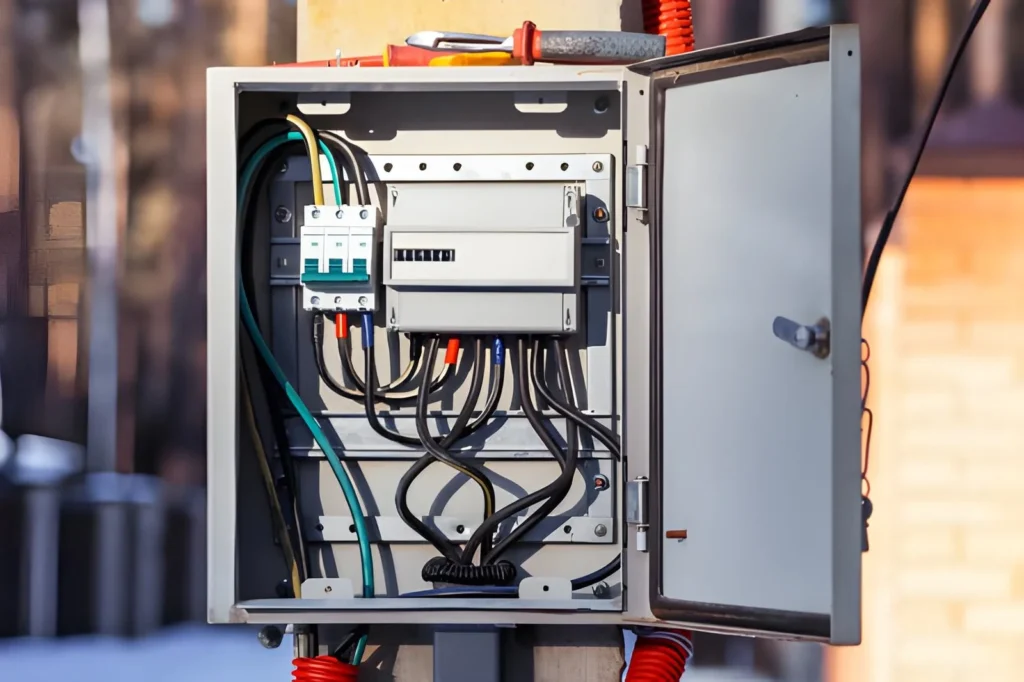
Install the SPD on a DIN rail close to the main incoming breaker or the main AC bus.
Connect L1, L2, L3, and N to the SPD’s phase terminals.
Run a short, dedicated earth cable (for example 6–10 mm²) from the SPD’s ground terminal to the main earthing bar.
Keep the cable length as short as practical (ideally under 0.5 m) and avoid loops.
Many modern SPDs include a status window or LED indicator so you can see if the module is still active. Some also support remote alarm contacts that can be wired to a BMS, SCADA, or alarms panel.
When you’re sourcing lightning surge protection for AC distribution panels, insist on units with visual status indication and remote alarm capability—this makes maintenance much easier for facility managers.
Single‑phase SPD for HVAC and auxiliary circuits
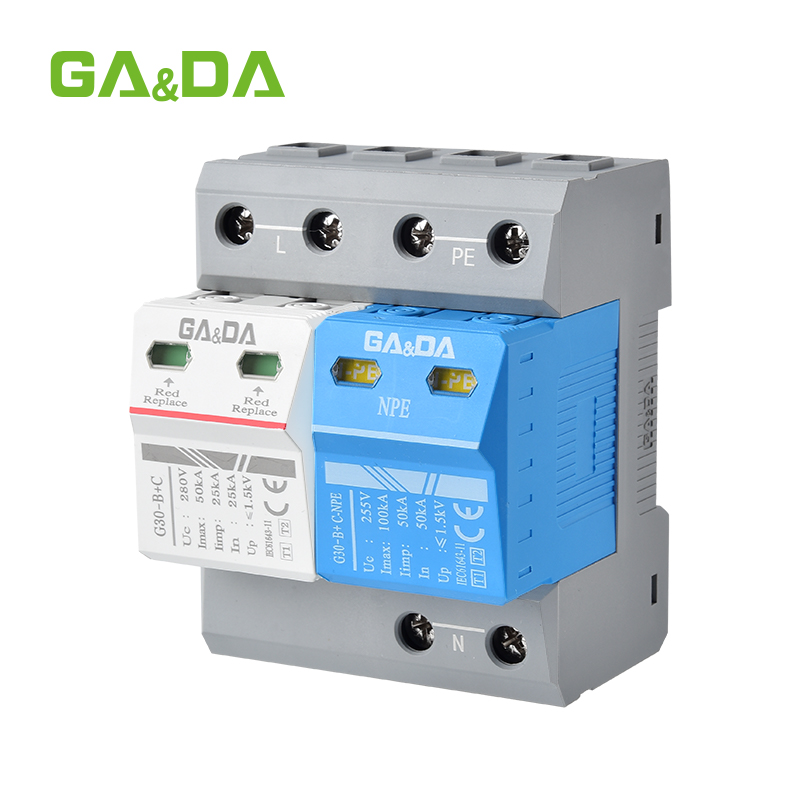
For AC G30-B+C/25 Type1+2 surge protection device for HVAC systems, you often see:
Single‑phase SPDs mounted in the HVAC control cabinet or near the compressor.
A Type 2 device with In 25–40 kA and low Up to protect both the compressor and the control board.
The wiring is simple:
Connect L and N from the power supply to the SPD input.
Connect the SPD output to the HVAC load.
Keep the earth cable short and direct to the cabinet’s earthing bar.
This setup is common in commercial buildings that use wholesale AC surge protector for commercial buildings packages for multiple HVAC units.
When to choose which kind of AC surge protective device
Whole‑building protection (main panel)
If a project asks for AC surge protective device for industrial applications or lightning surge protection for AC distribution panels, you’re usually talking about:
Type 1 SPD or Type 1 + 2 SPD at the main service entrance.
High kA rating (60–100 kA) to handle lightning‑related surges.
IEC 61643‑11 compliant AC SPD certification for trust and compliance.
For industrial plants, solar farms, and tall buildings, this is the first line of defense.
Distribution‑level protection (sub‑panels)
For Type 2 AC surge protective device for distribution boards, the use case is more about daily protection than pure lightning defense.
Protects motors, drives, lighting circuits, and control panels.
Often used in commercial buildings, warehouses, and office complexes that buy wholesale AC surge protector for commercial buildings to standardize products across multiple floors.
HVAC‑specific surge protection
For AC surge protection device for HVAC systems, the goal is straightforward: prevent surges from killing the compressor, inverter, and control electronics.
A Type 2 SPD at the HVAC main supply is usually enough.
If the HVAC system is part of a larger industrial setup, you may combine it with lightning surge protection for AC distribution panels at the main building intake.
How to read an AC surge protective device datasheet
When you’re comparing AC surge protective device for industrial applications versus AC surge protection device for 3‑phase systems, the datasheet is your best friend.
Here are the key parameters buyers should focus on:
Parameter
Why it matters in B2B
Uc (Max Continuous Voltage)
Must match your system voltage (e.g., 230 V, 400 V, 480 V).
Un (Nominal Voltage)
Reference level for rating; helps confirm compatibility.
In / Imax (Nominal / Max Discharge Current)
Indicates robustness; choose 60–100 kA for main panels, 25–40 kA for distribution.
Up (Voltage Protection Level)
Lower Up = better protection for PLCs, VFDs, servers.
Mounting type
DIN‑rail, plug‑in, or bus‑bar; important for panel layout.
Status indication
Visual window or LED; helps maintenance teams.
Remote alarm contact
Useful for BMS/SCADA integration in commercial buildings.
When you’re comparing two Type 2 AC surge protective device for distribution boards, the one with lower Up, higher In, and a clear status indicator is usually the better choice for long‑term reliability.
If you’re sourcing wholesale AC surge protector for commercial buildings, you can standardize on a single SPD model with a robust In, low Up, and DIN‑rail mounting used across all sub‑panels.
If you’re dealing with AC surge protective device for industrial applications, AC surge protection device for 3‑phase systems, wholesale AC surge protector for commercial buildings, and AC surge protection device for HVAC systems, the smart move is to narrow your list to units that actually fit your most common projects.
When you’re ready, feel free to share your typical voltage levels, panel types, and project size, and you can get a tailored SPD specification checklist.
An AC surge protective device (SPD) is a component installed in an AC power system that limits transient overvoltages and diverts surge currents to ground. It protects downstream equipment such as motors, control units, PLCs, and inverters from damage caused by lightning, grid switching, and other electrical disturbances.
How does an AC surge protective device work?
Most AC SPDs use metal oxide varistors (MOVs) or gas discharge tubes (GDTs). Under normal voltage, the SPD looks like an open circuit. When a surge raises the voltage above a certain level, the internal components “clamp” the voltage and divert the excess energy to the earth conductor.
Where should I install AC surge protective devices?
For a layered protection strategy: Type 1 SPD at the main service entrance or main distribution board. Type 2 SPD at sub‑panels or distribution boards. Type 3 SPD close to sensitive equipment (PLCs, servers, medical devices). This setup is common in industrial plants, data centers, hospitals, and commercial buildings.
How do I choose the right voltage rating?
For AC systems, match the SPD’s Uc to the system voltage: 230 V AC single‑phase → SPD with Uc ≈ 275 V AC. 400 V AC three‑phase → SPD with Uc ≥ 440 V AC. Choosing a Uc too close to the nominal voltage can cause nuisance tripping; choosing one too high can weaken protection.
What kA rating do I need?
Main panel (Type 1): 60–100 kA for high‑risk or lightning‑prone areas. Sub‑panel (Type 2): 25–40 kA for typical commercial and industrial sites. Point‑of‑use (Type 3): 10–20 kA with low Up.
Can I mix SPDs from different brands in one system?
Technically, yes—but it’s better to use a coordinated system from the same manufacturer or a supplier that provides coordinated SPD sets. Coordination ensures that the upstream SPD takes the big hits and the downstream SPD handles the residual energy, instead of both modules fighting each other during a surge. When you’re sourcing, ask: “Can you provide a coordinated Type 1 + Type 2 SPD set for our main panel?”
How long does an AC surge protective device last?
SPDs are consumable in the sense that they wear out with repeated surges. However, many modern units have status indicators and replaceable modules. A visual window that turns red or black indicates the module is worn out. Some SPDs support hot‑swap module replacement without shutting down the panel. In practical B2B terms, plan for periodic inspection and modular replacement rather than expecting a lifetime of 20+ years.
Are AC surge protective devices compatible with solar and wind systems?
Yes, but you must choose the right configuration. In solar plants, you typically see: AC SPDs at the main inverter output and at the grid connection point. DC SPDs on the DC side of the installation. For wind farms, you’ll often install SPDs in control cabinets and tower‑bottom cabinets to protect control electronics from switching and lightning‑induced surges.
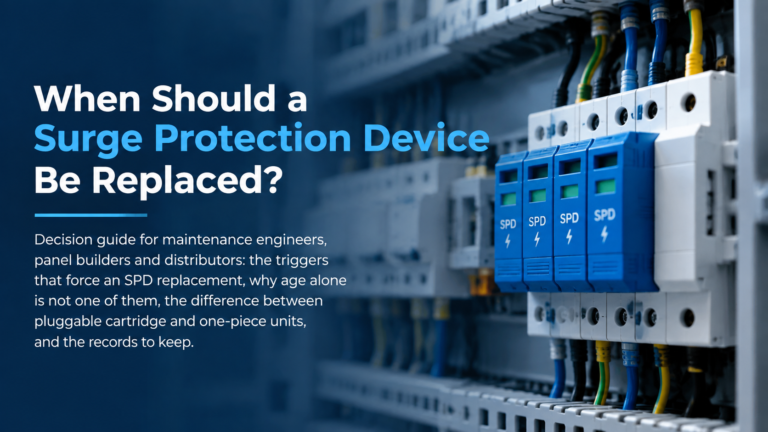
An SPD that has failed is not automatically a bad device. Most surge protection devices are sacrificial by design: they absorb surge energy, give up a little of their capacity each time, and eventually reach a condition in which they can no longer clamp anything useful and must come out of service. Ask why does […]
Ask when should an SPD be replaced and most answers stop at the status window. That is one input, and on its own a weak one: it shows that a device has reached end of life, never that a device is still fit for service. An SPD can be electrically exhausted while the window still […]
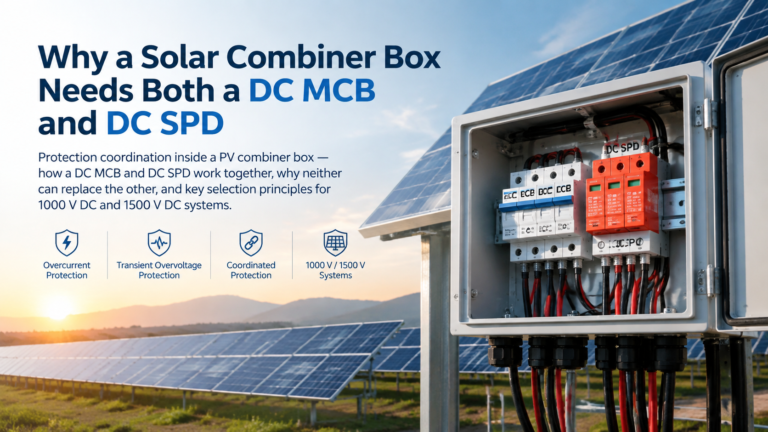
Why a solar combiner box needs both a DC MCB and a DC SPD: the division of labour between overcurrent and transient overvoltage protection, why neither device can substitute for the other, how they coordinate on the DC bus including the SPD backup protection requirement, and how the pairing changes between 1000 V DC and 1500 V DC systems.